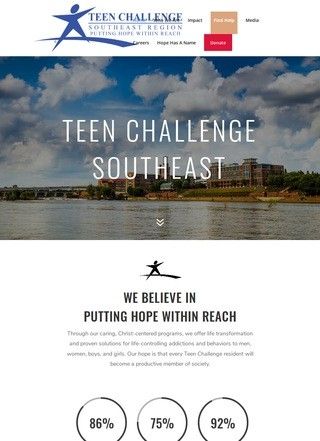
Adult & Teen Challenge, listed here at teenchallenge.cc, is the Southeast U.S. regional affiliate of a faith-based nonprofit that runs long-term residential recovery programs for people struggling with drug and alcohol addiction, operating out of Columbus, Georgia. The page is built around two tracks: one for teenagers and one for adults aged 18 and up. Both rest on a residential model, meaning participants live on site for the duration of the program, with counseling, mentoring, life-skills work, and a spiritual component running alongside each other. That last element is not incidental. Adult & Teen Challenge is openly a religious program, and the site does not soften or bury that fact, which is the right call for anyone trying to figure out whether the approach fits.
Program structure and service options
What Adult & Teen Challenge lays out is fairly complete for a family in the middle of a crisis. There is program detail for the adult side and the teen side separately, admissions information that explains how to start the process, and pathways for people who want to volunteer or donate. Beyond the core residential offering, Adult & Teen Challenge runs an outpatient arm under a Hope Counseling banner and boarding school programs aimed at adolescents who are struggling but may not need the full residential intervention. So the range is wider than a single rehab format. Someone could enter through outpatient counseling, a structured boarding environment, or the long-term residential track depending on severity and age, and the page gives enough to tell those apart before picking up the phone.
Funding sources and operational transparency
The funding side is also visible, and it explains some of the structure. Thrift stores and an event center are run to support the programs, which is a common nonprofit setup and worth knowing if a reader is weighing where donations go. It means Adult & Teen Challenge has revenue streams beyond grants and gifts, and it gives volunteers and supporters a concrete way to contribute that is not purely financial. None of this is hidden behind vague mission language; the operational pieces are named clearly.
Self-reported outcome statistics
Adult & Teen Challenge reports an 86 percent sobriety rate one year after program completion, a 75 percent employment rate among graduates, and 92 percent of graduates rating their own health as good to excellent. These are strong figures, and they are also self-reported, which is the part a prospective family should hold in mind. Self-reported outcome statistics from any recovery organization, religious or secular, are not the same as independently audited results, and the framing here (rates measured among graduates, for instance) naturally excludes people who left before completing.
That is not an accusation of bad faith. It is simply how these metrics tend to work, and a reader doing real diligence should ask the admissions staff directly how those rates were measured and over what sample. The numbers are encouraging on their face and should be treated as a starting question rather than a closing argument.
Contact information and accessibility
On contact, the site does well, and that matters a great deal in this category, where families are often acting fast and under stress. There is an admissions line and a separate office number, a working email, and the full Columbus, Georgia street address right on the landing page. Having both an admissions number and a general office number is a small thing that signals the organization expects urgent inquiries and has staffed for them. The street address being public is reassuring too, since residential programs ask people to physically relocate a loved one, and knowing exactly where that is before arriving is a basic expectation that the page meets without making anyone hunt.
National charity rating versus public reviews
Outside reputation is where the picture gets more complicated, and it is worth being precise about what exists and what does not. The national parent body, Adult & Teen Challenge USA, holds a 4 out of 4 star rating from Charity Navigator, which evaluates nonprofits on financial health and accountability. That is a meaningful credential for the network as a whole. At the same time, an aggregation of 25 Google reviews for the national entity sits at 2.4 stars, and the gap between a top charity-accountability rating and middling public reviews is real and should not be smoothed over.
Regional reputation and independent verification
A Minnesota affiliate carries a 4.2 out of 5 from 36 employee reviews on Glassdoor, which speaks to staff experience at one location, not patient outcomes nationally. The specific affiliate behind teenchallenge.cc, the Southeast region, does not have a distinct third-party review count that surfaces in a search, so the local entity a Georgia family would deal with is, in reputational terms, largely unknown and riding on the strength and weaknesses of the broader Adult & Teen Challenge name.
That mixed signal deserves more than a shrug. Adult & Teen Challenge as a brand is old and well established, with roots going back to 1958 and the work of David Wilkerson. The network has had decades to build infrastructure, which shows in the breadth of programs and the polish of the admissions process. Longevity and a strong charity-accountability score count for something genuine. But the near-absent public-review record at the regional level means the marketing claims and the institutional pedigree are doing most of the persuading, with almost no independent voices to corroborate or contradict them. A careful family should treat the 4-star Charity Navigator rating as evidence the money is handled responsibly and the 2.4-star public reviews as a prompt to ask harder questions, not as a verdict in either direction.
Faith-based model as core method
The religious framing is not a flaw, but it is a fit question. Adult & Teen Challenge integrates spiritual guidance as a core method, not an optional add-on, and that will be a strong positive for some families and a non-starter for others. The site is upfront about it, which is the most useful thing it could do. Anyone for whom a faith-based recovery model is a deal-breaker can see that quickly and move on, and anyone seeking exactly that environment will find it clearly described rather than implied.
Pulling it together, the offering from Adult & Teen Challenge Southeast is substantial and the transparency on contact and structure is better than average for a recovery nonprofit. The program variety is real, the institutional history is credible, and the Charity Navigator rating should reassure donors. The reservations are honest ones: the success metrics are self-reported and the Southeast affiliate specifically lacks its own independent review record, so trust has to be borrowed from the national Adult & Teen Challenge brand and tested in a direct conversation with staff.
How to evaluate Adult & Teen Challenge for your family
A parent open to a faith-based, long-term residential model would do well to call the admissions line, ask specifically how the sobriety and employment rates were measured, and arrange a visit to the Adult & Teen Challenge Columbus site. Families who need a secular or short-term clinical approach will not find it at Adult & Teen Challenge, and knowing that up front saves everyone time.