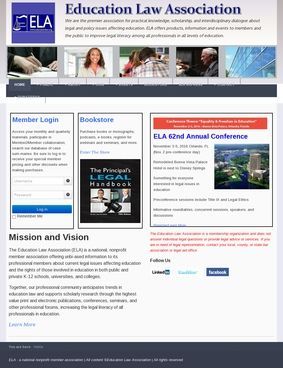
Who needs a place to study the law that governs schools, when most legal groups split along practice lines and education law touches everyone from kindergarten principals to university counsel? The Education Law Association answers that by gathering the whole field under one roof: attorneys and law professors sit alongside school administrators, classroom teachers, graduate students, and public officials, all sharing an interest in how the law shapes education from K-12 through higher education and policy. It is a nonprofit membership organization, and the breadth of who it admits tells you a lot about how it reads its own purpose. You do not have to be a litigator to belong. A student writing a thesis on Title IX and a superintendent worried about discipline policy can sit in the same session.
What the organization does not do
The first thing worth being clear about is what the Education Law Association does not do, because it states the boundary itself and that honesty colors everything else. The organization does not give legal advice and does not take on representation. Someone arriving with a live dispute gets pointed toward a local bar association instead. That refusal is a feature rather than a hedge. It frees the organization to do what it is built for, which is producing and circulating unbiased information about current legal questions in education, without the conflict that comes from also selling services. A reader looking for counsel will be disappointed. A reader looking to understand the terrain will find the orientation refreshingly plain.
Publishing journals and magazines
On the publishing side, the output is substantial and clearly aimed at people who read for a living. There is a line of ELA Books, peer-reviewed journals, and a periodical called Law and Policy in Schools Magazine. Peer review matters here because it holds journal content to scholarly standards instead of passing off a newsletter as research. The magazine reads as the more accessible end of the catalog, the kind of thing an administrator might keep up with between board meetings. Together they cover the range a working professional needs: the deep, citable material for academic and litigation work, and the plainer briefings for people who apply the rules day to day.
Annual conference and Coffee Talk
The events calendar is where the Education Law Association shows its rhythm. An annual conference anchors the year, with the next gathering set for the Raleigh-Durham area of North Carolina across four days in late October. Around that, the organization runs webinars and a series of informal discussion sessions branded as Coffee Talk, a format that implies a membership wanting to compare notes on emerging problems before those problems harden into reported cases. It lowers the barrier for newer members who might never raise a hand in a ballroom of senior practitioners, which is a more useful design choice than it may sound. The Coffee Talk series and the annual conference together cover the formal and conversational ends of the same professional need.
Early Career Fellows program
That attention to people early in their careers shows up again in the Early Career Fellows program, which is one of the details that moved the Education Law Association past the level of a generic professional body. Fields with a steep barrier to entry tend to either ignore those climbing in or treat mentorship as an afterthought, and a named, structured fellowship is a real commitment of effort and money. The organization also reaches beyond U.S. borders with international programming, which fits a discipline where comparative questions about student rights, governance, and academic freedom keep surfacing. The international angle is not the headline, but it widens the conversation past a single national framework.
Member directories and job board
For members specifically, two practical tools stand out. There is a searchable directory of practicing education law attorneys, which is genuinely useful as a referral and networking spine, and a job board, which is the kind of resource that keeps people renewing even in years when they skip the conference. The attorney directory deserves a note of nuance, since the Education Law Association itself does not provide representation; the directory is a way to find practitioners, not an endorsement engine. Still, for a school district trying to identify counsel who specialize in this niche, a vetted-membership roster is a sane starting point. The job board, meanwhile, quietly marks this as a working profession with its own labor market, not a hobbyist circle.
Named awards and field recognition
Recognition runs through five annual awards, among them the Joseph C. Beckham Award for distinguished contributions to the field. Named awards in a specialized association serve a purpose beyond ceremony. They mark which work the community considers foundational, and over time that record becomes an informal canon for anyone trying to learn who shaped a given doctrine. A newcomer reading past honorees gets a fast map of the field's intellectual leadership. The practice keeps the Education Law Association tethered to substance.
Neutrality through structure
What holds all of this together is the stated mission: to deliver unbiased information about the legal issues affecting education at every level. That neutrality claim is easier to make than to keep, yet the structure here supports it. An organization that explicitly declines to litigate or advise has fewer incentives to spin its analysis toward a client's interest. The membership mix reinforces this, because a room containing plaintiff-side attorneys, district counsel, professors, and the administrators who live with the consequences is not a room that comfortably settles into one ideological lane. Whether the Education Law Association fully achieves balance is something a member can only judge by reading the journals, but the design points in the right direction.
No consumer ratings or reviews
On third-party platforms, the Education Law Association does not accumulate consumer ratings; a search of the main review sites turns up no star ratings or user counts. That is not surprising for a professional membership body in a specialized academic field. Reputation here travels through citations, conference attendance, and how practitioners discuss the organization's publications, none of which shows up on a ratings aggregator.
Who this organization serves best
There are limits worth naming so the picture stays honest. This is a body for professionals and serious students, not for parents or employees hunting for help with a specific grievance, and the Education Law Association is upfront that it will redirect those people elsewhere. The value is front-loaded toward those who engage: the publications, the fellowship, the directory, and the conference reward participation, while a casual visitor will mostly absorb that the field is organized and active. For the intended audience, the combination of peer-reviewed scholarship, recurring events, career support, and a referral directory is a coherent package.
Set it against the obvious alternative and the case sharpens. A practitioner could lean instead on the National School Boards Association's legal arm, COSA, which is excellent if the work sits squarely on the K-12 governance and school-board side. Where the Education Law Association pulls ahead is reach across the whole education spectrum, higher education and policy included, plus scholarly publishing and an unusually open door for students and academics rather than a membership defined by institutional role. The Education Law Association covers more of the map, and does so without the conflict of interest that comes from representing clients at the same time.