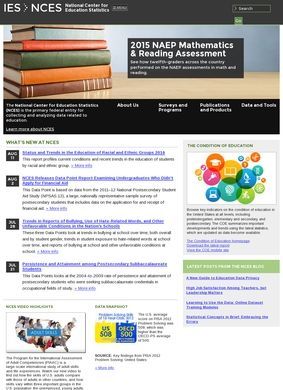
Run by the U.S. Department of Education's Institute of Education Sciences, the National Center for Education Statistics is the federal agency charged with collecting and reporting data on American education, from preschool through adult learning. That mandate is broad, and the site reflects it: this is less a single publication than a clearing house for almost every kind of education number a researcher, reporter, or administrator might need. Anyone who has tried to pin down a national figure on school enrollment, test scores, or college costs will recognize the value of having one nonpartisan place that gathers it.
Data programs that track student performance
What the National Center for Education Statistics does best is its data programs, and they are extensive. The National Assessment of Educational Progress, better known as the Nation's Report Card, is the flagship, tracking how students perform across subjects and years. The Common Core of Data covers roughly 100,000 public elementary and secondary schools, making it the backbone for anyone needing school-level records at scale.
Longitudinal studies and specialized surveys
The Early Childhood Longitudinal Study follows four separate cohorts over time, the National Teacher and Principal Survey looks at the people staffing classrooms, and the Program for the International Assessment of Adult Competencies extends the lens to adult skills. There is also the School Pulse Panel, built to capture school conditions quickly when slower surveys cannot keep up. Taken together, these programs are why the National Center for Education Statistics is treated as the default reference for national figures.
Interactive tools for researchers and students
Beyond the raw survey data, the site builds a real set of interactive tools on top of all that collection. College Navigator lets a user search postsecondary institutions directly, and it is probably the single most useful feature here for an ordinary visitor weighing where to study. For the more technical crowd there is the Elementary/Secondary Information System, the Public School and District Navigator, the International Data Explorer, and a range of IPEDS analysis tools. DataLab allows online analysis without downloading anything, and several dashboards (the Achievement Gap Dashboard, the Teacher and Principal Dashboard, an American Community Survey education dashboard) package complex figures into something a non-statistician can read.
Infrastructure and demographic analysis
Two strands deserve separate mention because they serve a quieter but important function. The Statewide Longitudinal Data Systems Grant Program backs data infrastructure in 41 states plus the District of Columbia, which means a good deal of what individual states can do with their own education records traces back to support running through the National Center for Education Statistics. It is the kind of plumbing that rarely gets attention but underpins a lot of state-level reporting.
The other is the Education Demographic and Geographic Estimates program, which ties education figures to geography, alongside school district finance tools that get at the money side of the picture. These are not glamorous features, and a casual visitor may never touch them, but for the policy and research audience they are exactly the sort of detail that makes the National Center for Education Statistics worth keeping bookmarked rather than consulted once and set aside.
On the publication side, the annual Condition of Education report is the recurring reference point, with the 2026 edition available, and it pulls the year's headline indicators into one document. Characteristics of Private Schools in the United States fills a gap that public-school data alone leaves open, a reminder that the National Center for Education Statistics tries to cover the whole field, including the parts that are harder to count. The Forum Guides aim squarely at data practitioners who need consistent methods alongside numbers. The Nation's Report Card portal gives the NAEP results their own dedicated home, which keeps the most-cited figures from getting buried.
The audience here is wide by design. Federal and state policymakers lean on this material to justify decisions, education researchers treat it as source data, and school administrators and teachers use it for comparison and planning. Journalists pull from it constantly, often without crediting it, because it is one of the few places where a national education statistic comes with a defensible methodology behind it. The general public is served too, though plainly some tools assume more statistical comfort than others.
Why does the site feel overwhelming to newcomers?
That is the honest caveat. The breadth that makes the National Center for Education Statistics so useful also makes it sprawling. Someone arriving with a simple question can find the answer, but they may have to wade past a dozen survey acronyms and overlapping tools to get there, and the distinction between, say, ELSI and the Public School Navigator is not obvious until you have used both. The site rewards people who already know roughly what they are looking for more than it guides a newcomer.
From policy work to casual research needs
Even with that friction, the verdict is straightforward. As a single source of nonpartisan, methodologically grounded education data, the National Center for Education Statistics has few real peers, and the combination of deep survey programs with genuinely usable tools like College Navigator and DataLab covers both the specialist and the curious general reader. The depth is the draw and occasionally the obstacle. For policy work, journalism, or serious research into U.S. education, the National Center for Education Statistics is close to indispensable; for a quick casual lookup it can feel heavier than the question warranted, and that is the only meaningful mark against it.