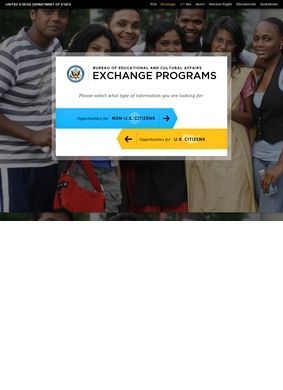
Running the Fulbright Program, the best-known academic exchange in the world, puts exchanges.state.gov in a category of its own from the first click. That is the headline fact about the Bureau of Educational and Cultural Affairs (ECA), Department of State, and it sets the tone for everything else on the site: this is the U.S. government's working hub for sending Americans abroad and bringing foreign students, scholars, and teachers into the country. The bureau operates under the Mutual Educational and Cultural Exchange Act, the Fulbright-Hays law, which gives the whole enterprise a statutory backbone most education sites cannot claim.
Two separate application tracks
What makes the site usable, and slightly unusual, is that it splits its audience in two from the start. One track is for people who are not U.S. citizens and want to study, teach, or research in the United States. The other is for Americans looking outward for the same kinds of opportunities. The Bureau of Educational and Cultural Affairs (ECA), Department of State keeps these lanes separate, which spares a Fulbright applicant in Cairo from wading through pages meant for a graduate student in Ohio. It is a small structural decision, but it does a lot of work when the programs span every world region and multiple distinct populations.
Fellowship and language exchange programs
Beyond Fulbright, the program list runs deep. The Hubert H. Humphrey Fellowship Program brings mid-career professionals from developing countries to the United States for a year of study and practical experience, supported through a cooperative agreement worth roughly $8.4 million. There are Fulbright Teacher Exchange programs that move both American and international educators across borders, and the Critical Language Scholarship Program, which funds intensive study of languages the country considers strategically important.
Each of these is a real, funded program with its own application cycle and its own administering organization. The Bureau of Educational and Cultural Affairs (ECA), Department of State administers them globally, and the site is where the eligibility rules, deadlines, and program descriptions live. The breadth of what the Bureau of Educational and Cultural Affairs (ECA), Department of State covers comes straight from a federal mandate to build people-to-people ties across borders.
Check how grants reach partners
The honest answer is that the Bureau of Educational and Cultural Affairs (ECA), Department of State does not do everything in-house. It awards grants and cooperative agreements to nonprofit educational and cultural organizations, which then run the programs on the ground in their respective countries and regions. That model explains why the site reads less like a single application portal and more like a directory of efforts the bureau funds and oversees. For someone trying to apply, this can mean an extra hop: the page describes the program, then points you to the organization that actually processes candidates. It is worth knowing going in, because that handoff reflects how the federal government runs exchanges through funded partners.
Visa guidance and advising networks
The supporting sections are where the site pays off for people who are not chasing a marquee fellowship. There is detailed J-1 Visa information and guidance on sponsorship, which anyone entering the United States on an exchange visa needs early, along with the institutions hosting them. EducationUSA, the State Department's advising network for international students, has a presence here too, and it is one of the few genuinely neutral starting points for someone abroad trying to make sense of American higher education without a commission-driven agent steering them.
American English teaching materials
For Americans, the Study Abroad resources collect practical guidance on going overseas, and the American English materials offer language-learning content aimed at learners and teachers around the world. The American English section is more substantial than the usual government afterthought, with actual teaching resources rather than a bare set of links pointing elsewhere. The ECA Alumni networks connect the people who have come through these programs, which fits a bureau whose entire premise is long-term relationships. It functions as a living record of who the Bureau of Educational and Cultural Affairs (ECA), Department of State has reached and continues to reach.
Mission behind the exchanges
The stated mission threading through all of it is mutual understanding between Americans and people of other countries, built through people-to-people ties. That is a soft goal stated in broad terms, yet the programs underneath it are concrete: scholarships for graduate students, fellowships for researchers, exchanges for language teachers, funding for mid-career professionals from across every world region. The Bureau of Educational and Cultural Affairs (ECA), Department of State is the rare case where a lofty mission statement is backed by named, budgeted machinery you can actually point at.
Who benefits from these programs?
Who is this site genuinely for? Students and scholars are the obvious answer, but the range is wider. A high school language teacher in the American Midwest, a mid-career civil servant in a developing economy, a doctoral researcher needing a year abroad, an international undergraduate trying to figure out which U.S. universities to even consider: all of them have a real path through the Bureau of Educational and Cultural Affairs (ECA), Department of State. The breadth is the point, and the site organizes it about as well as a federal portal serving that many distinct populations reasonably can.
There are limits worth naming. Because so much is delegated to partner organizations, the depth of information on any one program can vary, and the site sometimes hands you off before you have the full picture. Federal web pages also change with administrations and budget cycles, so a program described one year may be reshaped the next, which is the nature of government funding more than any failing of the Bureau of Educational and Cultural Affairs (ECA), Department of State. Anyone serious about applying should treat the relevant program page as the starting authority and follow it through to the administering organization for the binding details. The Bureau of Educational and Cultural Affairs (ECA), Department of State publishes those partner relationships openly, at least, so the chain is traceable.
My verdict is positive but specific. The Bureau of Educational and Cultural Affairs (ECA), Department of State is worth visiting if you fall into one of its target groups, and not especially useful if you do not. As a reference point for U.S.-connected international exchange, it is the primary one. The branding is dry and the navigation asks some patience, yet what sits underneath is the real machinery of American educational and cultural exchange. The programs are named, funded, and administered through a statutory framework going back decades. The Bureau of Educational and Cultural Affairs (ECA), Department of State makes all of that visible in one place, and the Bureau of Educational and Cultural Affairs (ECA), Department of State is clear about which partner organization handles each program. That is what the site is for, and it delivers on it.