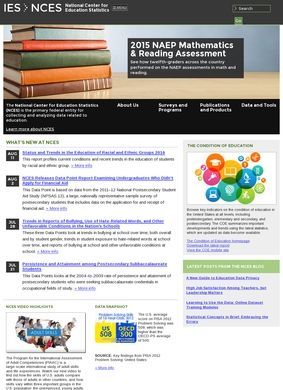
Run by the National Center for Education Statistics, the federal statistical arm of the U.S. Department of Education, this site has been gathering and publishing education figures in one form or another since 1867. That long run is worth taking seriously, not as a slogan but as a reason the time series stretch back far enough to be genuinely useful for tracing how enrollment, attainment, or school finance has shifted over decades. Most visitors arrive looking for the National Assessment of Educational Progress, branded here as the Nation's Report Card, and it sits right alongside dozens of other datasets that go far deeper than headline scores.
Datasets spanning early childhood through adult education
What separates this resource from a generic stats page is the spread of what it actually measures. The data run from early childhood through postsecondary and adult education, and the surveys behind them are named, documented, and downloadable. The Common Core of Data alone covers roughly 100,000 public schools. The Early Childhood Longitudinal Study follows children over years. The National Teacher and Principal Survey covers staffing patterns, and the Program for International Assessment of Adult Competencies pulls the lens out to how adult skills compare across countries. None of this is locked behind a paywall or a sign-up form, which is worth saying plainly: every dataset and tool at the National Center for Education Statistics is free and open.
Interactive tools for school and institution searches
Raw federal data can be punishing to work with, so the most practical part of the National Center for Education Statistics is the set of interactive tools built to query it without a statistics degree. College Navigator lets a person search and compare postsecondary institutions side by side, the kind of thing a parent or a high-school counselor can use in an afternoon. ELSI, the Elementary/Secondary Information System, handles school and district lookups. The Public School District Finance Peer Search answers a narrower but real question: how does one district's money stack up against comparable ones? These tools get linked occasionally in a business directory or research roundup, but they hold up to sustained use in a way that quick mentions rarely convey.
Advanced query engines for researchers
For people who want to go further, there is DataLab for custom statistical analysis, the International Data Explorer, and school district boundary mapping with geographic tools attached. I spent the most time with the mapping and peer-search features, and what struck me was how much they assume you already have a specific question, which is fair given the audience. These are instruments for researchers and analysts, and they behave that way. The casual visitor gets College Navigator and the dashboards; the specialist gets the query engines.
Different entry points for different users
That layering is sensible. A journalist on deadline, a graduate student building a dataset, and a state policymaker checking an achievement gap are all served by the National Center for Education Statistics, but they enter through different doors. The dashboards for state-level data and gap tracking give a quick read. DataLab and ELSI reward patience and a clear research question going in.
Published reports and data products
Beyond the interactive tools, the site keeps up a steady stream of published material. The recurring Condition of Education report, the statistical digests, press releases, and a research blog all sit here, and they tend to translate the numbers into something readable for a non-specialist. The condition reports are a good entry point for someone who wants the analysis without running the queries themselves. Data products cover enrollment, attainment, finance, staffing, assessments, and international comparisons, so the coverage is broad without feeling padded.
Methodology and source documentation
Accuracy and methodology are where a source like this justifies itself, and the National Center for Education Statistics publishes survey designs and technical notes alongside the figures, which is what separates a primary source from a secondary one repeating it. When a number appears in a news story about American schools, there is a decent chance it traces back to the National Center for Education Statistics, and being able to follow it to the original collection is the whole point. The Nation's Report Card scores, the CCD school counts, the finance peer comparisons all carry that provenance, and that traceability is the core value.
How to navigate surveys and tools
If there is a fair caution to raise, it is the same one that applies to most deep federal repositories: the breadth can be overwhelming on a first visit, and knowing which survey answers your question takes some orientation. The naming conventions, the acronyms, the overlapping programs all take a moment to sort out. The documentation is there to help, but a newcomer should expect to read before downloading. That is a function of how much is on offer, not a flaw in how it is organized. Identifying your question first, then picking the matching tool, is the practical approach: College Navigator for institution comparisons, ELSI or DataLab for school and district queries, and the Condition of Education report when you want the trends already interpreted. Start with the named survey closest to your topic and work outward from there.
Why traceability matters for education data
For defensible numbers on U.S. education, the National Center for Education Statistics is a first stop rather than a fallback. The depth here is real, the methodology is documented, and the tools are built for people who need to do something with the data rather than just look at it. Researchers, educators, and journalists have been citing this source for decades, and the published record behind each figure is what keeps it credible.