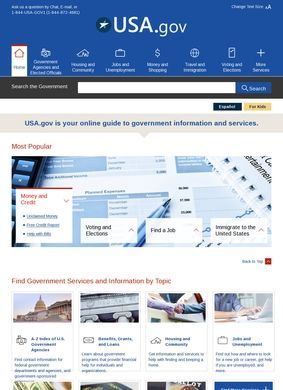
USA.gov is the U.S. federal government's official public portal, operated by the General Services Administration as a single entry point to the agencies, programs, and services that an ordinary person needs to find. Rather than forcing someone to guess which department handles passports, food assistance, or a tax refund, the site sorts everything into 19 broad topic areas and routes outward to whoever owns the answer. It is a directory and a guide more than a service provider in itself, and that distinction shapes how useful it ends up being.
Organizing government services by everyday problems
The topic spread is wide, and it is organized around problems people have rather than the bureaucratic boxes the government is divided into. There is a section on how the federal government is structured and a slice of its history, which sits oddly next to the more practical material but makes sense as a reference. Most of the rest is grounded in everyday situations.
Someone facing eviction can find housing help covering rental aid, buyer guidance, and emergency shelter. Someone dealing with a fraudulent charge or a stolen identity gets routed through the scams and fraud area, including how to report Social Security fraud. Complaints have their own track too, whether the gripe is against a federal agency, a bank, a telemarketer, or a travel company. The plain topic labels mean you do not need to know government jargon to land in the right place.
Benefits coverage is heavy, and that is probably the part most visitors care about. USA.gov maps out government benefits for food, housing, and healthcare; spells out education pathways including Federal Student Aid, Head Start, and special education; and pulls together health resources spanning insurance, mental health support, and help with medical bills. Money and credit is its own dense corner, with grants, loans, credit reports, unclaimed money, and taxes all grouped together. Veterans and active military get a dedicated benefits section. Immigration and citizenship walks through Green Cards, residency, and naturalization.
Small business owners get startup guidance, funding routes, and import and export licensing pointers. The innovation section gathers citizen science projects, federal competitions, and volunteering, which is a less expected inclusion and a welcome one. Few people will need more than a couple of these areas at a time, but the point of USA.gov is that whatever the need is, it has a home here.
Interactive tools that solve common tasks
A portal that mostly forwards you elsewhere can either save time or become an extra click between you and the agency you needed. USA.gov leans toward the first outcome because it carries a set of interactive tools that do real work on the page: a tax refund status checker, a benefit eligibility finder, a passport renewal guide, a housing assistance locator, and an unclaimed money search. These turn vague questions into concrete next steps, which is exactly what a confused visitor wants and what a plain list of links cannot deliver.
How the eligibility finder works
The eligibility finder is the most quietly valuable of them. Benefit programs are notorious for opaque qualification rules scattered across separate agency sites, and a single tool that screens you against several programs at once removes a lot of guesswork. The refund status checker and the passport renewal guide solve narrower but common headaches. None of these replace the underlying agency systems, but they shorten the distance to them, and that is the honest measure of whether a portal layer is worth having at all.
USA.gov also covers voting and elections, including registration and polling place lookups. Disaster and emergency assistance, disability services, jobs and unemployment insurance, and laws and legal issues such as vital records and child support all sit alongside the benefit sections. The site is structured so that a user who arrives with a vague problem, not a specific agency in mind, can narrow down in two or three clicks to the right federal destination. That is a harder design problem than it looks, and USA.gov handles it well enough that the experience rarely feels like a dead end.
What USA.gov does not provide
What you should not expect from USA.gov is depth on any single subject. The site is deliberately a starting point, so the detailed eligibility math, the actual application forms, and the binding rules live on the agency sites it sends you to. That is the right design for something at this scale, but it means a determined researcher will pass through quickly on the way to somewhere more specific. For the first-timer who does not even know which agency to ask, though, that handoff is the value. The two groups have different needs, and USA.gov is clearly built for the first.
Maintaining links and integrations at scale
A portal this broad lives or dies on how current its links and tool integrations stay. The architecture is sound and the topic organization is clear. A government operator has maintenance obligations a private aggregator does not, which works in favor of USA.gov over the long run. The breadth on display is not something you assemble and leave untended, so the scope itself argues for ongoing upkeep even if that cannot be verified from the surface alone.
Strengths as a navigation starting point
Weighed against the alternatives, which in most cases is either guessing at agency URLs or calling around, USA.gov does the job it sets out to do without clutter or unnecessary friction. A knowledgeable user may find it too high-level for anything except initial orientation, and the depth question is real. But as the place to send someone who has no idea where to start with a benefit claim, a passport, a complaint, or a refund inquiry, USA.gov is a practical and well-organized resource. The working tools lift it above a plain link list, the coverage is genuinely comprehensive, and the topic structure is human enough to feel designed, not assembled by committee. The verdict is a solid yes for triage and navigation, with the understanding that the real answers usually wait one click further on.