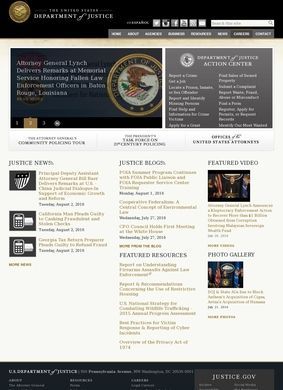
Few government websites carry the organizational complexity of the US Department of Justice's public presence. The agency's site covers more than 40 component organizations and over 115,000 employees, and the architecture of the pages reflects that: this is less a single homepage than a layered structure of sub-offices, each maintaining its own section within the same domain. Clicking through it feels more like navigating a large institution's internal directory than reading a public-facing government site, which is exactly what it is.
Litigating divisions and prosecutors
The legal work divides along functional lines. Five litigating divisions handle the courtroom side of the US Department of Justice's mandate, covering Antitrust, Civil, Civil Rights, Environment and Natural Resources, and Tax. A reader trying to understand a federal civil rights case or an antitrust action will find the relevant division's pages a more direct route than general news coverage, because the material comes from the office actually arguing the matter. Alongside the divisions sit the 94 U.S. Attorneys' Offices, which carry federal prosecution across every district in the country. The site lets you drill down to a specific district office instead of treating prosecution as one undifferentiated block, which is useful if you are trying to track something in a particular jurisdiction.
Federal law enforcement bureaus
Then there is the enforcement side, where most people already know the names without realizing they all report up to the same cabinet department. The FBI, the DEA, the ATF, the U.S. Marshals Service, and the Bureau of Prisons are all bureaus under the US Department of Justice, and the site functions as the connective tissue between them. That framing is genuinely useful, because the relationship between, say, the Marshals Service and the federal prison system is easy to miss when you only ever encounter each agency on its own. Seeing them grouped under one parent clarifies how a case can move from investigation to arrest to incarceration without leaving the department's structure at any point.
Immigration sits in its own corner here. The Executive Office for Immigration Review administers the immigration courts, and the US Department of Justice pages on it are worth consulting for anyone trying to understand how those courts differ from the rest of the federal judiciary. They sit inside the executive branch, not under the judicial branch, and the source explaining that distinction is the office that runs the system. No secondary explainer handles the nuance as cleanly as the primary pages do.
Grants and victim services programs
A large part of what the US Department of Justice publishes targets people who will never set foot in a courtroom. The Office on Violence Against Women administers 19 grant programs tied to domestic violence, sexual assault, and stalking, nested inside a much wider grant operation. The US Department of Justice distributes more than $3.2 billion annually to state, local, and tribal partners through the Office of Justice Programs, the COPS Office, and that same Office on Violence Against Women. For a police chief, a victim services coordinator, or a tribal government, that funding pipeline is the most consequential part of the site, and it is documented in considerable detail.
The mechanics of that money run through JustGrants, the department's grants management platform. Federal funding administration is its own specialized skill, so having the platform documentation hosted directly alongside the program pages is a real practical convenience for grantees. The Access to Justice office rounds this out by funding legal aid and public defense programs, which speaks to a side of the US Department of Justice concerned with whether people can get a lawyer at all, separate from its role prosecuting cases.
From research to legal opinions
For researchers and students, the National Criminal Justice Reference Service is the standout feature. It collects research and information resources on criminal justice topics, and it has long been a starting point for anyone writing seriously about crime policy, sentencing, or law enforcement practice. The US Department of Justice also publishes a steady flow of press releases on active litigation, which is the most direct available record of what the department is doing in court on any given week. Those releases, paired with policy guidance documents and formal legal opinions the department posts, give a reader primary material instead of secondhand summary.
The legal opinions deserve particular attention. When the US Department of Justice issues guidance on how a statute should be read or how a policy will be enforced, that document has real influence across federal agencies, and reading it firsthand is preferable to relying on a paraphrase. The organizational mission manual serves a quieter purpose, laying out how the department is meant to operate, the sort of reference a journalist or a law student reaches for when they need to cite structure rather than opinion.
Breadth is the obvious strength, and it is also the obvious difficulty. The US Department of Justice site assumes you already know roughly which component you need. The sheer number of offices, bureaus, and programs means general browsing can feel like wandering a large building without a map. Someone who arrives knowing they want the Civil Rights Division or the NCJRS will move quickly. Someone who only knows they have a vague "justice" question may spend a while orienting. That is the nature of an institution this large, and the site at least keeps each component's material coherent within its own section.
Set against Cornell's Legal Information Institute, the comparison clarifies what this site is actually for. The LII is the better destination for reading statutes and case law with annotation and context, because that is its entire purpose. The US Department of Justice site is the right stop when you want the executive branch's own account of what it is enforcing, who is funding what, and how a federal case is being framed by the office prosecuting it. A crime victim researching grant-funded services, a tax litigator checking a division's current posture, and a graduate student pulling primary sources for a sentencing paper are using the same domain for entirely different ends, and the depth within each section is substantial enough that all three will find what they came for.
The US Department of Justice site is not the place to start if you want annotated law or comparative legal analysis. It is the place to start if you want the government's own account of what the US Department of Justice is doing and why, in granular detail that no third-party summary can match.