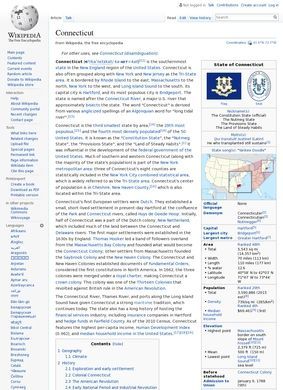
The person who lands on this page is usually mid-task: a student drafting a report, a journalist checking a figure under deadline, someone weighing a move and wanting the lay of the land in one read. For that person, Wikipedia: Connecticut does the job. It gives the orienting facts up front, layers the deeper material in a sensible order, and dates its numbers so they can be lifted straight into a piece of writing. As a general reference it holds together. As a substitute for specialist depth it does not pretend to be one, and that honesty is part of why it works.
Geography and basic facts
The opening hands over the basics most people want first. Connecticut covers 5,543 square miles, the third-smallest state in the country. It borders Massachusetts, Rhode Island and New York, with Long Island Sound to the south. Hartford is the capital, Bridgeport the largest city. From there Wikipedia: Connecticut moves outward into history, government, economy, education and transport, roughly the sequence a curious reader would follow on their own.
History through multiple names
This is the part that rewards patience. It runs from the colonial founding through the Revolutionary War, into the manufacturing surge of the Civil War years, and on to the early twenty-first century. In Wikipedia: Connecticut the "Constitution State" nickname is tied directly to the Fundamental Orders of 1639, and the article explains the link instead of leaving the label hanging. The older "Nutmeg State" tag gets its turn, as does "Arsenal of Democracy," earned through heavy wartime industrial output. The etymology reaches back to the Algonquian "Quinnetuket," meaning long tidal river. Small grounding details like that save a reader from opening a second tab. For a state this compact carrying this many names, the section quietly sorts out why.
Population density and local government
Here Wikipedia: Connecticut leans on precise figures a student or reporter can quote with confidence. Population sits above 3.6 million, which puts the state 29th in size yet fourth in density. That pairing tells you more about the place than either number on its own. The 169 incorporated towns get a mention, hinting at how local government is organized before the formal Law and Government section spells out the executive, legislative and judicial branches. The structure is broad strokes first, constitutional detail further down for whoever wants it. A reader can stop at the top layer or keep going.
Economy, education and Yale
The economy coverage stays concrete. Median household income is listed as $91,700 for 2023, and the article anchors that figure to real employers: Pratt and Whitney and Sikorsky Aircraft in aerospace, plus the finance and insurance sectors that have shaped the state for generations. Yale University shows up as an anchor institution, which carries the reader naturally into education. That section spans K-12 through higher education and names Yale alongside the prestigious boarding schools the state is known for. Side by side, the two sections explain why Connecticut keeps coming up in conversations about wealth and academic standing, a connection neither one could make alone.
What does the transport section cover?
Transport and politics close things out without filler. The infrastructure summary covers roads, rail, bus, air and ferry, useful to anyone planning travel through the New York-to-Boston corridor or thinking about relocating. The politics section sticks to voter registration data and statewide voting patterns, holding to ground that can be checked. Sports gets its own treatment, professional and college both. No section sprawls. Each does its work and steps aside.
From overview to specialist sources
A reference entry can collapse into a pile of disconnected facts, and Wikipedia: Connecticut mostly sidesteps that by ordering material the way understanding actually builds: name and origin, then land and people, then the institutions stacked on top. The cross-links pull their weight. A mention of Yale in the economy material connects forward to the education detail without sending the reader off to hunt for it. Figures keep their years attached throughout, the small discipline that separates a usable reference from a vague one. The thick web of internal links turns a single overview into a hub that points outward toward narrower sources, which is precisely the format's purpose.
Be plain about the limits. Taken as a general reference, Wikipedia: Connecticut delivers. It is a general-purpose summary, not a specialist monograph. Anyone needing deep treatment of the state's insurance regulation or its rail history will use this as a starting map and then follow the citations outward. The page makes no claim otherwise, and it is engineered for exactly that handoff. For most questions a student or traveler arrives with, the answer is already on the page. For the rest, the trail is marked.
The register stays neutral and encyclopedic from top to bottom, which fits the subject. There is no salesmanship in how the state is presented, just figures, history and government structure laid out in sequence. That restraint is the right call when you are verifying a fact against a clock or assembling background for something longer. Wikipedia: Connecticut reads like a reference meant to be consulted in pieces rather than start to finish, and it functions either way. The verdict is straightforward: this is a solid, well-organized entry that earns trust by knowing its own scope, and a careful reader gets what they came for.