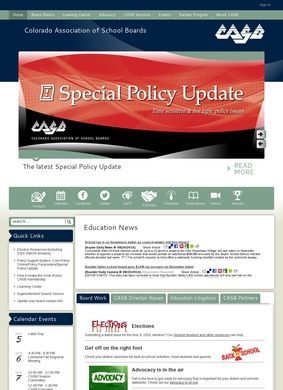
Most of Colorado's 178 school districts belong to a single membership organization, and the elected board members who run them, roughly 1,160 people in all, are the exact constituency the Colorado Association of School Boards was built to serve. It is a trade body for the people who govern public schools, not for the schools themselves, and that distinction shapes everything on the site.
The mission it states is plain enough. Through leadership, service, training, and advocacy, the Colorado Association of School Boards says it engages and supports local boards of education to advance a system of quality public education. Strip the phrasing back and the work falls into a few concrete buckets: telling boards what the law requires, training the members who sit on them, and lobbying on their behalf.
Governing the people who govern schools
School board membership in Colorado is an elected, largely volunteer role, and the people who win those seats rarely arrive knowing education law. A newly elected parent or local business owner can find themselves responsible for a multimillion-dollar district budget with no training at all. That gap is the reason a group like this exists.
The Colorado Association of School Boards positions itself as the shared back office that individual boards could never afford on their own. A single small district cannot keep a policy lawyer or a governance trainer on staff, but pooled dues across most of the state make both affordable. That pooling is the underlying logic of the whole operation.
The reach is the strongest argument for taking it seriously. When a clear majority of the state's 178 districts hold membership, the organization is effectively speaking for the governance layer of Colorado public education as a whole, which is a different thing from any one district acting alone. Scale is its main asset, and everything it offers flows from having that many boards under one banner.
Advocacy at the capitol and beyond
A large share of the value on offer is lobbying. The Colorado Association of School Boards represents boards at both the state and federal level, pressing their interests where education budgets and statutes are actually decided. For a single rural district, that collective voice is the sort of thing membership dues are meant to buy, and it is the part of the operation that outside records, from Ballotpedia to a university archive of the association's history, most consistently document.
This is also where a member has to trust the organization's judgment. Advocacy means the Colorado Association of School Boards takes positions on contested education questions, and a board that disagrees with a given stance is still represented by it. That is the standing tension inside any trade body: the collective voice is powerful precisely because it does not perfectly match every member's view.
The federal reach adds a second layer. A district in a small Colorado town has no realistic way to lobby Washington on its own, so pooling that effort through a statewide body is one of the few routes it has to be heard on national education policy at all. That value is hard to put a number on, but a district lobbying Congress alone would have no voice at all.
Policy guidance and the legal backbone
The policy work is where the site gets specific. A policy-services menu supports the governance duties a Colorado board carries under state law, with the association pointing directly at the relevant statute, C.R.S. 22-32-109. For a board member trying to work out what they can and cannot vote on, having those obligations mapped out is the practical core of the service.
This is the least glamorous and probably the most used part of what the Colorado Association of School Boards provides. Policy and legal reference is dry, but it is exactly what a volunteer board reaches for when a decision could end up challenged. A board that adopts model policy vetted against state law is far less exposed than one improvising its own, and reducing that legal risk is a concrete, checkable benefit, not a talking point.
This is the quiet machinery that keeps the Colorado Association of School Boards useful year after year, long after a new member's first training has faded.
Superintendent searches and board duties
Beyond policy, the organization runs superintendent search services, stepping in at one of the highest-stakes moments a board faces, the hiring of its top executive. A superintendent search is rare, expensive, and easy to get wrong, and most boards have no in-house capacity to run one well. Offering that service where a district would otherwise pay a private search firm is a clear, tangible piece of the value.
Pairing the searches with day-to-day governance support means the Colorado Association of School Boards covers both the routine and the rare: the weekly policy question and the once-in-a-decade leadership hunt. That range is what justifies year-round membership as opposed to a one-off consultation, and it is the reason a district treats the association as a standing resource instead of a vendor it hires only when a crisis lands.
Training under the Boardsmanship banner
Professional development is packaged as Boardsmanship, delivered through an online learning platform. The catalogue there is modest and honest about its size: 11 courses on education governance and leadership, drawn from RocketPD's library. It is enough to onboard a new member and cover the basics, without pretending to be a sprawling academy.
The events calendar fills in the rest of the training. Conferences, workshops, regional meetings, and an annual convention give members a reason to gather, compare notes, and hear the same guidance in person. The Colorado Association of School Boards uses these gatherings as much for cohesion as for instruction, keeping a scattered statewide membership loosely aligned on how boards should operate.
For a member juggling a day job with unpaid board service, that blend of on-demand courses and scheduled events is the realistic shape of professional development. The Colorado Association of School Boards is not asking anyone to enroll full time; it is trying to lift the floor of competence across a thousand-odd volunteers who each give the role a few hours a week, which is a sensible goal for a body whose members did not sign up to become education-law specialists.
The convention and regional meetings
The annual convention is the marquee date, but the regional meetings may matter more to a working board member, since they bring the association's guidance within driving distance instead of asking a rural trustee to travel to a single central event. That distributed model fits a state where districts sit hours apart, and it is a sensible answer to Colorado's geography.
One caveat runs through the whole training offer. Because the course library is licensed from RocketPD, a visitor cannot easily tell how much of the instruction reflects the association's own expertise and how much is a third party's general material rebadged for Colorado. For anyone outside a school board, meanwhile, almost none of this is usable: the policy tools, the superintendent searches, and the courses are gated to a very particular audience, and an organization this reliant on outsourced content and closed membership leaves a curious outsider with little to take away.