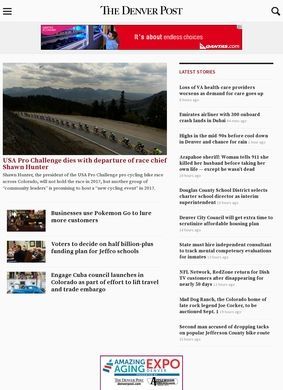
Say a wildfire jumps a containment line west of the metro overnight, or a ballot measure on marijuana policy clears a committee, or the Broncos pull off something in the fourth quarter that nobody saw coming. A reader in Colorado wants the local account, written by someone who knows the streets and the standings, not a wire summary stitched together from elsewhere. That is the gap The Denver Post fills. Colorado's largest daily newspaper since 1892, The Denver Post carries that history into a format that updates through the day.
Local reporting organized by Colorado beats
The reporting is organized around beats that a person living in the state would recognize. Local Denver and statewide Colorado coverage sits next to national news and politics. There are dedicated streams for environment, crime, courts, health, education, and obituaries, along with the marijuana policy reporting that has followed the state since legalization made it a national test case. Investigative work runs through these sections, not walled off as a special project, which is how a daily paper is supposed to operate. Staff reporters, columnists, and editors handle the Colorado-specific assignments, and that local staffing separates a paper like this from an aggregator.
Professional and college sports coverage
The sports operation is where The Denver Post gets granular. The professional teams each get sustained attention: the Broncos, the Nuggets, the Avalanche, the Rockies, and the Rapids. College fans are not an afterthought, with the CU Buffs and the Colorado State Rams both covered through their seasons. High school prep sports round it out. That last layer tends to disappear first when a newsroom shrinks, so its presence here says something about the scope of what the paper still attempts.
Around the games sit business, weather, and traffic, the three things a working reader checks before the day starts. Entertainment and the opinion and editorial pages fill in the rest. The opinion section is clearly labeled as such, and that distinction turns out to be load-bearing, because the line between reporting and commentary is exactly where local papers lose trust when they blur it. Photo galleries and video run alongside the articles, so a story about a storm or a game arrives with images rather than a stock photo.
Digital access and print replica options
For people who still want the paper as a paper, The Denver Post offers a Digital Replica, an e-edition that reproduces the printed pages on screen. It is a genuinely useful format for readers who think in terms of front pages and section fronts and find the endless-scroll homepage disorienting. The same content is available through a mobile app on both iOS and Android, with offline reading built in, useful for a commuter on a train or anyone in the parts of Colorado where a signal comes and goes. The weather and traffic pages serve a similar everyday purpose, pulling local conditions into a place where a reader is already going for the news.
Subscription model for original reporting
Access to The Denver Post is gated behind subscription, with digital and print membership both on offer. That is the standard arrangement for a metro daily now, and it is honest about what it is: original reporting costs money to produce, and the paywall is the mechanism that pays the reporters doing it. A reader gets continuous Colorado coverage and pays for the staff who generate it. For a paper that still funds full beats across courts, education, and the environment, that exchange is straightforward enough.
Ownership is part of the picture, and it is worth stating plainly: The Denver Post is owned by Alden Global Capital through MediaNews Group. Alden's reputation among media watchers is its own long story, and a reader weighing how much of the paper's history survives the present can keep that ownership in mind. The Denver Post still produces original Colorado reporting across its beats, and that output is what a visitor actually interacts with on any given morning. On Yelp the paper has a small number of reviews reflecting general reader sentiment, with no dominant pattern in either direction. A search through the standard business directory platforms turns up the publication listed but not reviewed, which is typical for a newspaper of this kind.
Site structure built around reader priorities
The structure of the site reflects the priorities of the people it serves. A Denver resident does not navigate to a generic news section and hunt for their city. They go to local Denver coverage, then statewide, then the team they follow, then traffic before the commute. The Denver Post arranges itself along those lines, and the e-edition gives the print-minded a parallel route to the same material. Coverage of courts and crime sits where civic readers expect it, and the education and health beats give parents and patients something specific to their lives in the state. The entertainment section and the columnists add texture that keeps a daily worth opening when there is no emergency to track.
A paper running since 1892 has covered the territory through more than a century of change, and The Denver Post channels that institutional knowledge into daily breaking news, sports that go down to the prep level, and opinion kept distinct from the reporting. The marijuana beat alone is a reminder that Colorado generates stories no national outlet tracks with the same care. A visitor opening the homepage on a typical morning finds the day's Colorado news, the latest on whichever team is in season, the weather, and the traffic, refreshed through the day and accompanied by photo and video that the staff produced rather than borrowed. The Alden ownership raises real questions about the newsroom's long-term resources, but the reporting that is there today is local, specific, and produced by people whose job is Colorado and nothing else.