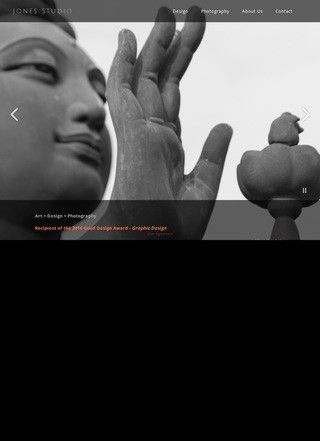
Someone has a wedding shoot to commission, or a brand that needs design work and a set of clean product photographs, and they want one place that handles both without bouncing them between freelancers. Jones Studio sets itself up for exactly that kind of visitor. The site splits cleanly into Design and Photography, with an About Us section sitting alongside, and the structure tells you straight away that this is a working studio taking on commissioned jobs, not a hobby gallery.
Portfolio and browsing features
The portfolio itself does most of the talking. You can browse recently added pieces and a featured selection, which is a sensible way to surface current work without forcing a visitor to dig through everything. A studio that keeps its newest work visible is probably one that is still actively shooting and designing, not coasting on a few old highlights from three years ago. There is also a favorites feature: you can save items into named sets, which is genuinely useful if you are a client comparing several photographs or design directions and want to come back to a shortlist later. It is one of those small details that makes the experience feel built for clients who take their time deciding, not casual browsers.
Building client comparison tools
What pushes this beyond a plain gallery is the commerce side. There is a shopping cart, which points to print or image sales being part of the offering alongside commissioned work. So the audience splits in two. On one side are clients who hire the studio to produce design or photography. On the other are buyers who simply want to purchase a print or an art piece they have spotted in the gallery. Running both through the same site is a reasonable choice, though it does ask a casual buyer to understand which mode they are in, and the site does not make that distinction especially loud on arrival.
Sales and dual audience model
For people who follow the work closely, the site offers RSS and Atom feeds covering recently added and featured items. That is slightly old-school now, but it means a returning client or a fan can track new uploads without checking the homepage every week. Someone built this with a bit of care about how content gets distributed, and that tends to be a good sign about the rest of the operation.
How does the studio distribute updates?
There is a Client Access login area, separate from the public browsing. Existing clients sign in to view and manage their content, which is the kind of setup you would expect from a studio handling private proofs, ordered sets, or commissioned material that is not meant for the open gallery. It keeps the public face clean while giving paying clients a private channel for their own work. For a one-person or small studio, that is a thoughtful piece of infrastructure to have in place rather than emailing files around and hoping nothing gets lost in a thread.
On entry the site presents a cookie and user agreement. It is a minor friction point and entirely normal, worth noting only because it is the first thing a visitor meets before reaching the work. Once past it, navigation is straightforward.
Client access and contact routes
Contact is handled through a tab in the main menu, so there is a clear route to get in touch. The homepage itself does not put a phone number, an address, or any direct line in front of you; those details sit behind the Contact page and do not greet you on arrival. That is a defensible design decision for a portfolio site, where the work is meant to lead and the practical details follow once someone is interested. A buyer wanting to ask about print sizes or a client chasing a quote will need to take that one extra click. It would cost nothing to surface at least a basic contact line on the landing page for people who are ready to act immediately rather than browse first.
The reputation side is where things go quiet. A search for jonesstudioltd.com turns up no review-platform listings at all: no Google reviews, no Trustpilot, nothing on the usual sites that would let an outsider gauge how past clients felt about the work. The name does not help. "Jones Studio" is shared by an architecture firm in Tempe, Arizona, and by Jennifer J L Jones Studios in South Carolina, so a casual search throws up businesses that have nothing to do with this one. Anyone trying to research the studio before commissioning it has to be careful they are even looking at the right company, and once they are, there is little independent feedback to read.
That absence is worth weighing honestly. The portfolio can show that Jones Studio can produce good design and photography, and the client login and feeds point to a real operation with returning customers. None of that is the same as a stranger's verdict on what it is like to hire them, how revisions are handled, or whether timelines hold. A prospective client is left judging Jones Studio on the strength of the gallery and the professionalism of the site, with no third-party voice to confirm or complicate that impression. The work on display is polished enough to earn a serious look, but the gap in outside feedback means the initial conversation carries more weight than it might with a studio that has a visible track record.
Taken together, Jones Studio presents as a competent, fairly polished portfolio-and-sales operation that knows who it serves and gives existing clients a private space to work in. The gallery is front and centre, the buying and favorites tools are practical, and the structure is easy to follow. What you cannot do from the outside is check the studio's track record against anyone else's experience, and the common name makes even that small effort harder than it should be. The published work is the main argument Jones Studio makes for itself, and for most of what this studio offers, that argument is a reasonable one.