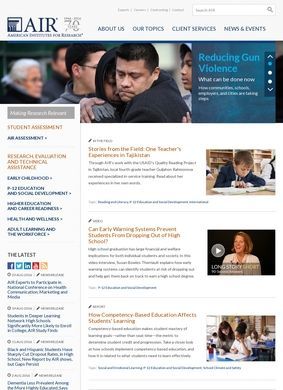
A 100-year national longitudinal study tracking U.S. children and families as artificial intelligence works its way into everyday life is not the kind of project most research organizations would announce. American Institutes for Research calls it the AI Century Study, and committing to a single observation window that stretches across a full century says something concrete about how the organization thinks. This is a nonprofit behavioral and social science research body that plans in decades, not quarters.
Research services and practice areas
The day-to-day work is more grounded than that headline implies. American Institutes for Research runs program evaluation, technical assistance, data science and technology services, survey design and administration, and advisory work on artificial intelligence. Output takes the familiar forms of applied social science: reports, newsletters, event proceedings, and shorter insight pieces, backed by dedicated research centers and named project teams. A large roster of staff experts and Institute Fellows is attached to that work, and a study is only as trustworthy as the people who designed it.
Five practice areas of work
Five practice areas carry most of the activity. Education covers evidence-based programs and policies aimed at students, educators, and policymakers. Health stretches across physical, social, and emotional well-being over the whole life cycle. Human Services focuses on outcomes for youth, families, and communities. International Development addresses program quality and access in developing countries. Workforce builds research, tools, and systems around human and organizational potential. The spread is wide, and the obvious concern with any organization touching that many domains is whether depth survives the breadth. American Institutes for Research answers that partly through its center model, where specific teams own specific questions rather than one generalist bench trying to cover all of it.
Clients and funding sources
Federal and state government agencies, school districts, foundations, and international development organizations are the buyers, and that shapes everything about how the work is framed. Recent examples are concrete: collaboration on Medicaid policy, STEM education through an NSF-funded center announced in 2026, and workforce development projects. These are commissioned studies and evaluations meant to feed decisions that move money and change programs, which is a useful anchor against chasing whatever topic is fashionable.
Independence as a research nonprofit
That funding base also clarifies the independence claim. American Institutes for Research presents itself as an independent nonprofit, and an organization that takes government and foundation contracts has to defend its neutrality constantly, because the credibility of the evaluation is the entire product. The tagline, "Advancing evidence. Improving lives," reads as a statement of method rather than marketing: the evidence comes first, and the social outcome is the point of generating it.
Funding community-driven projects
Then there is the money the organization is spending, not collecting. The Opportunity Fund commits over $225 million across ten years to innovative research and community-driven projects. That is a serious figure for a research nonprofit, and it points to a willingness to back work that may not have a paying client behind it, including projects driven by communities with no agency sponsor. A listing in a business directory tends to flatten an outfit like this into a list of services, but the Opportunity Fund is the part that hints at institutional ambition beyond fulfilling contracts.
The organization's core purpose
For anyone trying to understand what American Institutes for Research is for, the simplest frame is this: it turns questions that governments and foundations cannot answer in-house into studies, tools, and evaluations they can act on. A school district wondering whether a literacy program works, a state agency weighing a Medicaid change, a development organization measuring access in a difficult region, these are the situations where the work lands. American Institutes for Research organizes itself around problems and the centers built to study them, not around a sales pitch.
Checking reviews and reputation
Searching for independent reviews of American Institutes for Research on general rating platforms turns up very little. The organization's clients are government agencies and foundations, not individual consumers, so the usual review platforms are not where its reputation gets made. What exists instead is a long record of commissioned work for serious institutions, published reports that carry names and methodologies, and a network of fellows and staff whose own reputations are tied to the quality of the output. On Glassdoor, American Institutes for Research has several hundred employee reviews, which is worth noting as one of the few places where outsider assessments accumulate in any volume.
Weighing scale against depth
What is harder to judge from the outside is whether the sheer scale helps or dilutes. American Institutes for Research spans education, health, human services, international development, and workforce, runs centers and fellows across all of them, manages a nine-figure fund, and has now staked out a research commitment measured in a hundred years. That is enormous reach for one organization, and reach cuts two ways. The named experts and the center model point toward real depth, and the long client relationships with serious institutions support that reading. Yet the open question stays open: whether a body stretched across this many fields, this many decades, and this much money can keep every line of it as rigorous as the AI Century Study implicitly promises.