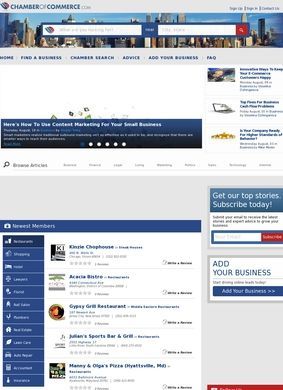
Visitors landing on chamberofcommerce.com often arrive expecting a local business association's website. Chamber of Commerce, the private platform behind that address, has no affiliation with any official chamber organization at the local, state, or federal level. That gap is foundational, not incidental, and Chamber of Commerce does not go out of its way to correct the impression. A visitor who reads carefully will eventually work it out, but the name does most of the misleading on its own.
Directory coverage across states and industries
As a directory, the platform covers the full map: all 50 states plus the District of Columbia, sorted by geography and by industry, with more than twenty sectors listed. Automotive, beauty, contractors, finance, legal, and real estate are among them, along with a dozen others. Chamber of Commerce cites an audience of over 2 million business community members and roughly 25 million directory visitors per year. Those are the platform's own numbers, so treat them as marketing claims until something independent backs them up, but they do indicate how large the operation is meant to be.
Small-business guidance in four topic areas
Alongside its listings, Chamber of Commerce has organized a library of small-business guidance into four areas. Planning content covers business plans, franchises, grants, and insurance. Launch material walks through naming a company, registering it, getting a tax ID, sorting out licenses, and opening a bank account. A managing section addresses taxes, compliance, and finances, and a growing section reaches into exporting, federal contracts, and loans. A blog adds articles on small-business topics. The library is genuinely useful as a starting point for an owner in the early stages, even though it overlaps heavily with what the SBA and other free resources already publish. Chamber of Commerce packages the material neatly, but it is not proprietary or hard to find elsewhere.
Paid membership features and their costs
The commercial layer comes through paid membership tiers, and this is where the arrangement deserves scrutiny. Paying members can strip competitor ads from their own listing page, access dispute tools for negative reviews, claim top placement in local search, display an accreditation badge, and tap partner deals that Chamber of Commerce markets as saving an average of $4,937 per year. Several of those features exist to manage problems the platform itself can create: competitor ads appearing on a page about your own company, negative reviews surfacing against you, and an accreditation badge whose value is set entirely by Chamber of Commerce. A business paying to suppress ads on its own listing is a notable arrangement. Companies can also appear through a self-submit link, which explains why many businesses end up in the business directory without ever actively signing up.
Comparing third-party ratings and complaints
Third-party feedback on Chamber of Commerce is limited but points in one direction. On Sitejabber, the platform holds roughly 1.9 out of 5 across about ten reviews, with complaints focusing on unauthorized scraping of business data and fake reviews. PissedConsumer sits at 1.0 out of 5 over a couple of reviews that describe the platform as a scam and press hard on the absence of any real chamber affiliation. The Better Business Bureau profile, logged out of Orlando, Florida, carries multiple complaints, several citing unresponsive customer service and misleading claims about what the platform actually is. Trustpilot lists it as well, though a clear aggregate score did not surface from a page-level check.
ScamAdviser rates the domain as legitimate and safe, which cuts against the human feedback. That kind of automated assessment measures technical signals like domain age and SSL certificates, not whether customers received value, so it sits oddly alongside the low human-written scores. Smart.reviews adds one more data point to the pile. Across all of these sources, the number of reviews is low, but the pattern among those that do exist is consistent and unflattering. The recurring complaints, data scraping without consent and the implication of an official affiliation that does not exist, are exactly what a cautious buyer should weigh before paying anything to Chamber of Commerce.
Contact access limited to account holders
Reaching a human at Chamber of Commerce is its own hurdle. The homepage shows no phone number, no public email, and no mailing address. There is no obvious path to support for a visitor who is not logged in; contact access appears reserved for members or account holders. For a platform asking businesses to spend money and to engage in review disputes, keeping that door closed at the front end is a real problem, and it lines up with the BBB complaints about service that goes unanswered.
Free listings versus paid membership value
It helps to separate what Chamber of Commerce offers into two halves, because the verdict on each is different. The free educational content and the basic listing function are fine for what they are. A small-business owner can look up a competitor, read a guide on setting up a company, and leave with something of value. Chamber of Commerce is large, indexed broadly, and a listing here adds to a company's online footprint, which is part of why so many businesses appear in it without having asked.
The paid side of Chamber of Commerce is where skepticism should harden. The membership pitch leans heavily on managing problems internal to the platform itself. The headline savings figure is an unverified company average. The accreditation badge means whatever Chamber of Commerce decides it means. Pair that with the documented scraping complaints and the contact information hidden behind a login, and the case for opening a wallet looks poor. The name draws in visitors who expect something official, and nothing on the page moves to correct that expectation once they arrive.
Chamber of Commerce works well enough as a free reference and as one more place a business can appear online. On that narrow basis, a listing here is harmless and occasionally useful. The paid membership is harder to defend: the benefits are mostly defensive, the external ratings are low across every platform that has them, and Chamber of Commerce offers little outside evidence to justify the cost. Treat the directory entry as a convenience and verify any premium promises through independent sources before spending anything here.