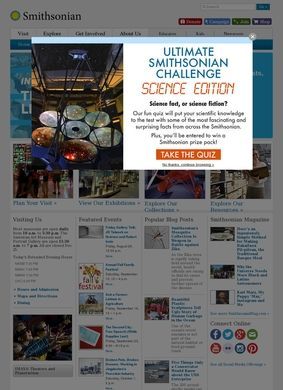
Over 155 million objects, specimens, and archival items sit behind the Smithsonian Institution, a number so large it stops meaning much until you notice how the site tries to make even a sliver of it reachable from a browser. This is the world's largest museum, education, and research complex, and the website behaves like a front door to all of it at once: art on one click, deep-sea specimens on another, fossils a screen away from design objects.
A network of museums and research centers
The scale is broken into parts that a visitor can use. Twenty-one museums and galleries, plus the National Zoo and fourteen education and research centers, are listed and linked, with seventeen of those museums and the zoo clustered in the Washington, D.C. area and free to enter. Two more sit in New York: the Cooper Hewitt National Design Museum and the National Museum of the American Indian Heye Center. That free-admission point lands differently than it sounds, because a lot of what the site funnels people toward costs nothing to see in person, and the pages treat that as a plain fact rather than a selling line.
Highlights inside the natural history museum
If you want a sense of what individual collections hold, the named museums give it. The National Museum of Natural History carries the largest natural history collection in the world, and the Smithsonian Institution is upfront about its headline holdings: the Hope Diamond, the Hall of Human Origins, the National Fossil Hall, Ocean Hall, and Egyptian mummies. These are the things people travel for, and seeing them itemized online helps you plan a visit instead of wandering in cold. I found the candor about what is physically where more useful than any amount of general description would have been.
Digitizing collections through 3D scanning tools
What pushes the digital side past a simple directory of buildings is the work of the Digitization Program Office, which puts collections online directly. The Smithsonian Institution's 3D Voyager tool lets you look at scanned objects in three dimensions, which is the rare case of a museum technology that earns the screen instead of decorating it. Alongside that sit research publications and online exploration that spans, as the institution itself puts it, art to zoology. The breadth is browsable, not asserted.
Research reaching across continents
Research is woven through the whole operation, not bolted on. The Smithsonian Astrophysical Observatory dates to 1890, and the network of centers reaches across Washington, D.C., Maryland, Virginia, New York City, and Panama. That last location says something about the reach here: this is a research body with field presence on more than one continent, not a domestic museum group with a polished front page. For someone trying to figure out whether the Smithsonian Institution does original science or mostly curates, the answer is plainly both.
Resources for educators and student trainees
Educators get a section that does more than gesture at lesson ideas. The site offers workshops, webinars, and classroom materials, and the Smithsonian Science Education Center anchors the teaching side with structured resources. There is also a clear path for people who want to work or train inside the institution: fellowships and internships run through the Office of Fellowships and Internships, with the application routes laid out rather than buried. A student weighing a research placement can find the relevant program without guessing where to look.
Ways to support the institution
Support and membership get their own structures, and the distinction between them is handled plainly. Individual visitors can join as Friends, while corporate membership opens behind-the-scenes access and a way for companies to back the Smithsonian Institution's work. Neither option is dressed up; the pages explain what the money supports and what a member gets, which is about as much as anyone needs before deciding. The framing stays on the side of contribution to a public trust, which fits an organization set up as an independent trust instrumentality of the United States.
Different audiences, one shared homepage
Where the Smithsonian Institution's site is strongest is in matching its sprawl to a person's actual question. A teacher, a researcher, a parent planning a day in Washington, and a designer studying the Cooper Hewitt collection each have a route through the same homepage, and those routes do not collide. The audiences named here, the general public, researchers, educators, students, and corporate partners, map to different doors that all open from the same building.
For all that, the experience asks something of the visitor. The Smithsonian Institution holds so much that no front page can summarize it honestly, and the site does not pretend otherwise, so a first-timer can feel the weight of choosing where to begin. The payoff is that almost any thread you pull, the National Zoo, a fossil hall, an astrophysics paper, a 3D scan, leads somewhere with real depth behind it. The collections run from a single famous diamond out to 155 million catalogued things, and the website is the index to that range.