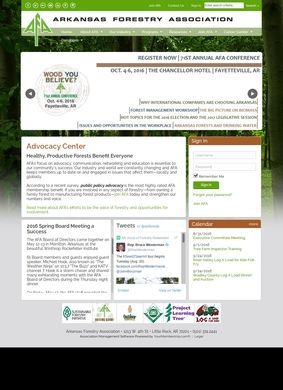
What does a single organization do for forestry in a state where timber covers more than half the land? In Arkansas the answer runs through the Arkansas Forestry Association, a statewide trade and professional group that gathers a wide cast under one roof: working forestry professionals, manufacturers who turn trees into product, families who own woodland, plus teachers, students, and people who care about how the state's forests are managed. The site lays out what that membership covers without much fuss, and the picture that comes through is of a group built mainly around advocacy, connecting people, and teaching. That framing undersells it slightly; the range is wider than it implies.
Policy advocacy and political engagement
Advocacy sits at the front, and the Arkansas Forestry Association is plain about why. Public policy work at both the state and national level is described as the single benefit members value most, which tells you where the energy goes. For an industry whose economics turn on regulation, tax treatment, and how public land gets handled, having a body that speaks for the sector in Little Rock and beyond is a concrete reason to join. The ForestExpress PAC is part of that machinery, giving the membership a formal channel into the political process. None of this is dressed up; it reads like a working association that knows its members are watching legislation closely and that a single bill can change the math on a stand of timber faster than any market shift can.
How the ForestExpress PAC shapes legislation
The education side is where the offering gets unexpectedly broad. The Arkansas Forestry Association runs a cluster of programs aimed at classrooms and young people: Growing Champion Classrooms, the long-running Project Learning Tree curriculum, a Teacher Conservation Tour that takes educators into the field, and a Green Careers Expo pointed at students weighing a future in the sector. Environmental education resources sit alongside these. The thread connecting them is workforce and public understanding, two things a timber-dependent state has to keep replenishing if the industry is to have foresters and mill workers a generation from now. An association that bothers with second-grade classrooms is thinking longer than the next election cycle, and that perspective shows in how the programs are structured.
Education programs for students and teachers
For the professionals themselves, the calendar centers on the Annual Meeting, with the 81st edition slated for October 2026. An association that has held that gathering more than eighty times has a track record most trade groups would envy, and the number does more to establish standing than any adjective could. Eighty-one years is a long horizon for any membership group, and the Arkansas Forestry Association has clearly used that stretch to become a fixture rather than a passing effort. There is institutional memory in that continuity, the kind members rely on when they need to know how a policy fight went last time or who to call about a certification question.
Growing the next generation of forestry workers
That certification work is handled through the American Tree Farm System, including inspector meetings, which is relevant to family forest owners who want their land recognized as sustainably managed and need qualified people to verify it. The Arkansas Forestry Association also runs a Witness Reward Program, a practical measure aimed at the timber theft and arson that genuinely threaten woodland owners. These are not showpiece offerings. They are the unglamorous services that keep landowners and producers coming back, because they solve problems that only get serious attention from people who live close to the work.
Certification and theft prevention services
The resource library is worth a closer look for anyone in the trade. There is a Buyers Guide for sourcing within the sector, an online store, forest management publications, and Landscape Management Plans that give owners a documented approach to their property. The Voices of Forestry Podcast adds an ongoing channel of conversation, and a Career Center with active job postings ties the workforce mission back to real hiring.
Member resources and marketplace tools
A Career Center on a trade association site is a quiet indicator that the group is plugged into who is hiring and who is looking, which is exactly the function a sector body should serve. Between the Buyers Guide and the job board, the Arkansas Forestry Association doubles as a small marketplace for the trade, connecting supply, demand, and labor in one place. For a professional researching the sector, this is a more useful stop than a generic business directory, where forestry-specific depth rarely exists.
From buyers guides to job postings
Taken together, the Arkansas Forestry Association covers a lot of ground without spreading itself into vagueness. Each program maps to a real constituency: the PAC and policy updates for professionals and manufacturers, the certification and Witness Reward Program for landowners, the classroom programs and Green Careers Expo for the next generation. The membership pitch is straightforward, since joining opens access to all of it plus the policy briefings and the networking that, for many members, is the whole point of belonging to a statewide group in the first place.
Balancing diverse needs across constituencies
It is fair to note what that breadth implies. A group trying to serve mill owners and second-grade teachers and timberland families at once has to balance very different needs, and the site handles that by keeping its many programs distinct instead of blending them into one fuzzy mission. The Annual Meeting and the inspector meetings speak to one audience; Project Learning Tree and the Teacher Conservation Tour speak to another. The Arkansas Forestry Association seems comfortable being many things to many people, which is probably the only honest way to represent an industry that touches so much of the state's land and economy. It suits a sector where the mill, the woodlot, and the schoolroom are all part of the same long cycle.
A search turns up no aggregated public ratings for the Arkansas Forestry Association on the usual platforms. For a trade association of this type, that is expected; membership satisfaction gets aired at the Annual Meeting or in sector publications rather than in consumer review threads.
Inside the Voices of Forestry Podcast
The Voices of Forestry Podcast deserves a second mention. A trade group that produces ongoing audio content is making an effort to stay present between annual gatherings, to keep members engaged when there is no meeting on the calendar. Paired with the Career Center and the online store, it points to an organization that treats its website as a living service, not a static brochure updated once a year for the annual gathering.
Someone wanting to understand Arkansas forestry could go straight to the Arkansas Department of Agriculture's Forestry Division, the state agency, and get the official regulatory and fire-management picture. That is the right source for rules and public-land data. But the agency speaks for the government, not for the people who own and work the forests, and it does not run a PAC, host an eighty-first annual meeting, or maintain a job board for the trade.
The Arkansas Forestry Association occupies the seat the agency cannot: the membership voice of the sector itself, with the advocacy muscle and the practical member services that come with being run by and for the industry. For a forestry professional, a woodland owner, or an educator in Arkansas, the published record on the Arkansas Forestry Association is substantive enough to act on without waiting for more outside validation.