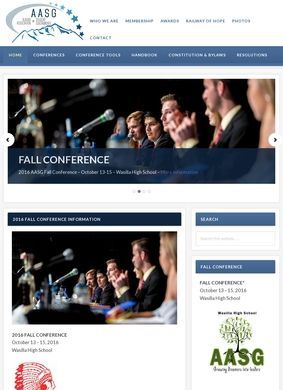
What does a high school student who wants a real say in how their school and state are run actually do with that ambition? The Alaska Association of Student Government gives them a structure to work inside. It is a statewide organization that ties together student councils from member schools across Alaska, and its purpose is plain enough: train student leaders, move student voice past the level of a suggestion box, and put teenagers in rooms where decisions get argued and voted on.
The scope is genuinely statewide, and in a place as spread out as Alaska that is not a small thing. A student council in one district can feel isolated. The Alaska Association of Student Government connects those scattered councils into something that meets, debates, and speaks with a shared voice, on issues that run from local school policy up through state and national questions.
What the organization puts in front of student leaders
The core of the offering is not abstract. It runs on events, elected roles, and a set of recognitions that give the whole thing shape across a school year. Anyone trying to understand the value here should look at the specific programs, because that is where the leadership training takes concrete form as events on a schedule.
The membership of the Alaska Association of Student Government is built around student council members, student leaders, and the advisors who work alongside them at member schools. That last group is easy to overlook. Advisors are teachers and staff who keep these councils functioning, and the fact that the organization builds programming and recognition around them tells you it understands how student government actually survives from one year to the next.
Two statewide conferences that anchor the year
The calendar turns on two annual gatherings, a Fall conference and a Spring conference. Each runs three days. These are working events, not pep rallies. Delegates sit through business meetings, draft and argue resolutions, and hold debates. That is where the model is most credible. A student who attends comes away having done the mechanics of governance, motions, votes, the work of persuading a room, instead of merely hearing about them.
Three days is a real commitment for a teenager and the school that sends them. Building the year around two of these signals that the Alaska Association of Student Government treats the process seriously, and it gives member schools a predictable rhythm to plan around.
An executive board drawn from across the state
Leadership is not handed down from an office. The Alaska Association of Student Government runs an Executive Board made up of student leadership positions filled by students from around the state. These are the delegates who carry responsibility between conferences and set direction.
Putting students in genuine board positions is the difference between a program that talks about leadership and one that hands over the reins. The geography helps too. A board pulled from across the state keeps a single large district from dominating and gives smaller or more remote schools a path into the top roles.
A route to the national stage through NASC
The reach does not stop at the state border. Through affiliation with the National Association of Student Councils, Alaska delegates can take part in national and regional conferences, some featuring international speakers. For a student in Alaska, that connection is not trivial. It links a council in Fairbanks or Juneau to a network that runs across the country and beyond.
Travel is the obvious obstacle, and the Alaska Association of Student Government has an answer for it. Travel scholarships help delegates cover the cost of getting to conferences. In a state where distances are enormous and airfare is the price of participation, that support is the mechanism that lets students from far-flung schools actually show up rather than watch from home.
Recognition and service that reach past the meeting room
Beyond the debates and the board work, the Alaska Association of Student Government hands out a slate of awards: Student Council of Excellence, Leader of the Year, and Advisor of the Year. Naming an advisor award alongside the student honors is a small thing that says a lot. It credits the adults who make the whole system run.
Community service projects, another piece the Alaska Association of Student Government funds and tracks, round out the picture. They are the practical half of the mission. Leadership training that ends at parliamentary procedure would be incomplete, and folding service into the program pushes students to apply what they practice at conference to their own towns and schools. The awards then give councils something concrete to aim at across the year.
Taken together, these pieces fit. The conferences supply the training and the arena, the Executive Board supplies continuity, NASC supplies a wider horizon, the scholarships remove the cost barrier, and the awards and service work keep the effort pointed at results. It is a coherent cycle, and each part reinforces the next.
A fair question is who this really benefits. The honest answer is that it rewards the students who lean in. A delegate who only attends will get something from it; a delegate who runs for the board, writes a resolution, and helps organize a service project gets far more. The structure is there. What a student draws from it depends heavily on how much they put in, and that is true of most things worth doing at this age.
It is also worth being clear-eyed about scale. This is student government, so leadership turns over every year as delegates graduate, and that churn is built into the model. The counterweight is the Executive Board and the fixed rhythm of two conferences, which carry institutional memory forward even as the faces change. For an organization run largely by teenagers, the Alaska Association of Student Government has landed on a sensible design, and the NASC affiliation gives it a stable frame to lean on when the roster resets each spring.
Outside its own conference materials and NASC ties, the group does not have much of a public footprint. A search does not surface entries in a business directory, a consumer review site, or independent press coverage; what turns up instead is mostly references from member schools, education boards, and NASC itself. That is ordinary for an organization built around teenagers rather than customers, but it does mean an outsider is working from what the group and its partners publish, not from a pile of public reviews.
A student leader who wants more than a title should aim at the next Fall or Spring conference, ask an advisor about the resolution and debate process ahead of time, and find out whether a travel scholarship can cover the trip. An advisor weighing whether to bring a school in should look at what board membership and the awards program would mean for students over a full year.
Judged on what the Alaska Association of Student Government actually runs, conferences, an elected board, a national affiliation, scholarships, and a set of awards, the pieces fit together into something a student can put real time into.