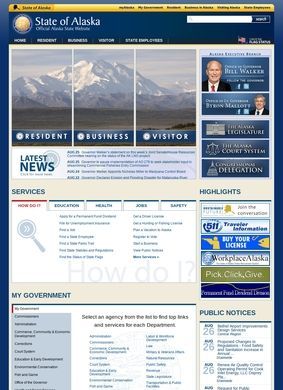
Alaska.gov is the official online portal of the State of Alaska government, the single front door to the services and information that the state's agencies put online. The State of Alaska built it to serve several audiences at once: residents handling personal business, companies registering or licensing, travelers planning a trip north, state employees, and the agencies themselves. The breadth is what defines it, and most of the practical day-to-day reasons a person in Alaska would go looking for a government service are answered somewhere on the site or one click away from it.
Services for Alaska residents
For residents, the portal pulls together the recurring tasks that touch most households. Driver license services sit alongside the Permanent Fund Dividend application, which is the standout item here given that the PFD is unique to Alaska and reaches a large share of the population every year. Hunting and fishing permits, concealed handgun permits, and Medicaid and Medicare enrollment are all reachable from the same hub. There is also a path for reporting child protection concerns, plus substance abuse resources and emergency preparedness material.
That mix says a lot about what the State of Alaska is trying to do with one address: keep the routine licensing next to the more serious public safety functions so people do not have to guess which agency owns what. A parent worried about a child and a hunter buying a permit start from the same place, which is a sensible way to run a portal that has to be everything to everyone in the state.
Licensing searches for contractors
Businesses get their own well-defined track on the State of Alaska portal. The site handles state business registration, professional licensing searches, and business license applications, so an owner can both file their own paperwork and check the credentials of someone they are about to hire or contract.
The licensing search is the kind of feature that quietly does a lot of work, since it lets a customer confirm that a plumber, an accountant, or a care provider holds a valid state credential before money changes hands. Unemployment insurance filing, a job bank, and workforce development programs round out the employer-and-worker side. These are not afterthoughts tucked into a corner; they form a coherent set of tools for the labor market in the state, and pairing the licensing search with the application flow is a genuinely useful touch for anyone vetting a contractor or a clinic.
Travel information and ferry schedules
A good chunk of the portal speaks to people who want to move around Alaska or come visit it. Travel information, accommodations, and tourist attractions are gathered for visitors, and the Alaska Marine Highway ferry schedules are folded in, given that the ferry functions as genuine infrastructure in Alaska and not a novelty. Community profiles give a sense of individual towns. For drivers, the 511 real-time road conditions system is the practical centerpiece, joined by vehicle registration and airport information. In a state with long distances and hard weather, having live road conditions linked from the same place as registration and ferry times is the kind of consolidation that earns regular use.
Cabin reservations and recreation guides
The recreation side leans into what the state is known for. There are cabin reservations for state parks, trail maps, and wildlife viewing guides. Those are concrete, plannable resources, not vague encouragements to enjoy the outdoors, and they connect naturally to the visitor and transportation sections so a trip can be assembled from one starting point. Veteran employment services and state job openings also live here for people looking to work in or for the State of Alaska, which makes the portal a recruiting channel as much as a service desk.
Beyond the headline tasks, the portal carries a long tail of reference functions. Unclaimed property searches and tax services are present. So is a comprehensive directory of every state agency and the commissioners who run them, which is the sort of plumbing that makes a government site navigable when you do not already know which department handles your question. A public notice board, legislative and administrative information, and a kids' educational section extend the audience further, down to schoolchildren learning how their state works.
Navigation and cultural design
Two design choices stand out as specific to this state. The site integrates Real ID compliance alerts, which is timely and practical for anyone who flies. And it features indigenous language greetings that reflect Alaska Native heritage, a small detail that signals the State of Alaska is aware of who its residents are and chooses to put that front and center instead of burying it. That choice is easy to overlook and hard to dismiss once noticed. Social presence spans Facebook, X, Flickr, Vimeo, and YouTube, so updates and visual material reach people through more than one channel.
How does the portal connect its pieces?
What is worth saying about a portal this large is that its value depends on whether the pieces connect, and on the evidence of what it offers, they mostly do. The PFD, the 511 system, the licensing search, and the agency directory are each strong enough to justify a visit on their own. Bundling them means a resident filing a dividend application is a short hop from checking road conditions or registering a vehicle, and a visitor reading community profiles is near the ferry schedule and the cabin reservations. That coherence is the difference between a useful state portal and a link dump, and the State of Alaska lands on the useful side.
Learning the directory structure
The breadth does come with the usual cost of any all-things hub: a first-time user has to learn where things live, because so much is gathered under one roof. The agency-and-commissioner directory is the answer to that, and its presence suggests the people running the site understood the navigation problem and built a map for it. For a state with a small population spread across enormous geography, an online front door that covers driver licenses, the dividend, fishing permits, road conditions, and ferry schedules without sending people to five separate sites is doing the core job a government portal exists to do.
One more practical note: the spread of functions means the State of Alaska portal works as a reference even when you are not transacting. The public notice board and the legislative and administrative information turn it into a place to check on what the government is doing, beyond simply filing forms. A resident can read a notice, look up a commissioner, and register a vehicle in the same sitting, and a business owner can verify a license and file unemployment insurance paperwork without leaving the State of Alaska domain. The kids' section and the indigenous language greetings sit at the edges of that same structure, widening who the site is plainly built to reach.