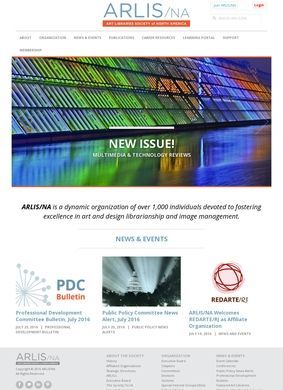
ARLIS, properly the Art Libraries Society of North America, is a professional membership body for the people who manage art and design information across the United States and Canada. Its constituency is more varied than the name might suggest at first glance: architecture and art librarians, visual resources professionals, curators, educators, publishers, working artists, and students all fall under its umbrella, and the membership runs past a thousand. That breadth shapes everything the ARLIS site sets out to do, because it has to speak to a cataloguer at a museum library and a doctoral student hunting for an internship in roughly the same breath.
Publishing and scholarship
Publishing is where the organization has built the deepest record. Its peer-reviewed journal, Art Documentation, anchors a body of scholarship on the practice of art librarianship, and that is joined by specialized reviews and directories aimed at the field. For anyone trying to keep current on how visual collections are described, preserved, and made findable, this is a real source of literature, not a newsletter dressed up as one. The peer-review process puts the writing on the same footing as other scholarly work in adjacent disciplines, which is a meaningful distinction for a field that has had to argue for its legitimacy within larger institutional settings.
Peer review in art librarianship
Professional development gets comparable attention. ARLIS runs an annual conference, organizes study tours, and fills the calendar between those marquee events with webinars and lunchtime chat sessions. I find the smaller-format options the more telling detail, because an association that bothers to host informal midday conversations is one trying to stay useful between conferences instead of going quiet for eleven months a year. Study tours in particular point to a field that still values seeing collections and buildings in person, which fits a discipline built around physical and visual material.
Professional development programs
The member-facing tools are practical rather than decorative. There is a searchable member directory, a commons platform for ongoing exchange, job listings, and a separate directory of internships (that last split is a thoughtful one, given how different the early-career search is from a mid-career move). A structured mentoring program rounds this out, pairing people deliberately instead of leaving connections to chance encounters at the annual meeting.
Member directory and job listings
Taken together, these are the working machinery of a field that is fairly small and geographically scattered. Art and design librarians do not turn up in large numbers at any single institution, so a central place to find a peer, a posting, or a mentor does genuine work for the membership. The job and internship listings alone justify a regular visit for anyone trying to break in or move up, and the directory makes the network legible in a way that a closed mailing list never could.
Financial sustainability mechanisms
On the institutional and financial side, ARLIS maintains sponsorship arrangements for vendors and institutional partners and runs a planned-giving program it calls The Society Circle. These are the quieter mechanisms that keep a nonprofit association solvent, and their visibility is itself a sign of an organization thinking past the next conference. A planned-giving track is not something a loosely run group bothers to build; it points to long-horizon planning about how the work continues when founding generations move on.
Advocacy across two countries
Advocacy threads through all of it. ARLIS positions itself as a voice for excellence in art and design librarianship throughout both countries it serves, and the dual US and Canada scope is worth noting. Cross-border professional bodies often tilt heavily toward the larger market, so an explicit commitment to serving members on both sides of the line is a real advantage, even if the day-to-day balance is hard to measure from the outside. The society also publishes advocacy statements and participates in broader library coalition work, which extends its reach beyond the immediate membership.
Outside reputation is difficult to assess from public channels. ARLIS is a specialist organization whose audience is largely professionals who already know it exists; general consumer review platforms are not where this kind of body gets evaluated, and none turned up in a straightforward search. The more useful measure is the longevity of the journal, the retention of a membership across two countries, and the breadth of programs described on the site. A professional society that has maintained peer-reviewed publication and an active conference calendar over decades is one that the field has continued to fund and attend.
Who should join ARLIS?
If there is a limit to who should bother, it is one of fit rather than quality. The ARLIS site is built for practitioners and the students heading toward the field. A general reader curious about art will find little aimed at them, since the content assumes you already work with collections or want to. That is the correct call for a professional society, and pretending otherwise would dilute what makes the resource useful.
Comparison with the ALA
Set against a more general option like the American Library Association, the case for ARLIS comes down to depth in a narrow lane. The ALA covers the whole profession and offers more sheer volume, but an art or visual-resources specialist will find the conversation, the journal, and the job board here tuned precisely to their corner of the work. The focused society is the one worth keeping in regular rotation for that specific slice of the profession.