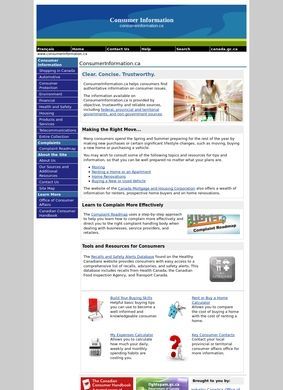
A payday loan has ballooned, the collection calls have started, and the borrower has no idea which rules the lender is bound by or where the line of legality sits. That is the moment Consumer Information is built for. It is the Government of Canada's consumer resource, published through Innovation, Science and Economic Development Canada and known on the site as the Canadian Consumer Handbook, and its job is to put plain guidance in front of ordinary residents before a bad deal hardens into a worse one.
Where the money problems live
The Financial section is the most substantial, which fits, because money is where most consumer trouble begins. Consumer Information gathers guidance on collection agencies, contracts, credit reporting, debt management, mortgages and payday lending in one place, the tangle of obligations that catches people who signed something they never fully read.
The value here is orientation. Someone deep in debt rarely knows whether the real problem is a credit-reporting error, a contract clause or a lender working outside the rules, and Consumer Information sorts those into named topics a worried reader can follow one at a time. It does not argue your case. It tells you which case you are in.
Collection agencies get an entry of their own, and that is a telling choice. A person hearing from one is usually frightened and rarely told plainly what the agency may and may not do, which is where a calm entry in Consumer Information does more good in the moment than almost anything else on the page. Contracts sit right beside it, the documents people sign fastest and understand least.
From payday loans to credit files
Take the two ends of that section. Payday lending gets its own treatment, the short-term, high-cost borrowing that squeezes people who are already short on cash, while credit reporting sits at the quieter far end, the machinery that decides whether a person can borrow at all and on what terms. Consumer Information covers both, along with debt management and the mortgage that is, for most households, the largest contract they will ever put their name to.
None of it stands in for a lawyer or a licensed advisor. It is the map you read before deciding whether you need one, and that alone spares a lot of people an expensive first phone call.
Buying, renting, and the fine print
Beyond money, Consumer Information widens into the everyday transactions where people bleed small amounts almost without noticing. The Products and Services section runs through cellphones, vehicle purchases, warranties, travel, insurance and gift cards, the ordinary furniture of a shopping life, and it ties each of them to guidance on complaint resolution for when one goes sideways.
Housing gets a section of its own, a sensible call given how much money passes through a home. Renovations, landlord and tenant disputes, property transactions and the plain logistics of moving are all set out here. A tenant fighting over a returned deposit and a homeowner arguing with a contractor are chasing the same thing, a clear account of what they are owed, and Consumer Information hands both a place to start reading.
Some of those entries are small but genuinely useful. Gift cards come loaded with expiry rules and fees that shift from one province to the next, while travel and insurance are both fields where the contract keeps talking long after the sale is done. Grouping them beside warranties and cellphone plans gives a shopper a single door into the whole awkward category of things bought largely on trust, and that consolidation is half of what a handbook is for.
The topics are browsable, and there is a site search for anyone who arrives with one exact worry and no patience for menus.
When a purchase goes wrong
The complaint-resolution thread is the most practical part of Consumer Information. A warranty the seller will not honour, a used car with a fault nobody mentioned, a trip that fell apart after the money changed hands, these are the situations that send people searching at midnight, and the handbook frames them as steps a person can take instead of losses to absorb quietly.
What I find fair about it is the refusal to treat the reader as powerless. The tone assumes you have recourse and points you toward it, and for a shopper who feels stuck, that framing does real work before a single form is filled in.
Staying safe and the edges of the map
The Consumer Protection section is where the reference does its most important work. It covers identity theft, phishing, misleading advertising, online shopping safety and deceptive practices, threats that mutate from one month to the next, which is exactly why a plain-language reference on them helps the person who just opened a suspicious email or spotted an online price too good to be real. Consumer Information also carries an Environment section, a less obvious inclusion, covering e-waste disposal, energy efficiency and sustainable living, the consumer decisions that outlast the receipt.
Online shopping safety sits near the center of that protection section for an obvious reason. More buying moves onto a screen every year, and the tricks follow the money: counterfeit storefronts, checkout pages built to skim a card number. A resource like Consumer Information that keeps the basic defences in plain language, and refreshes them as the schemes evolve, is the sort of quiet public service that justifies the whole project even when nobody thinks to thank it.
Two things tie the whole reference together. There is the search-and-browse pairing already mentioned, and there are outbound links to the Federal, Provincial and Territorial Consumer Affairs Offices and to consumer advocacy groups. That second feature is more useful than it first appears: so much consumer law in Canada is written and enforced at the provincial and territorial level, and a federal handbook that quietly routes you to the right regional office is doing something a purely national guide could not.
That reliance on outside links is also where the confidence wobbles. An Important Notices page states plainly that these external links are provided for convenience and that the government does not take responsibility for what sits on the other side of them. So the trail that begins on solid federal ground can lead somewhere the same stewardship no longer reaches. Consumer Information's entire pitch rests on trusted guidance, and the exact point where it hands a reader off and stops vouching for what comes next is the thing a careful reader is left turning over.