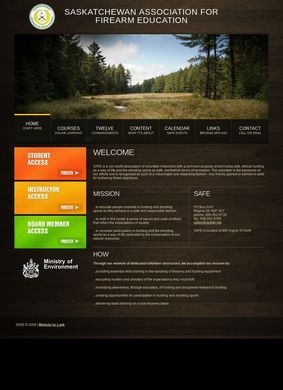
A new hunter in Saskatchewan needs firearm training before they can legally head into the field, and for most people in the province that path runs through S.A.F.E., the Saskatchewan Association for Firearm Education. It is a provincial non-profit staffed by volunteer instructors who deliver the Hunter Education course, and the website reflects that mandate without much padding: safe handling, ethical hunting practice, and the certification the law requires. The people behind S.A.F.E. are clearly hunters and shooters first; the web presence is a working tool, nothing more.
Hunter Education course structure
The Hunter Education course is the core offering, and the Course Information section walks through what the training covers and points prospective students toward instructors who run sessions across the province. There is some useful history buried in there too. S.A.F.E. used to run a separate firearms safety course but stopped doing that directly in 2003. What happens now is that many certified instructors fold the firearms safety material into their Hunter Education sessions for an added fee. The site spells this out plainly, which is worth noting because the two certifications get confused regularly and a beginner could easily arrive expecting one and receive the other. That transparency about a structural quirk says something about how the organization handles its audience.
Instructor Portal access
Beyond the public course pages, an Instructor Portal sits behind a password-protected login. The front-facing side serves students and prospective hunters; registered instructors get a gated area, presumably for scheduling, materials, and the administrative work that volunteers running courses across a large province need to coordinate. A Links page collects resources for hunters and shooters too. Provincial regulations, wildlife rules, and related shooting-sport material change often enough that pointing people to authoritative sources is more practical than trying to reproduce it all in-house.
Five volunteer zones
The regional structure is where S.A.F.E. gets genuinely useful. The organization is split into volunteer zones across Saskatchewan, Zones 1 through 5, covering Meadow Lake, Battleford, Wilkie, Swift Current, and Prince Albert. Each zone has a named coordinator and a direct phone number.
Contact methods across Saskatchewan
Someone in the Swift Current area who wants a course nearby contacts a person in their part of the province rather than a head office inbox. For a volunteer network spread across a large and sparsely populated region, that model is the right one. S.A.F.E. lists a mailing address in Regina, a street address on 9th Avenue North, a main phone line, a fax number, and email routes through both the general manager and a SaskTel address, alongside those per-zone contacts. For an organization run largely by volunteers, that level of openness is more than many full-time outfits manage.
Storage and handling guidelines
The website also carries a brief section on firearm storage and handling guidelines, consistent with the emphasis S.A.F.E. places on responsible ownership beyond the classroom. Course candidates are expected to read this material before attending, and the instructors who run sessions across the five zones reinforce those principles in person. It is a practical arrangement for a province where hunting seasons draw tens of thousands of participants annually and many of them are new to firearms entirely. The organization has been delivering this certification since long before online registration was standard, and the current site reflects that institutional continuity. Instructors must meet S.A.F.E. accreditation requirements and renew their standing periodically, which keeps the teaching pool accountable to a consistent standard across all five zones.
Public feedback availability
On independent opinion, there is not a great deal available. The S.A.F.E. Facebook page has gathered around 869 followers, enough to suggest a real community of hunters paying attention, but the page carries no star rating and no posted reviews. Searches across Google, Trustpilot, Yelp, and the BBB turn up nothing notable in either direction. For a provincial education non-profit, that absence does not mean much. Bodies like this build their standing through word of mouth in hunting circles and through the instructors who teach the courses, not through star counts on review platforms. Anyone who likes to see independent feedback before getting started should know going in that the public record is essentially empty.
What S.A.F.E. offers is a focused, credible operation that knows exactly who it exists to serve. The site will not win design awards, and a first-time visitor might wish the course-registration path were spelled out in one or two fewer clicks. The substance is there, though. Find your zone on the Contact page, reach the coordinator nearest you, and ask which instructor is running a course this season and whether the firearms safety portion is included. That is the whole process, and S.A.F.E. makes it possible to start it in a single phone call.