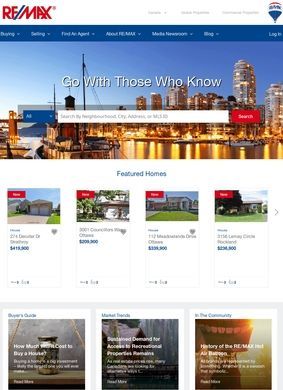
Open remax.ca and the property search sits right there on the homepage, filterable by city and region, and that search bar is the thing the whole site is built around. Type in a place, and you get homes for sale, homes to rent, and a route toward the local agent who has the keys. RE/MAX Canada runs this as the national front door to a franchise network that most Canadians already recognize from the red, white and blue balloon and the yard signs. The banner line it puts on itself, "Canada's #1 Real Estate," sets a high bar, and the site is clearly structured to try to back that up with volume and reach.
Property search and agent matching
What the platform does well is match the two things a house hunter actually needs at the same moment: inventory and a person. The listing search covers residential properties across the country, and threaded through it are the office and agent locator tools, so a buyer in one province and a seller in another both land on someone local. That local someone is a real distinction worth understanding. The brokerages under RE/MAX Canada are independently owned and operated, which means the office you walk into is a separate business trading under the RE/MAX name, not a branch staffed by head office. The national site is the connective layer that points you to them.
How independent brokerages operate
Beyond the core search, the site is set up to carry the wider set of resources a real estate portal is expected to hold. There are separate paths for buying, selling and renting, each meant to guide a different kind of visitor. The corporate structure of a RE/MAX Canada national site usually extends into market reports and blog content, mortgage and affordability calculators, and a recruitment track aimed at agents thinking about joining the brand or opening a franchise. That last audience is easy to overlook, but franchise and agent recruitment is a real part of how a network like this grows, and the site serves it alongside consumers.
Resources for buyers, sellers, renters
This is where honesty about the review matters. The top layer of the RE/MAX Canada site is easy to describe: a search engine over Canadian listings, an agent finder, and clearly signposted buy, sell and rent sections. The deeper content, the market data, the affordability tools, the volume and freshness of the underlying listings, could not be fully checked in this pass, because the fetch returned limited page detail. So the picture of the shallow end is confident, and the picture of the deep end is inferred from how RE/MAX corporate sites are normally built.
Limits of what could be verified
That gap is worth naming rather than papering over. A real estate portal lives or dies on the quality of what sits behind the search box. If the listing database is broad, current and well tied to the individual brokerages, RE/MAX Canada earns the traffic its brand pulls in. If the market reports are stale or the calculators barely function, the homepage promise loses ground with every click. The tools are almost certainly present in some form, given the standard template, but present and genuinely useful are two different things, and only the first can be confirmed here. A separate search for outside commentary on RE/MAX Canada as a corporate site, rather than reviews of individual local offices, turned up nothing substantial enough to cite.
Trade-offs of the franchise model
The independence of the offices cuts both ways for a visitor trying to judge the whole thing. On the upside, it means local expertise and someone who knows a specific neighbourhood market. On the downside, it means the experience after the click can vary from office to office and agent to agent, in a way the polished national site does not, and cannot, standardize. RE/MAX Canada controls the shop window. It does not control every conversation that happens once a buyer is handed off to an independently run brokerage, and that handoff is the moment where the brand promise gets tested in practice.
Where the platform delivers most value
The practical value depends on which side of a deal someone is on. A buyer shopping anywhere in Canada has good reason to start here, cross-reference listings, and find a nearby agent working under a name with decades of market presence behind it. A seller gets less out of browsing the site directly and more out of the reach of the network, the sheer volume of eyes the brand attracts once a listing goes live under it. A renter is closer to an afterthought: the site works fine if a RE/MAX-listed property happens to be the right fit, but nobody chooses it over a dedicated rental platform as a first stop. The search is plainly weighted toward the sale side of the market, and it shows.
Behind the commercial engine
There is also the matter of what a national franchise portal is really selling to the person browsing it. Partly it is the listings. Partly it is the funnel that routes a warm buyer or seller toward a specific agent, which is the commercial engine underneath the whole thing. None of that is hidden or dishonest, it is simply worth seeing clearly: the recruitment and agent-connection machinery is not a side feature, it is close to the point of the site, sitting right alongside the consumer search that draws people in.
Testing the brand promise in practice
Taken together, RE/MAX Canada presents as exactly what its brand would lead you to expect, a competent national gateway to a large agent network with a functional property search and clear routes for buyers, sellers and renters. The offering is coherent and the structure is sensible. What stays open is whether the parts that could not be verified here, the depth and freshness of the listing inventory, the substance of the market tools, and the consistency of the independently run offices behind the polished front, actually deliver on the "#1" claim once a real search turns into a real transaction. That question does not get answered from the homepage, and it is the one that decides whether the site is a strong tool or just a strong logo.