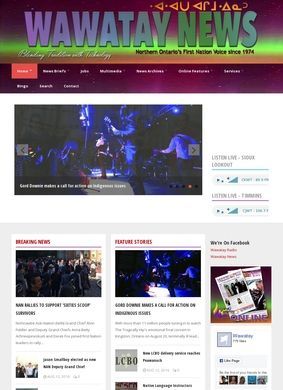
Four languages run through this newspaper, and that is the fact that pins it down before anything else does. Wawatay News Online publishes in English, Ojibway, Oji-Cree, and Cree, and by its own account it is the only paper in Canada doing all four. That is a real distinction, and it shapes who Wawatay News Online is for: First Nations communities across the Nishnawbe Aski Nation territory in Northern Ontario, a region where mainstream coverage is sparse and where language holds a depth that goes well beyond the practical.
News categories across politics, health, education, sports
The operator is Wawatay Communications Society, and the output of Wawatay News Online reads like a full regional newsroom rather than a bare community bulletin. News is sorted into politics, health, education, culture, environment, sports, arts and entertainment, business, and technology.
So the range covers both the civic and the everyday. Someone following a band council decision or a health advisory has somewhere to go, and so does a reader who wants the local sports result or an arts feature. The categories are conventional, which counts as praise here: they suggest editorial discipline rather than a grab bag of whatever happened to be filed. A reader landing on the front of Wawatay News Online for the first time will find the navigation legible and the priorities obvious, which is not always true of small outlets that try to cram everything above the fold.
Four languages as the foundation
Language is the spine of all of this, and it is worth dwelling on what publishing in four languages actually demands. English is the default for most of the web, but Ojibway, Oji-Cree, and Cree are not interchangeable, and producing original or translated material across them means real translators, real editorial judgement, and a sustained relationship with the communities whose words these are. That Wawatay News Online keeps this going, year after year, is the clearest evidence that the platform is more than a clipping service. It is doing the slow work of keeping languages present in print and online, where younger readers in particular spend their time.
Audio, video, podcasts, live radio streams
Where Wawatay News Online gets more interesting is the multimedia. There is audio, there are photo galleries, video features, and podcasts, with titles like "Boozhoo to You" and "Fire Within Us." Podcasting is not cheap to sustain, and a small outlet keeping a couple of named shows going says something about the commitment of Wawatay News Online to the format. On top of that, the site carries live radio streaming for two stations, CKWT 89.9 FM out of Sioux Lookout and CJWT 106.7 FM out of Timmins. For listeners spread across remote communities, having the broadcast feed sit alongside the written news is genuinely useful, and it ties the print, web, and over-the-air sides of the organisation into one place.
Community classifieds, obituaries, job listings
Then there is the community layer, which is where you can tell the platform actually serves the people it claims to. Birth announcements and obituaries sit next to letters to the editor, classified ads, job listings, and discussion forums. These are not glamorous features and they will never win an award, but they are exactly the things that make a regional paper part of daily life. A classified board and a job listing section mean people are using Wawatay News Online to transact and to find work, as well as to read. Obituaries and birth announcements, in particular, are the quiet record-keeping that a community paper has always done, and their presence here is a good sign that the audience treats the site as theirs.
Translation services and freelancer guidelines
The business side is laid out plainly too. There is online and print advertising, translation services, education resource links, and a freelancers guide. The translation offering is worth pausing on, because it follows directly from the four-language mandate: an organisation that already works across Ojibway, Oji-Cree, and Cree is well placed to sell that capability, and it is rare. The freelancers guide shows that the newsroom wants outside contributors and has bothered to document how to pitch, which is more than many small outlets manage. Subscriptions to Wawatay News Online open up full access, so some of the content sits behind a paywall, which is a reasonable model for a publication that has to fund original reporting in a costly part of the country.
On reaching the organisation, the picture is straightforward. A physical address is given at 16 Fifth Avenue in Sioux Lookout, Ontario, there is a contact page on the site, and an About Us page fills in the background. A phone number is publicly listed through the organisation's Facebook presence. Nothing about reaching Wawatay News Online is buried or evasive, and for a news outlet that publishes letters to the editor and invites freelance pitches, being easy to reach is part of the job.
Outside reputation is the one area where the evidence runs short. The Facebook page shows a single review that has not been rated, which is to say there is almost nothing to weigh from third parties. That cuts both ways, and probably means little. A regional Indigenous-language newspaper is not the kind of outlet that accumulates star ratings the way a restaurant or a contractor does, and the audience for Wawatay News Online reaches it through radio, print, and word of mouth as much as through a review widget. The absence of ratings reflects the nature of the readership, and the breadth of what the site publishes says more than a review count would.
What does give me some pause is the same thing that makes the site ambitious. Maintaining four languages, two radio streams, multiple podcasts, a forum, classifieds, and a full news desk is a heavy load for a community organisation, and a visitor should set expectations accordingly: some sections may update more often than others, and the polish will not match a national outlet with a national budget. That is not a flaw so much as the reality of regional journalism done at this scale, and it is fair to name it.
For anyone connected to Nishnawbe Aski Nation communities, or with an interest in northern Ontario affairs, Indigenous-language media, or the region's politics and culture, Wawatay News Online is worth bookmarking. It does something no one else does, it does a lot of it, and it makes itself easy to find and to contact. The four-language reporting alone gives it a reason to exist that no competitor can copy, and the community sections show people are using Wawatay News Online the way a hometown paper is meant to be used.
Set against a national service like CBC Indigenous, the trade-off is clear enough. CBC brings far more resources, a polished interface, and a country-wide lens, and a reader who wants broad national Indigenous coverage will get more there. What CBC cannot offer is news written in Ojibway, Oji-Cree, and Cree for the specific communities of Nishnawbe Aski Nation, the local obituaries and classifieds, or the two FM streams that tie the coverage to place. For a reader inside that territory Wawatay News Online is the one to keep open, and CBC is the supplement, not the substitute.