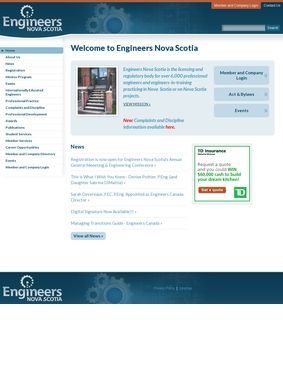
More than 9,000 professional engineers and engineers-in-training hold their right to practise in Nova Scotia through a single organisation, and Engineers Nova Scotia is that organisation. It is the provincial regulator, operating under the Engineering Profession Act, and its authority is the reason an engineer's stamp on a drawing has legal force in the province and on Nova Scotia projects handled from elsewhere.
That role is narrower and more consequential than a professional club. Engineers Nova Scotia decides who is qualified to call themselves a professional engineer here, processes applications, administers the examinations that gate entry to the profession, and keeps the register current. Grant a licence and a person can practise. Withhold it and they cannot.
Most people outside the field never think about Engineers Nova Scotia until a bridge, a building, or a municipal water system depends on the judgement it certifies.
From application to licence, and what follows
The site is arranged around the working life of an engineer, from a first application through the ongoing obligations of a licensed career. Registration and application processing sit at the front. Running behind them are continuing professional development requirements, a mentor program that pairs newer engineers with experienced ones, and student services aimed at people still deciding whether the profession suits them. Engineers Nova Scotia also administers awards and recognition programs and consults its members when the rules that govern them are up for change.
A member directory and company resources, maintained by Engineers Nova Scotia, let the public and other engineers confirm who is licensed. That verification is one of the quietly important things a regulator provides, and it is worth knowing the register is there.
Two threads run through the offering and are easy to miss. One is upkeep: continuing professional development is a standing requirement, not a one-time hurdle, so a licence is something an engineer keeps earning across a career. The other is participation. Engineers Nova Scotia runs member engagement and consultation, which means the people it regulates have a say in how the regulation evolves. For a self-governing profession that feedback loop is the point, and it is built into how the organisation operates.
The myEngNS portal and getting registered
Applications and much of the administrative work run through myEngNS, the Engineers Nova Scotia online portal. For an applicant, that is where a file is opened, documents are submitted, and the status of a licence or an engineer-in-training registration is tracked. The split between open information and the member portal is sensible, and I came away thinking it was done with the applicant in mind: general resources stay public, while the transactional work sits behind a login where it belongs.
For an engineer moving to the province with a credential earned somewhere else, this is the practical starting point, and the examination and registration pathways are the part of the site to read before anything else. The portal also carries an applicant through the stages that follow submission, so the process does not go quiet once the paperwork is in, and the same login later handles the routine renewals a working engineer has to keep up.
Complaints, discipline and the Code of Ethics
The harder edge of regulation lives here. Engineers Nova Scotia publishes its Act and Bylaws alongside a Code of Ethics, and it handles complaints and disciplinary proceedings against members who fall short of those standards. This is what separates a licensing body from a trade association: Engineers Nova Scotia can investigate, and it can sanction. Anyone with a concern about the conduct of a Nova Scotia engineer can find the complaint route from these pages, and the published Code sets the benchmark such concerns are measured against.
The discipline function gives the licence its real weight, because a credential that could never be lost would mean very little.
Beyond those core functions, Engineers Nova Scotia posts regular news and events and lists career opportunities, so a member who visits for a routine reason often finds something else worth reading. Awards and recognition programs sit alongside the student services, so the newest entrants to the profession share space with people honoured for long careers in it. The breadth suits what a professional regulator has to do rather than looking padded for its own sake.
Anyone doing business with an engineering firm in the province has a reason to consult this resource at least once. A homeowner commissioning a structural report, a municipality tendering a project, a company hiring for a role that requires a professional stamp: each can confirm a credential through the same register, and each can read the Code of Ethics to see what standard the professional is held to. The value lies in one authoritative source for questions that would otherwise get guessed at.
An engineer trained elsewhere and now taking on Nova Scotia work should start with a myEngNS application and read the registration requirements before stamping anything, since practising without a licence is the line the Engineering Profession Act draws. Students weighing the field will get more out of the student services and the mentor program than out of the regulatory sections built for practising engineers. The member directory answers a narrower but common question: whether the person who signed off on a given project actually holds the licence to do it.