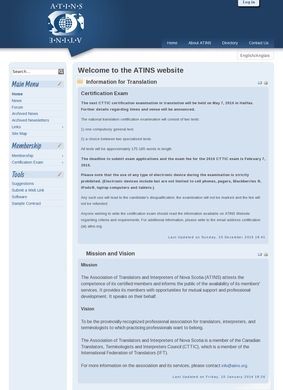
Certification by ATINS comes with a physical stamp, the kind a translator presses onto a document to declare it the work of a vetted professional. That detail tells you what kind of body this is. ATINS, the Atlantic Translators and Interpreters Nova Scotia, is the provincial professional association for translators, interpreters, and terminologists working in Nova Scotia. It runs the machinery you would expect of one: an examination that gates entry, a code of conduct that governs members, and a formal route for the public to complain when standards slip. The association is affiliated with the Canadian Translators, Terminologists and Interpreters Council, which places its certification inside a national framework rather than leaving it as a local badge with only local meaning.
Finding certified translators through the member directory
Two roles sit at the center of what the association does. One is attestation: confirming that a given member has met the bar to translate or interpret competently. The other is connecting the public with qualified language professionals available to hire across Nova Scotia and the wider Atlantic Canada region. Most outside visitors will come to ATINS for the searchable member directory. Someone who needs a certified translator for a legal filing, an immigration document, or a court appearance can look up a name and confirm the person holds the credential, instead of taking a vendor's word for it. That is a narrow function, but it is the one that counts most when a mistranslation can carry real consequences for a case or a contract.
Behind the ATINS directory sits the certification examination, the mechanism that decides who gets listed in the first place. ATINS issues certification stamps to members who pass, and those stamps travel with the documents they certify. The site lays out multiple membership categories, each with distinct benefits, which is the normal shape of a professional body where a student or associate stands at a different rung than a fully certified practitioner. For a working translator in the province, the path is legible: qualify, get examined, get certified, get listed.
Certification exam determines directory listing
The public-facing side and the member-facing side share the same spine. A person hiring trusts the directory because the examination behind it has substance; a translator joins because the credential holds precisely because the public trusts it. The association holds both ends of that loop, and the resources on the site reflect it. The terminologists in the ATINS name are worth noting here, since that discipline is often folded silently into translation work elsewhere. The site names it as a distinct category of professional it serves, which is an honest acknowledgment of what language work in a bilingual country actually involves.
The site is also available in both French and English, which is the correct posture for a body operating under a bilingual mandate and not simply a cosmetic addition. A bilingual code of ethics is the document a member is held to and a member of the public can cite, so publishing it in both languages is a practical commitment.
Bilingual code of ethics and website
ATINS participates in a national certification scheme through its CTTIC affiliation, meaning the credential issued here connects to a broader professional register. Practitioners who move between provinces or work with federal institutions where CTTIC certification is recognized benefit directly from that affiliation. The examination standards are also not set entirely in isolation. The association draws on that national framework while administering certification and governance locally.
Connecting local certification to national standards
What gives ATINS its standing is the governance scaffolding, not the size of its listing. The Code of Ethics and the Bylaws are published in both official languages. A complaint procedure is the piece that separates a genuine professional association from a list of self-described experts. A formal route to raise a grievance against a member, with ATINS positioned to act on it, is what makes the certification stamp mean something beyond a printout. The association also has an elected Board of Directors serving two-year terms and an Annual General Meeting held in the late-April-to-early-May window, so it answers to its membership on a fixed cycle.
Committees run by working members
Members are invited to sit on committees, which keeps the running of ATINS in the hands of the practitioners it certifies, not an outside secretariat. The people held to the standard help set and maintain it. That is a structural choice with real consequences: practitioner-led governance tends to keep the credential grounded in what the work actually demands, and it gives members a direct stake in protecting the association's reputation.
The breadth of the ATINS site is deliberately modest, and that is appropriate. The association does not try to be a content hub or a training marketplace. It does the few things a certifying body should do and publishes the documents that let an outsider check its work. The practical value for the public is specific: it answers the question of whether a given translator or interpreter in Nova Scotia is certified, and it provides somewhere to turn if that professional falls short. For practitioners, it offers a recognized credential tied to a national council, a defined path to earn it, and a voice in how the body is run.
Checking published governance documents
For anyone who lands on ATINS while looking up a translator's credentials, the site does what you need it to do. The bylaws, ethics code, and complaint procedure are published and checkable. Its claims rest on documents, not self-description. Within its scope, the association does exactly what it should, and the published governance materials mean its authority can be verified rather than simply assumed. Outside Nova Scotia and Atlantic Canada, ATINS has no particular relevance; within that region, and especially for anyone dealing with official documents that require certified translation, it is the definitive place to check credentials.