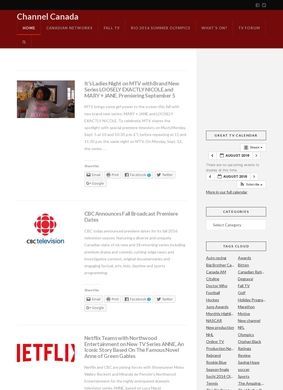
Figuring out what is on Canadian television on any given night is genuinely harder than it should be. Regional feeds, cable tiers, streaming exclusives, and sports rights split across three or four broadcasters mean that the old habit of flipping through a paper guide stopped working a decade ago. Channel Canada exists specifically to address that problem, and the "What's On?" section is as clear a statement of purpose as a homepage can have: it tells a Canadian viewer when and where a given show airs, across a wide range of networks that most listing sites ignore or bundle together without distinction.
Broadcast and specialty channel listings
The broadcast coverage on Channel Canada runs across CBC, CTV, Citytv, and Global, which are the obvious anchors. What makes the site more useful than a basic grid is the specialty-channel depth: CTV Comedy, CTV Drama, CTV Sci-Fi, Discovery Canada, Food Network Canada, HGTV Canada, History Canada, and Super Channel all get coverage. Specialty channels are where scheduling confusion is worst, and the coverage here reflects that. A show can quietly move from a main network to a specialty channel mid-season and a viewer relying on a generic guide will simply lose it.
Streaming services including FAST channels
Channel Canada extends the same thoroughness to streaming. BritBox, CBC Gem, Crave, Netflix, and Pluto TV are all catalogued, and the site goes further by listing FAST channels, the free ad-supported streaming options that have multiplied in the last couple of years and that almost no traditional guide bothers to track. FAST listings are scattered and rarely indexed anywhere a casual viewer would look first, so pulling them onto the same page as Netflix and Crave is a practical editorial choice rather than a cosmetic one.
Sports schedules across multiple leagues
Sports coverage on Channel Canada is handled with real specificity. Broadcast schedules cover the CFL, MLB, NBA, NFL, and NHL, spread across Sportsnet, TSN, and DAZN. The DAZN inclusion is important: streaming-only sports rights have made the old cable-guide habit unreliable, and Channel Canada naming the rights-holder per league saves the kind of frantic pre-game searching that has become a standard part of watching sport in Canada. This section solves a concrete problem.
News coverage and editorial content
Beyond scheduling, the editorial scope of Channel Canada is more substantial than a first glance suggests. The site runs news articles covering series cancellations, renewals, and premiere announcements. Viewership reports and ratings analysis sit alongside that, giving context for why a show survived or was axed. There are also weekly streaming overviews, top-ten ranking lists, a Fall Preview section, and a TV Series Listings directory organized by network. That is a fuller publication than a bare schedule grid. The network-by-network series directory in particular is a sensible piece of organization: when you know the channel but not the timeslot, browsing by network is the natural way in.
What the structure of Channel Canada gets right is that it mirrors how people look for this kind of information. Some arrive knowing the show and needing the platform. Others know the network and want to browse. A few want to see what is premiering this fall or which titles are moving up the ratings. The site accommodates all three without forcing everyone through the same front door, and for content as fragmented as Canadian television that flexibility is worth something real. The ratings and renewal coverage also gives returning visitors a reason to come back between scheduling lookups, which a static guide never provides.
It is worth being clear-eyed about scope. Channel Canada is an information and guide site, not a streaming service or a place to watch anything directly. Its value rises and falls on whether the listings stay current and accurate, and that is the one thing a reviewer cannot fully judge from outside without tracking it across a full season. The promise is comprehensive Canadian coverage; the evidence is in whether a Tuesday-night NHL listing or a mid-season renewal note is still accurate when you check it against what is on. For a site of this kind, freshness is the whole game, and the presence of weekly overviews at least shows an intent to keep things moving rather than letting the data go stale.
On the question of credibility, the picture is mixed but not alarming. A contact link sits in the footer, so there is a route to reach whoever runs Channel Canada, though the homepage itself does not surface a phone number, an address, or any direct line. You have to click through to find contact information, which is a minor friction point more than a red flag. Plenty of independent publications work exactly this way.
The reputation picture is limited. Notable third-party reviews or ratings for Channel Canada did not turn up, and searches mostly returned unrelated entities. That absence is not the same as a bad reputation; niche Canadian media guides rarely accumulate the kind of Trustpilot or Google review trail that a restaurant or retailer does, because their users come, check a schedule, and leave without thinking to rate the experience. Honesty requires saying it plainly: there is no external confirmation here vouching for accuracy, so a first-time visitor is judging Channel Canada on its own contents and consistency. That puts more weight on the quality and currency of what is published.
Set against that caveat is the simple fact that the offering is specific and well-aimed. A site that names individual specialty channels, distinguishes broadcast from cable from streaming, catalogues FAST channels, and breaks out sports by league and rights-holder is not throwing together generic filler. That level of detail takes ongoing effort to maintain, and the categories are chosen by someone who understands the Canadian viewing landscape. Whether the execution stays sharp week to week is an open question, but the editorial ambition behind Channel Canada is real. Bookmark it, check a show or two you already know the schedule for to gauge how current the data is, and use the footer contact link to flag anything that looks stale, since a guide like this only stays useful if its users help keep it honest.