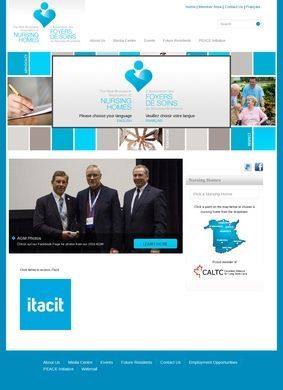
Exactly who speaks for the people who run nursing homes in New Brunswick has a precise answer, and NBANH is it: the provincial employer association covering every one of the 79 licensed nursing homes in the province, the facilities that together house more than 5,300 residents and employ over 8,100 people. The site puts that scope front and centre under the line "Leading Excellence in Long Term Care," and the numbers do most of the talking before any mission statement gets a chance to.
That single fact, that it represents all the licensed homes and not some subset, changes how you read everything else on the site. NBANH sits between long-term care operators and the wider machinery of provincial health policy, and the resources reflect that dual role. Some of what it publishes is plainly for the public. Some is locked to members. The split is sensible once you understand who the organization actually answers to.
Finding nursing homes by region
Start with the part that anyone can use. The Nursing Home Directory is searchable and organized by region, which is the right design for a province where families are often trying to find a placement within reach of where they live. Someone finding NBANH through a business directory listing will land here first, and the geography-first layout turns a stressful search into something you can narrow in a couple of clicks. It does quiet, practical work for people who may never think about who built it.
Employment portal for long-term care jobs
Then there is the employment side, which NBANH has given its own identity: an Employment Portal branded "Nursing Home Jobs NB." Long-term care across Canada runs short on staff, and a province-wide job board pointed straight at member facilities is a practical answer to a real labour problem. Rather than leaving each home to fish in the same small pond alone, the portal pools the openings in one place. For a personal support worker or a nurse weighing where to apply, that is a useful front door.
Research and sector reporting
The publications section is more substantive than the label implies. Association reports, newsletters, and sector research are the documents that show up when journalists, policymakers, or curious families want to understand the state of long-term care in the province, and having them gathered under one roof is genuinely handy. Numbers like the resident and employee counts NBANH cites do not appear from nowhere. They come from exactly this kind of compiled reporting, which is why the publications section is one of the more valuable corners of the whole operation.
Annual meetings and nursing home week
Events fill out the calendar in a way that fits an organization built around a membership. The Annual General Meeting is the formal anchor, the moment the association reports back to the homes it serves. Nursing Home Week is the more outward-facing event, the sort of recognition push that brings some attention to a workforce that mostly goes unnoticed. Both make sense for a body whose job is partly advocacy and partly keeping a scattered sector feeling like one community.
Member resources and partner network
For the members themselves, NBANH keeps a gated Member Area holding resources meant only for the facilities that belong. You cannot see inside it from the outside, and that is fine. An employer association exists to give its members something the general public does not get, so the locked door is a feature of the model working as intended, not a wall thrown up to hide anything.
Alongside the members, NBANH runs a Strategic Partner Network aimed at the corporate side: the suppliers, vendors, and service providers that sell into long-term care. This is the commercial scaffolding most trade associations build, a structured way for partners to reach a sector they would otherwise have to court home by home. It also tells you the association sees itself as a hub, a place where the people who run the homes and the people who supply them can find each other.
Safety coordination with specialists
Safety gets its own thread, and here NBANH points outward instead of trying to do everything in-house. The Safety Resources link through to the NB Continuing Care Safety Association, the body specialized in workplace safety for the continuing care field. Handing that work to the organization built for it, not duplicating it badly internally, is the more honest approach. It shows an association that knows the edges of its own expertise.
Bilingual service for French speakers
There is a bilingual dimension worth noting too. NBANH carries a French identity as well, in keeping with New Brunswick's status as the country's officially bilingual province. That status weighs on a sector where residents and staff alike may be more comfortable in French than English. For a provincial body, serving both linguistic communities is not a nicety. It is part of the job.
On the question of third-party ratings: consumer review platforms do not really cover provincial employer associations, and none turned up for NBANH on the usual sources. That is normal for this type of body. The credibility here rests on the official record: the 79-home membership count, the published research, and the standing the organization holds in provincial health policy circles.
Put the pieces together and the picture is coherent. A directory for families, a job board for workers, research for anyone studying the field, a member area and partner network for the industry, events to hold it together, and safety handled by the right specialists. NBANH is not trying to be a flashy destination. It is the connective tissue of long-term care in one province, and it reads exactly like an organization that has been doing that work for a while and knows what its various audiences come looking for.
The honest measure of a body like this is not how the homepage looks but whether each visitor finds the one thing they came for: a family the nearest home, a job seeker an opening, a researcher a report, an operator the members-only tools. The navigation is built around those distinct needs rather than around the association talking about itself, and the published scope is specific enough that NBANH does not need to oversell. What it does is documented; what it covers is verifiable. That is about as solid a footing as a provincial association can offer.