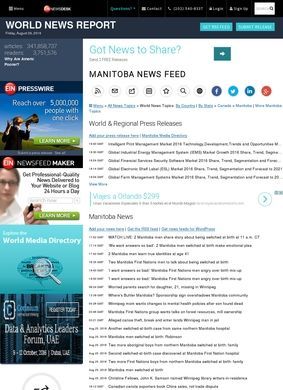
Where does a page like this fit for someone tracking what is happening across Manitoba? Manitoba News is a regional feed run by EIN Presswire, part of the World News Network, and it collects press releases and news items tagged to the province in one scrolling stream. That single fact shapes everything about how to read it. This is aggregation, not a newsroom, and the difference matters once you understand where the material comes from.
What the feed pulls together
The page gathers syndicated items keyed to the Manitoba region: local government notices, business announcements, political stories, and community items that arrive through press-release distribution. Because the parent operation, EIN Presswire, is a paid distribution platform, most of what lands on Manitoba News has been submitted by someone with a reason to publish it rather than assigned by an editor chasing a story.
That is worth sitting with for a second. A company launching a product, a nonprofit announcing an event, an agency posting a statement: these are the typical sources feeding a page like Manitoba News. The result is broad topical coverage with an uneven center of gravity, since the mix reflects whoever paid to distribute that week. One month it might lean heavy on corporate announcements, the next on advocacy campaigns, with no editor smoothing that out.
I tried to open the page directly and hit a bot-check wall, which tells you something about how the site is built more than how it reads. It is engineered for scale and syndication, pushing items out to Google News, journalists, and industry sites, with the province feed acting as one regional slice of that larger machinery. Manitoba News, in other words, is a view into a much bigger distribution pipeline rather than a destination built for local readers first.
Syndication over original reporting
The honest framing is that Manitoba News works as a distribution endpoint. Items here are meant to travel outward to other outlets and search results, and the province feed is a byproduct of that flow. Someone expecting staff reporters, bylined local journalism, or an editorial desk weighing what matters to Winnipeg or Brandon will not find it in this format.
None of that makes the feed useless. For catching official statements and organizational announcements as they are pushed out, a tagged regional stream can surface things quickly, sometimes before they reach wider coverage. The value depends entirely on what you came for, and being clear-eyed about the source is half the battle. Think of it as a wire service without the wire-service editing layered on top: the timing can be genuinely useful, but the framing is whatever the sender wanted it to be, and a reader has to supply the skepticism the feed does not.
Reading it with clear eyes on credibility
Because the content is submitted through a paid channel, the usual instinct to treat every headline as vetted news does not apply cleanly to Manitoba News. A press release is a primary source with a point of view. The page passes those through largely intact, so the burden of judgment sits with the reader more than it would on an edited site.
The reputation signals that exist attach to the parent service, not to this province page. EIN Presswire carries around 160 reviews on Trustpilot, and G2 lists product feedback with a mix of pros and cons from people who have paid to distribute through it. Comparison writeups on sites like Prezly and NewswireJet, plus discussion on Slashdot, tend to circle the same questions of pricing and value for money. No rating or commentary specific to the Manitoba subpage turned up in any of it.
So the credibility read is split. The distribution business behind Manitoba News has a visible, mixed track record that anyone can look into before trusting the pipe. The province feed itself carries no independent reviews of its own, apart from whatever attaches to the parent, and that gap is ordinary for a regional slice of a larger platform, worth naming plainly all the same. The practical takeaway is simple. Trust the mechanism to deliver what was submitted, and judge each item on its own merits once it arrives.
Contact and transparency on the page
The bot-check blocked a direct look at the province page, so I cannot vouch for exactly what contact details sit on Manitoba News itself. The parent company keeps a general contact and testimonials presence on einpresswire.com, which is where the business relationship actually lives.
For a reader, that arrangement is telling. If you want to reach a person about the content, your route runs through the parent platform, not a local desk. There is no sign of a Manitoba-specific editorial contact, which fits the aggregation model but does limit accountability compared with an outlet that answers for its own reporting. Treat this listing as a window into a service, and set your expectations for direct contact accordingly.
Who gets real use out of it
Public relations people, communications staff, and anyone monitoring announcements will get the most out of Manitoba News. If your job is to see press releases tied to the province as they circulate, a single tagged feed is a reasonable place to watch. Researchers hunting for primary-source statements can treat it as a net to catch material that would otherwise be scattered across dozens of individual sites, closer in spirit to a business directory of announcements than to a curated briefing.
A journalist chasing a lead might use it the same way, spotting the raw announcement early and then doing the verification work that the feed itself does not attempt. In that hands-on role, the tagged stream saves time even though it hands you no finished conclusions.
General readers wanting to understand the province, its politics, or its daily life are a poorer fit. The stream will give you announcements, not analysis, and the signal-to-noise ratio depends on submission volume you cannot control. Approached as raw input to verify elsewhere, Manitoba News holds up. Approached as a finished news product, it falls short, and pretending otherwise would do a reader no favors.
Set against the CBC Manitoba regional page, the contrast is sharp and useful for deciding where to spend your attention. CBC runs staff journalists, edited stories, and accountability for what it publishes, which is the opposite of a syndication endpoint. Manitoba News answers a narrower question of what is being pushed out under the province tag, and for that specific job it fits into a monitoring toolkit. On understanding Manitoba as a place, the edited outlet wins outright, and this page works best sitting beside it as a supplementary net, not in place of it.