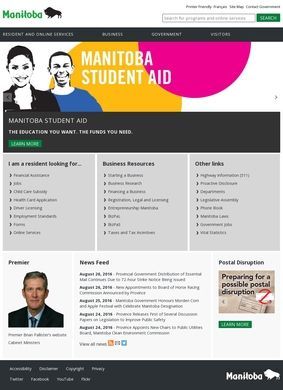
Someone has just moved to Winnipeg, or maybe back to a farm near Brandon, and they need three unrelated things sorted in the same week: a new health card, the right paperwork to register a vehicle, and an answer about whether their kid qualifies for an early learning program. That scattered, slightly anxious to-do list is exactly the use case the Province of Manitoba's official portal at gov.mb.ca is built to absorb. Instead of chasing down a dozen separate offices, a resident lands on one place that routes them by department and by topic, which is the more useful of the two paths since most people know what they need before they know which ministry owns it.
Health, education and early learning services
The health and wellness section is the part most people will hit first. It covers Manitoba Health directly, including health cards and immunization records, the two items that newcomers and parents reach for constantly. Sitting alongside it is education and early learning, which reaches from school divisions through early childhood programs and on to post-secondary funding. That span is genuinely useful because a single household often touches all three stages at once, and the Province of Manitoba keeps them under one roof instead of scattering them across separate sites a family would have to discover on their own.
Finding work, taxes and rural programs
Job seekers get a labour and employment area that goes past listings into workplace safety and labour standards enforcement, so the same section that helps someone find work also tells them what their rights are once they have it. Taxation and finance is handled as its own area, with provincial tax programs, grants, and rebates grouped so a small operator or a household can find the money side without wading through unrelated pages. These are not afterthoughts. The Province of Manitoba has organized them as full working sections with real depth, not placeholder pages that dump you into a phone queue.
Drivers and anyone who moves goods will care about the transportation and infrastructure pages, which cover roads, driver licensing, and vehicle registration, with the registration piece tied through to Manitoba Public Insurance. That linkage is a quiet but sensible decision, since MPI is where the actual transaction lives and pretending otherwise would only frustrate people. Rural Manitobans are not an afterthought either. Agriculture and rural development gets real space, with farm programs, Crown lands, and agri-food initiatives, the kind of content the Province of Manitoba cannot treat as a footnote when most of its geography is farmland.
There is also a clear seam for people whose lives are governed by provincial systems they did not choose to enter. Justice and public safety pulls together courts, corrections, and policing oversight. Family and social services runs from income assistance through child and family services to seniors programs. Putting those next to each other reflects how often they overlap in practice, and the Province of Manitoba does not try to hide the harder corners of provincial responsibility behind cheerier topics. The environment and climate change pages round this out with water stewardship, conservation districts, and climate action, each corresponding to a working function of government rather than filler added to look comprehensive.
Business licensing and economic development tools
Business users get a section worth bookmarking. Licensing and permits are there, along with access to the Manitoba Business Registry, procurement opportunities, and economic development programs. For a founder or an existing company, the registry access alone justifies the visit, and pairing it with procurement and economic development means the Province of Manitoba is addressing both the company that wants to sell to government and the one that wants help growing. The combination keeps a business owner from bouncing between three or four disconnected portals.
Several sections speak to people whose situations the rest of the site only touches indirectly. Immigration is covered, including the Manitoba Provincial Nominee Program, which for many newcomers is the single most consequential page on the entire site. Indigenous relations has its own substantive area, as do housing and municipal relations, the last of which is relevant to anyone trying to understand how their town or rural municipality connects to the provincial level. These are not decorative menu items. They map to real offices and real programs, and their presence tells you the Province of Manitoba is trying to serve the full population it answers to.
Behind the portal's institutional links
One structural strength is easy to undervalue. The portal links out to every provincial department, the Crown corporations, and the legislative bodies, the Legislative Assembly included. For a resident that is convenience. For a journalist, a student, a researcher, or anyone trying to follow how a decision was made, it is something closer to essential. A government site that makes its own institutional map legible is doing more than most, and the Province of Manitoba treats that map as part of the service instead of burying it.
On third-party platforms, the Province of Manitoba's gov.mb.ca does not accumulate the kind of public ratings a commercial service would. A search across Google Maps, Trustpilot, and similar aggregators returns no meaningful review count for the portal itself, which is normal for a government site and not a mark against it. What you can look at instead is how Manitoba compares on citizen-satisfaction surveys: Statistics Canada and the Institute for Citizen-Centred Service have published provincial comparisons over the years, and Manitoba has generally landed near the middle of the pack rather than at either extreme. That context is more useful than a star rating anyway, since it reflects actual transaction volume across real provincial services.
Comparing the portal to other services
If there is a fair caution, it is the one that comes with any portal this broad. Breadth can mean depth varies, and a site spanning health, agriculture, justice, and immigration will inevitably feel thorough in some corners and more like a signpost in others, pointing onward to a Crown corporation or a separate program site. That is the nature of a true government index and it is the right trade. A reader who arrives expecting a single page to resolve a complex file will instead be handed the correct door, which over a whole province is the more honest design.
Weighed against a third-party aggregator like a 211 community-services line, which is genuinely useful for human services and referrals, the Province of Manitoba portal is the better starting point for anything specifically provincial: tax programs, the nominee program, the business registry, licensing, the legislature. The 211 route shines for social-service navigation and crisis referral, and a resident may well end up using both. For the wide band of dealings a person or a company has directly with the Province of Manitoba, the official portal is the authoritative source, and it is organized well enough that most people will find their door on the first try.