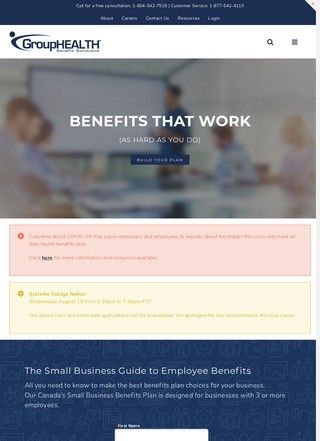
Can a single benefits administrator design plans that work the same way in Surrey, Barrie, and Etobicoke when the provinces underneath those cities do not? GroupHEALTH Benefit Solutions answers by staying Canadian-only and structuring its plans around that fact. Extended health coverage in Ontario stacks onto the provincial base differently than the equivalent coverage in BC, and disability provisions carry province-specific nuances that change both design and cost. A firm without genuine grounding in that patchwork would miss the interactions a plan member feels first, so the deliberately narrow footprint reads as a strength, not a limitation.
Coverage options ordered by employer size
The coverage catalogue is broad: extended health and dental, short- and long-term disability, life insurance, critical illness, and employee wellness programs. Custom plan builds sit alongside standard packages for employers who need something outside the preset options. None of those categories is unusual on its own, and breadth alone proves little. What gives the offering more shape is the order of operations. GroupHEALTH Benefit Solutions opens the conversation with employer size and sector before it discusses any product, which is the right sequence for benefits and a small but real point in its favour.
Four client segments defined by size
The client base is split into four tracks: small businesses of roughly 3 to 15 employees, mid-sized firms from 16 to 250, large organisations above 250, and a separate channel for non-profits. A 400-person technology company and a three-person professional services firm share almost nothing on the benefits side, so dividing them this way is more than cosmetic. It points to plans assembled around the operational reality of a given employer instead of one catalogue every buyer is expected to map themselves onto. The sectors GroupHEALTH Benefit Solutions names reinforce that focus: technology companies, clean energy firms, and professional associations.
Sector fit for clean energy and technology
Those choices are coherent. Employers competing hardest for skilled staff use benefits as a recruiting lever, which fits technology and clean energy. Professional associations sit in a structurally different spot, since they typically extend a plan to their members rather than to employees in the conventional sense, and GroupHEALTH Benefit Solutions calls that distinction out separately. Naming it is accurate and practical, not filler.
Checking the 7,000-client claim
Then there is the headline figure GroupHEALTH Benefit Solutions puts forward: over 7,000 Canadian businesses served. No third party verifies that number on the page, and a self-reported scale claim of that size invites scepticism by default. If it is even close to accurate, though, it speaks to operational capacity. Claims processing, billing, and member support are unglamorous and constant, and a provider needs real volume to fund the systems and staff that keep those functions from producing errors at scale. The claim is plausible; it is simply unaudited.
Delivery model built on dedicated specialists
On delivery, GroupHEALTH Benefit Solutions describes plan consultation and design up front, implementation measured in days, then ongoing claims administration and billing it characterises as transparent. The piece that separates this from a generic pitch is the assignment of dedicated Benefits Specialists to each client. An employee stuck mid-claim who reaches a named specialist already familiar with the account has a meaningfully different experience from one routed into a general queue. The catch is that the entire value of the arrangement lives in execution, and the listing cannot demonstrate execution. A prospective employer should ask, plainly, how many accounts each specialist carries and what happens when that person is out.
Does billing stay truly transparent?
The transparent-billing claim deserves the same scrutiny. Billing disputes are a quiet, recurring failure mode in benefits arrangements; an opaque or inconsistent invoice creates a reconciliation headache for every HR team trying to match cost against budget. Itemised, month-to-month consistent invoicing would remove genuine friction. Whether GroupHEALTH Benefit Solutions delivers on it is a question for references, because no public client commentary either confirms or contradicts the claim.
Reaching claims support by phone
Phone access splits into two numbers, one for general inquiries and one dedicated claims and coverage line, staffed Monday to Friday, 8am to 8pm Eastern. GroupHEALTH Benefit Solutions lists three offices with city-level addresses in Surrey, Barrie, and Etobicoke, and publishes a general email address. Separating the claims line and posting its hours gives a member with a coverage question a direct route instead of a path through a sales function. The contact details are specific and complete, with no guesswork about which number serves which purpose. For a benefits administrator, that everyday accessibility counts.
Employee reviews versus client experience
The third-party ratings tell a narrower story than they first appear to. They are employee-facing: Glassdoor carries roughly 3.3 out of 5 across about 144 reviews, and the Canadian edition of Indeed shows approximately 54 employee reviews. Those describe internal culture and management at GroupHEALTH Benefit Solutions, not the client experience of running a plan through it. Nothing surfaced on Google, Trustpilot, the BBB, or Yelp from employers or plan members. For B2B benefits providers this absence is ordinary; HR teams seldom post public reviews of their administrator. The practical consequence is that an employer here has almost no client-side crowd input and would be judging the firm on its proposal, a reference call, and a sample plan document.
What the published material supports is a clear read on what GroupHEALTH Benefit Solutions is: a specialised, Canadian-specific operation with deliberate segmentation, a full spread of coverage types, a service model organised around account assignment, and contact details that work without effort. What it cannot support is a read on whether the dedicated-specialist model and the transparent-billing claim hold in daily practice, because the people who would know have left no public trace. For an employer in technology, clean energy, or an association, GroupHEALTH Benefit Solutions belongs on a shortlist, with two specific things to confirm by reference: specialist caseload and an actual sample invoice. The website is unusually concrete about structure and unusually quiet about results, and that split is the honest measure of where it stands.