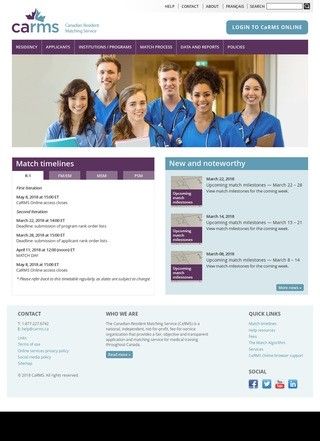
Running the application and matching machinery behind Canadian medical residency and fellowship training is what the Canadian Resident Matching Service does, and it does almost nothing else. It is a national, independent, not-for-profit organization funded by fees from both applicants and training programs, and the site is built around that narrow function with very little ornamentation. The people arriving on the page already know why they are there, and the design reflects that. There is no broad consumer pitch, no soft introduction for the curious, just the infrastructure of a high-stakes annual process.
Four separate match programs
The core offering is four distinct match programs, each kept clearly separated rather than bundled into one undifferentiated portal. The R-1 Main Residency Match is the large one, placing medical graduates into first-year residency positions across every Canadian province each year. The Fall Subspecialty Residency Match, the Spring Subspecialty Residency Match, and the Family Medicine and Enhanced Skills Match cover the rest of the landscape. Knowing which stream applies to you is genuinely important because each runs on its own timeline, and the Canadian Resident Matching Service lays the divisions out plainly. That is more helpful than it might sound when a misread calendar can mean waiting another full year.
R-1 Main Residency Match overview
Applicants log in on one side of the portal, Canadian graduates and international medical graduates alike, and participating postgraduate training programs log in on the other. The match only works if both populations are feeding their rankings and program data into the same system, and that two-sided structure is what the Canadian Resident Matching Service is, operationally. It also coordinates with medical schools and postgraduate offices nationwide, so the public-facing pages represent the visible edge of a much larger administrative effort happening behind the credentials wall.
How the two-sided portal operates
The open part of the site has more substance than a login gate usually permits. Program descriptions, application timelines, and historical statistical reports are all accessible without an account, and those statistics are not background noise in this context. They tell a prospective applicant how competitive a given specialty has been and where positions have consistently gone unfilled. Publishing that record openly is a meaningful step for an organization that controls a process most candidates have no real alternative to.
Public data on program competitiveness
There is also guidance for people pursuing the American training pathway through ERAS, a sensible inclusion given how many Canadian graduates weigh US options against domestic placements. The annual CaRMS Forum runs through the site too, with registration handled there, which points to an organization that sees its role as broader than a matching switchboard. Support comes via a 24/7 self-serve Help Center on Zendesk and the usual presence on Facebook, Instagram, YouTube, and LinkedIn. The pieces are organized around the applicant's actual calendar, which is the right way to do it.
Guidance for US training pathways
What is harder to judge from the outside is whether the public material is current and detailed enough to carry someone through a live cycle. Timelines and program descriptions are only as useful as their last update. The parts of the experience that matter most, the ranking interfaces and the program-by-program data, sit behind the login where no outside reader can inspect them. Because the Canadian Resident Matching Service is effectively the only door to most of these positions, its design choices are a constraint on its users, not a preference they can opt around.
Zendesk Help Center availability
The 24/7 Help Center cuts in two directions. A self-serve knowledge base is genuinely useful at three in the morning during a deadline crunch, and Zendesk is a competent platform for that purpose. The question it raises is what happens when an applicant has a problem the articles do not address, in a process where a missed window or a misunderstood rule can cost an entire year. The public pages give little sense of how readily a real person can be reached when the stakes are that high, and that gap is one an institutional resource of this standing should probably close.
When self-serve support falls short
The Canadian Resident Matching Service occupies a position that is effectively unavoidable for its audience, and that changes how you read both its strengths and its gaps. The clear separation of the four matches, the open statistical record, the ERAS guidance, and the forum all count in its favour. The Canadian Resident Matching Service clearly understands the cycle its users live inside, and the public face is competent at directing people to the right stream without wasting their time.
Can you verify the ranking tools?
On outside reputation, a general search turns up professional commentary and applicant discussions spread across medical school forums, but no aggregated rating platform with a meaningful count. That is unremarkable for an organization whose users are captive professionals rather than consumers choosing between options. The Canadian Resident Matching Service does not need to compete for attention; it is the process.
What remains behind the login wall
The part that would settle a fuller assessment is the part nobody outside the login can test. Whether the ranking tools hold under deadline pressure, whether the timelines stay reliable when a cycle shifts, and whether the Canadian Resident Matching Service can get a stranded applicant to a human answer quickly enough to matter, none of that is readable from the browsable pages. For a system this consequential, that gap in the public record is worth naming plainly. The published evidence is solid as far as it goes; the credential wall is where confidence either builds or does not.