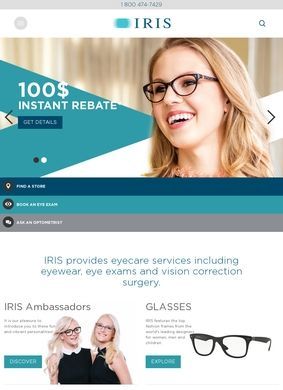
Sitting down with a year-old prescription and a pair of glasses that pinch behind one ear, you want one place to sort the whole thing out. Iris is set up to do exactly that. An eye exam with a licensed optometrist sits at the front of the process, followed by frame selection, lens work, and the fitting that decides whether the new pair sits right on your face. The chain runs across Canada with physical shops you book into online, so the digital side is a front door to a real optometrist's chair, not a mail-order checkout pretending to replace one.
Vision care beyond the eye exam
Iris does not stop at the exam. Contact lens fittings and ongoing supply are part of the offering, and so are consultations for eye surgery, including referrals for procedures such as cataract surgery. That last point is worth noting because it positions the business as a vision care provider first and a frame shop second. A customer who walks in for new reading glasses and leaves with a referral to a surgeon has been served by the same place, which is a genuinely useful breadth for anyone whose eyes are starting to need more than a stronger lens.
Frames spanning designer brands and house lines
The Iris product range is wide without feeling padded. Prescription eyeglasses cover men, women, and children, in different frame shapes and materials, which is the baseline you would expect. The sunglasses side carries names people recognise: Ray-Ban, Tom Ford, Oakley, and Gucci. Alongside those, Iris sells its own collections under the LYA, LYA Kids, Palma, and Apogee labels. The in-house lines deserve a mention because they suggest the company is willing to put its own name on frames instead of only reselling other brands, and the Iris Kids variant tells parents the children's offering is a deliberate line rather than an afterthought.
Testing frames with a virtual tool
The virtual try-on tool uses facial scanning to map frames onto your face, which sounds gimmicky until you have stood in front of a store mirror squinting at glasses you cannot see clearly because you took your old pair off. For people who shop carefully before buying, narrowing the field at home is practical. It does not replace the in-person fit, and Iris does not pretend it does, but it shortens the part of the visit most people find tedious.
Behind the scenes at the optical lab
Behind the Iris retail counter is something most optical chains do not advertise: an in-house optical laboratory in Montreal. Owning the lab means lens grinding and assembly stay under the company's roof, which usually translates into more control over turnaround and quality than a shop that ships every order out to a third party. Paired with an unconditional warranty program on eligible products, the message is that Iris expects to stand behind what leaves the lab. Financing through Affirm rounds out the practical side for buyers spreading the cost of progressive lenses or designer frames, which can run well past an impulse purchase.
Locating and booking a nearby store
The store locator lives on its own subdomain and feeds the appointment booking, so finding the nearest branch and reserving a time is one connected flow. For a chain with locations scattered across several provinces, that keeps the experience from falling apart at the most important step. A customer in Barrie and one in West Vancouver both need the same thing: the right address, the right hours, and a slot that fits their week.
How do you reach customer support?
On reaching a human, the picture is reasonable if not flawless. A contact page exists, and the company's Facebook listing carries a toll-free number and a Quebec email for regional queries. None of this is splashed across the top of the homepage, which is a mild knock, but everything is within a single click. Individual branch details, including addresses, sit inside the locator. A more visible phone number up front would help, yet the route to assistance is short and clearly laid out once you start looking.
Customer ratings across review platforms
Outside opinion is where Iris gets interesting, because it splits by where you look. The brand-level Trustpilot presence has only thirteen reviews and no headline rating worth leaning on. Facebook is warmer, sitting around sixty-eight reviews with roughly four in five recommending the Iris business. The real strength shows at the store level, where Google ratings aggregated by location run high: Calgary near 4.8 from over 180 reviews, Barrie around 4.9 from nearly 200, Chilliwack about 4.7 from roughly 200, and West Vancouver at 4.8 from 77. That pattern, modest national chatter but strong local scores, is common for service chains where the experience is really about your nearest branch and the staff in it.
One number cuts the other way, and it is fair to name it. Glassdoor puts employee sentiment at 3.0 out of 5, a middling mark that hints the people behind the counter are not uniformly thrilled. That does not undo the customer ratings, and a single aggregate score carries plenty of noise, but it is a caution worth holding next to the glossy retail side. Staff morale tends to leak into service over time, so it is the sort of thing a careful reader keeps an eye on rather than dismisses.
Pulling the threads together, Iris reads as a serious, established vision care operation with the infrastructure to back its claims: its own lab, licensed optometrists, a coherent booking and locator system, and a product mix that spans budget-conscious house lines to luxury sunglasses. The Trustpilot count is low and the employee rating is lukewarm, but the strong location-level Google scores suggest the day-to-day work is sound where it counts. Those two signals pull in opposite directions without cancelling each other out, and the honest read is that Iris performs well at the branch level while its national reputation profile is underdeveloped.
Set against a big-box optical counter like LensCrafters, the comparison is less about price and more about depth. Both will sell you brand-name frames and book an exam, but the Montreal lab, the surgery referrals, and the homegrown collections give Iris a slightly more clinical, full-service character, while a mall chain often leans harder on speed and foot traffic. A shopper chasing the lowest sticker on a pair of Ray-Bans might find either works. The Iris proposition is probably the more durable of the two for anyone who wants a steady relationship with an optometrist, lenses made in-house, and a warranty that does not read like fine print.