The Parliament of Canada is the federal legislature, composed of the King, the Senate and the House of Commons. It meets on Parliament Hill in Ottawa, on a limestone bluff above the Ottawa River, where legislators have gathered since 1866, a year before Confederation created the country they now govern. All three elements must agree for a bill to become law.
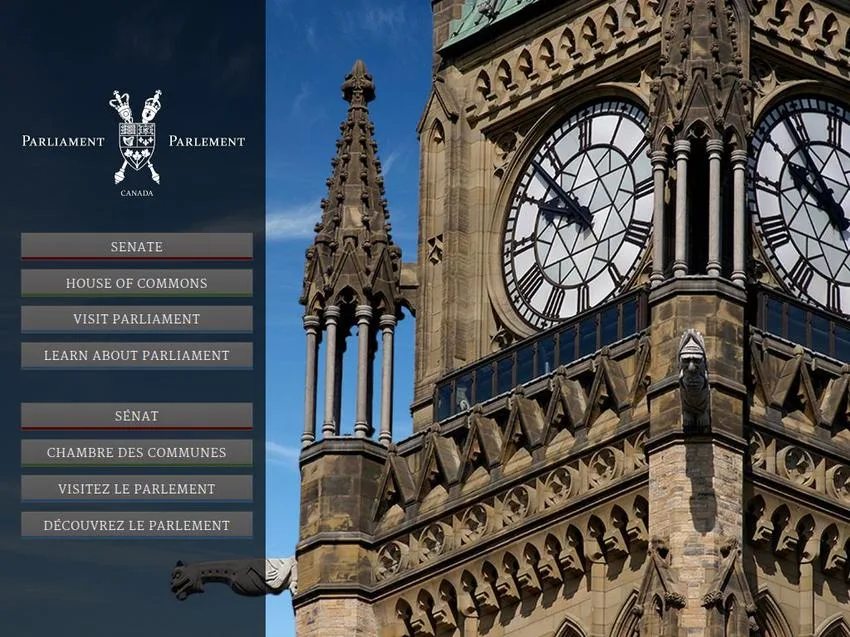
The institution's website joins the two chambers under one address. It links members' pages, bill tracking, committee schedules, live and archived video, the Library of Parliament and visitor services, in English and French.
Two chambers and the Crown
The House of Commons is the elected chamber. Since the 2025 general election it has 343 members, each returned by a single electoral district, and the party able to command its confidence forms the government. Money bills must start there. Daily sittings include question period, when ministers answer for their departments in front of cameras and a public gallery.
The Senate gives legislation a second review. Its 105 members are appointed by the Governor General on the advice of the Prime Minister and may sit until age 75. Seats are distributed by region: 24 each for Ontario, Quebec, the Maritimes and the West, six for Newfoundland and Labrador and one for each of the three territories. Senators amend bills, conduct long studies and represent regional and minority interests that the electoral map can overlook.
The Crown completes the trio. The Governor General summons and dissolves Parliament, opens each session with the Speech from the Throne and grants royal assent, the final step that turns a bill into a statute.
How a bill becomes law
A bill receives three readings in each chamber. Second reading settles the principle, a committee then examines the text clause by clause and hears witnesses, and third reading sends it on. When both houses pass identical wording the bill goes to the Governor General for assent. Government bills carry most of the legislative program, while private members' bills from backbenchers and public bills sponsored by senators move through the same stages with less debating time. Public bill tracking on the site records every stage, vote and amendment along the way.
Committees, officers and the Library
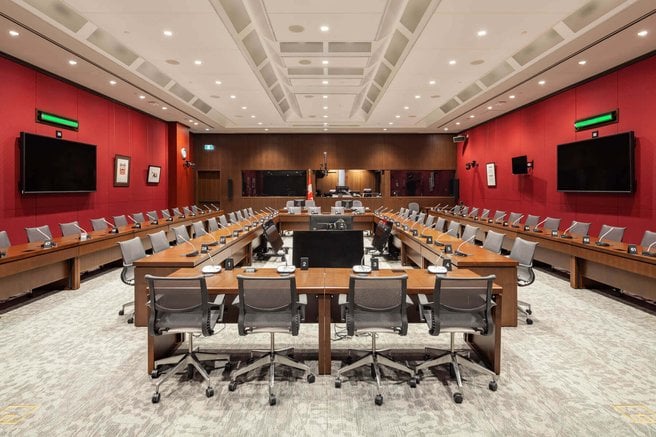
Much of the detailed work happens in standing committees, which review spending estimates, question officials and publish reports the government must answer. Each chamber elects or appoints a Speaker to preside over debate and enforce its rules. Parliament also draws on independent officers, among them the Auditor General and the Parliamentary Budget Officer, whose reports feed its oversight of public money. The Library of Parliament supports all of this with research for members and an information service that answers questions from the public by telephone and email.
Buildings on and around the Hill
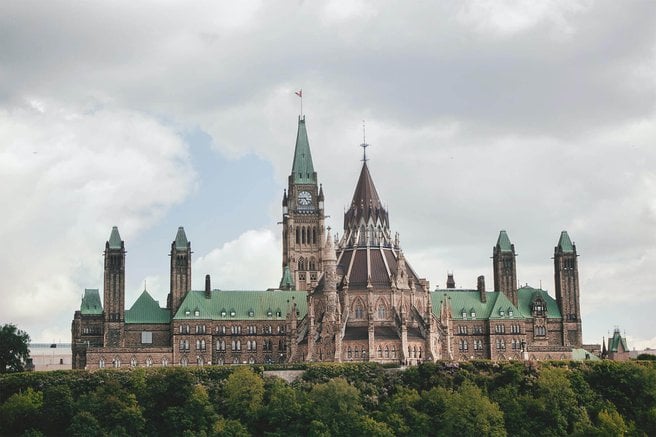
Centre Block, finished in 1927 after fire destroyed its predecessor in 1916, holds the traditional Commons and Senate chambers and the 92 metre Peace Tower with its carillon of 53 bells. The building closed in 2019 for a rehabilitation described as the largest heritage project ever undertaken in Canada, with structural, seismic and mechanical work expected to run into the 2030s. Excavation in front of the facade is adding an underground visitor welcome complex.
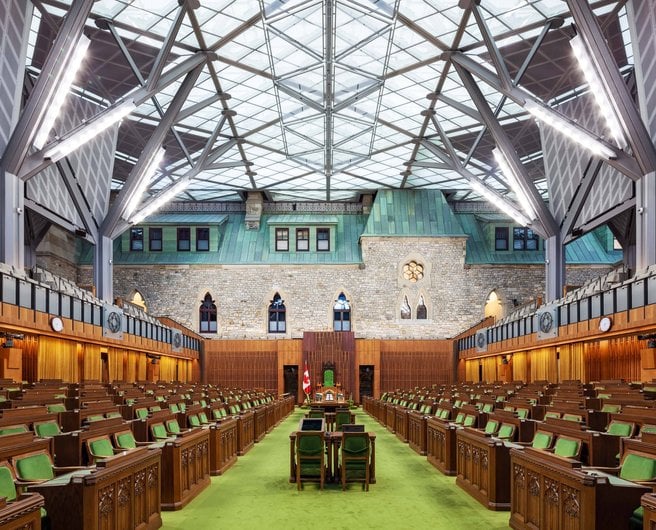
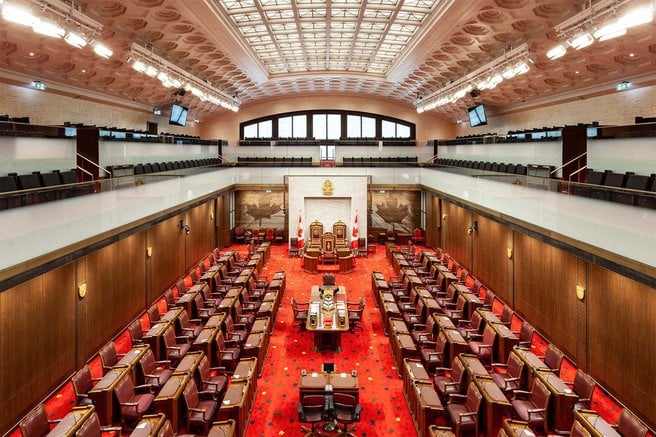
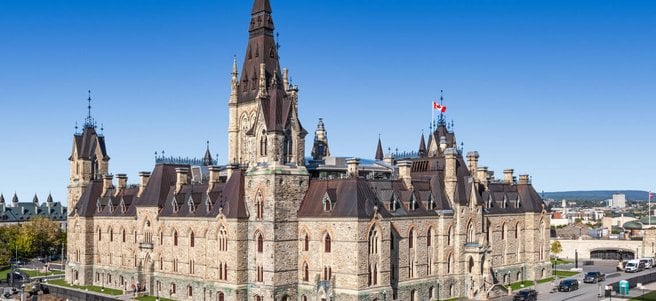
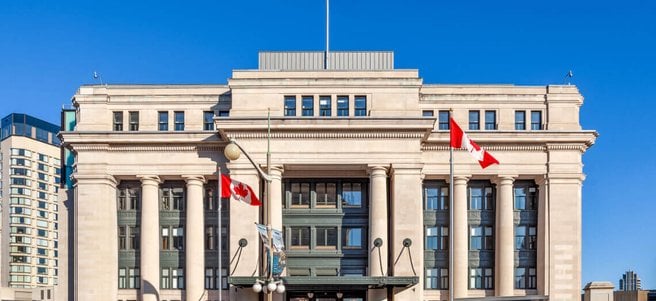
The chambers moved rather than pausing. The House of Commons now sits in a glass roofed courtyard chamber inside West Block, a Gothic Revival building from 1865 at the west end of the Hill. The Senate occupies the Senate of Canada Building at 2 Rideau Street, a beaux arts former railway station opened in 1912. East Block, largely unchanged since 1867, preserves restored offices of the first prime ministers, and the round Library of Parliament of 1876, saved from the 1916 fire by its iron doors, still anchors the north side of Centre Block.
The grounds themselves are open year round. Statues of monarchs, prime ministers and reformers stand across the lawns, and the Centennial Flame, first lit in 1967 to mark one hundred years of Confederation, burns above a fountain at the main gates on Wellington Street.
Visiting and following the work
Guided tours of West Block, the Senate of Canada Building and East Block leave from the Visitor Welcome Centre at 111 Wellington Street, and free same-day tickets are issued when reservations remain open. Debates are public, so visitors can watch question period or a Senate sitting from the galleries after a security screening. The grounds host daily flag ceremonies, summer light shows on the facades and national celebrations on the first of July. The Books of Remembrance, which record the names of Canadians who died in military service, were moved during the rehabilitation to a dedicated room in the visitor complex, where staff turn a page of each book every morning.
Those who cannot attend can still follow proceedings closely. Video of chamber sittings and most committee meetings streams live and stays available in an archive, while the verbatim record of every debate appears in Hansard within hours. Bill status pages, members' voting histories, petitions and committee evidence are all published without charge. School groups and teachers use a separate education program, and the general information line at the Library of Parliament fields questions about history, procedure and current business on weekdays. Everything Parliament publishes, from bills to committee evidence, appears in both English and French, with simultaneous interpretation covering every sitting and hearing.
Business address
Parliament of Canada
111 Wellington Street,
Ottawa,
Ontario
K1A 0A9
Canada
Contact details
Phone: 1-866-599-4999