The Supreme Court of Canada is the country's final court of appeal, the last judicial stop for disputes that begin in provincial, territorial or federal courts. Parliament created it in 1875, only eight years after Confederation, yet for decades litigants could still carry cases across the Atlantic to the Judicial Committee of the Privy Council in London. Criminal appeals to that body ended in 1933 and civil appeals in 1949, the point at which the court became supreme in fact as well as in name.
Nine judges sit on the bench: the Chief Justice of Canada and eight puisne justices. The Supreme Court Act reserves three seats for Quebec, which keeps civil law expertise on a court that otherwise works in the common law tradition, and by custom the remaining seats are spread among Ontario, the West and Atlantic Canada. Judges are appointed by the Governor in Council and must retire at age 75. The Chief Justice also chairs the Canadian Judicial Council and, when the office of Governor General falls vacant, acts as administrator of the federal government, a situation that last arose in 2021.
What the court decides
Most cases arrive only with permission. Several hundred applications for leave to appeal are filed each year, and a panel of three judges selects the small share that raises questions of public importance, usually enough for between forty and seventy hearings annually. Decisions from these appeals bind every other court in the country. A narrower class of criminal cases, mainly those where a provincial appeal court judge dissented on a point of law, comes as of right and needs no leave at all.
The docket runs from constitutional interpretation and Charter of Rights claims to contracts, tax, family disputes and criminal procedure. Because Canada operates two legal systems, common law in nine provinces and civil law in Quebec, the court is bijural, and it is bilingual as well, with parties free to plead in English or French. Attorneys general and public interest organizations frequently intervene in appeals, adding written and oral argument on the wider consequences of a case beyond the parties before the court.
Reference questions
The federal cabinet may also refer legal questions directly to the court for an advisory opinion. References have settled some of the sharpest arguments in Canadian public life, including the 1981 case on patriating the constitution and the 1998 opinion on whether Quebec could secede unilaterally. Provincial governments use the same device through their courts of appeal, whose answers can then be appealed up.
Hearings and judgments
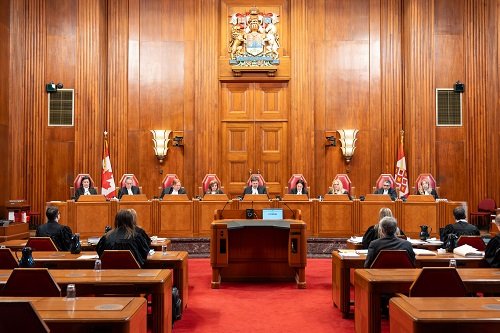
The court holds three sessions a year, in winter, spring and fall. Five judges form a quorum, though most appeals are heard by panels of seven or nine. Counsel argue under strict time limits, and the judges reserve most decisions for written reasons released months later. Hearings are open to the public, webcast live and kept in a video archive. Every judgment appears simultaneously in English and French and is collected in the Canada Supreme Court Reports, with the full text searchable in a free online database. The court has also sat away from home twice in recent years, hearing appeals in Winnipeg in 2019 and in Quebec City in 2022 so that the public outside the capital could watch it work in person.
The building on Wellington Street
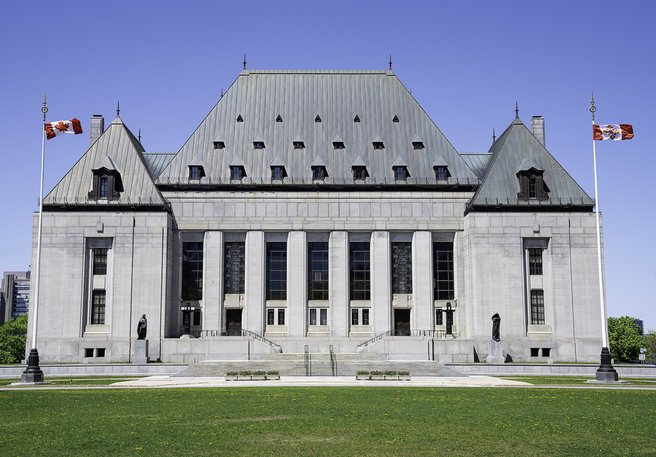
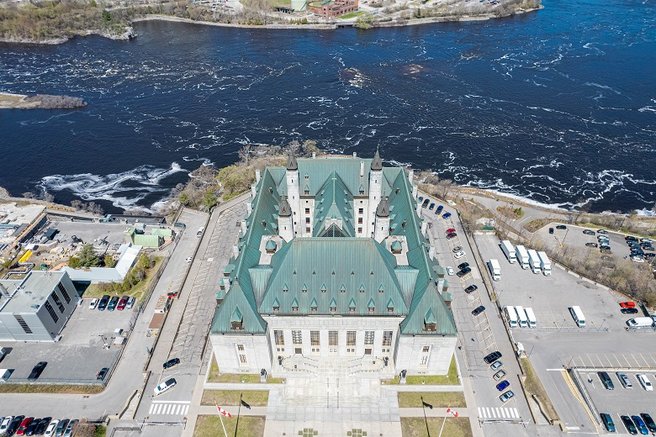
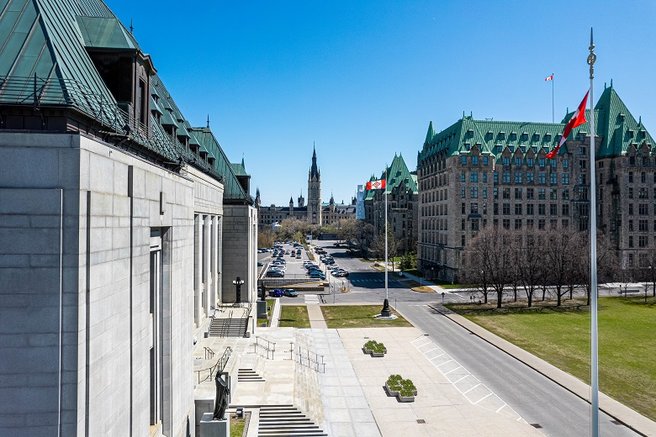
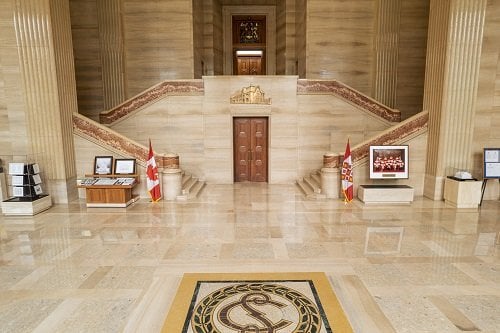
The court sits at 301 Wellington Street, just west of Parliament Hill on a rise above the Ottawa River. Montreal architect Ernest Cormier designed the building in a pared down classical style beneath a steep copper roof, and Queen Elizabeth, consort of King George VI, laid the cornerstone in 1939. Wartime delays meant the judges only moved in during 1946. Two bronze figures by Walter Allward, Veritas and Justitia, flank the entrance stairs, and the grand hall inside rises through two storeys of marble.
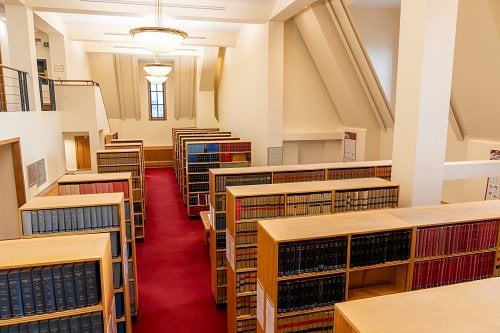
The main courtroom occupies the centre of the building, panelled in walnut. Two smaller courtrooms are used by the Federal Court and the Federal Court of Appeal, which share the premises, and a law library open to counsel and researchers holds one of the larger legal collections in the country. Law students lead free guided tours through the summer months, group tours can be booked the rest of the year, and visitors may watch any hearing from the public benches when the court is in session.
Services on the website
The court's site is built around case information. A docket search reports the status of every application and appeal, hearing lists give dates and panel details, and news releases announce forthcoming judgments a few days before delivery. Plain language summaries called Cases in Brief explain recent decisions for non-lawyers, a practice the court adopted in 2018 to make its work easier to follow.
The registry pages set out filing rules, fees and deadlines for counsel and for people representing themselves, with forms available for download. Statistics published each year track applications filed, appeals heard and average processing times. Separate sections cover the judges' biographies, the court's history and art, visiting arrangements, and contact channels that include a general information line, a registry telephone service and public email addresses. Email subscriptions carry notices of upcoming hearings and scheduled judgments to lawyers, journalists and anyone else who signs up.
Business address
Supreme Court of Canada
301 Wellington Street,
Ottawa,
Ontario
K1A 0J1
Canada
Contact details
Phone: 1-888-551-1185