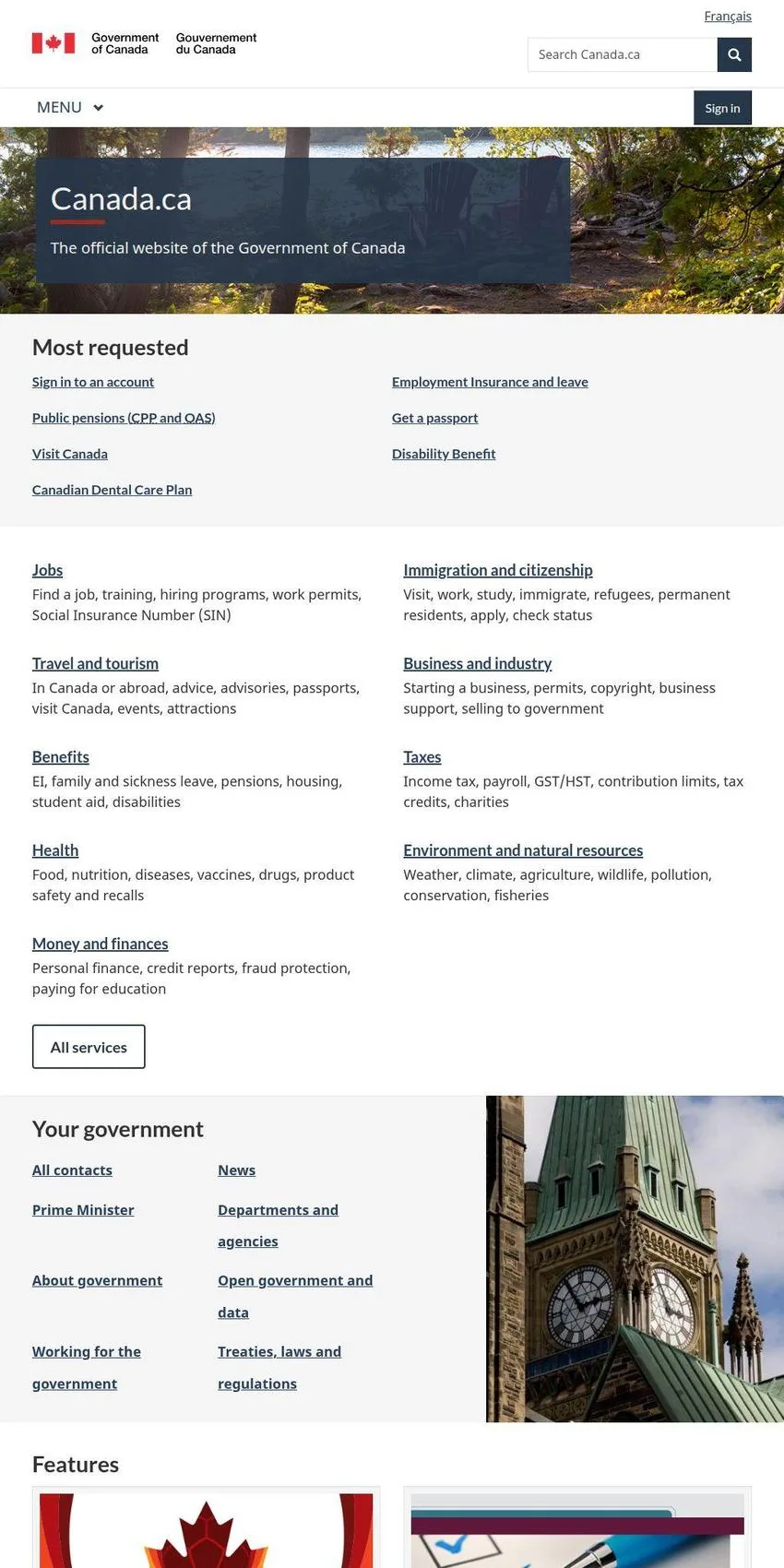
Canada.ca is the official website of the Government of Canada, the federal administration that delivers programs and services to roughly 41 million people across ten provinces and three territories. The domain brings together public content from more than two hundred departments, agencies and Crown corporations, replacing the thousands of separate sites those organizations once maintained on their own. Work to consolidate federal web publishing under a single address began in 2013 and has shaped how the government presents itself online ever since.
Content is arranged by task rather than by organization chart. A person looking for a benefit, a permit or a tax form finds the subject first and the responsible institution second. A lead department maintains each theme, and all of them appear in one shared design with the federal wordmark.
Services used most often
The busiest pages deal with money that moves between people and the state. Employment Insurance, the Canada Pension Plan, Old Age Security, the Canada child benefit and the Canadian Dental Care Plan each carry eligibility rules, application steps and payment dates. Tax matters, from personal returns to GST credits and business accounts, sit in the Canada Revenue Agency section. Passport pages explain first adult applications, renewals, urgent processing and fees, and list service locations across the country.
Major subject areas include the following.
- Benefits, including Employment Insurance, public pensions and family payments
- Taxes, business registration and permits
- Immigration, citizenship and travel
- Health, environment and public safety
Job seekers use the site as well. Job Bank matches postings to candidate profiles, while a separate careers section handles hiring into the federal public service itself.
Businesses have a stream of their own. Companies can incorporate federally, register for GST accounts, look up tariff codes, apply for grants and contributions, and file patents and trademarks with the intellectual property office, all starting from the same set of pages.
Signing in to federal accounts
Transactions run through protected accounts, chiefly My Service Canada Account for benefits and the Canada Revenue Agency sign-in for taxes. Access works with a GCKey credential or through the login of a partner financial institution, and multi-factor authentication is now standard. A change of address or new direct deposit details can be applied to several programs in one step, which spares users from repeating the same update with each office.
Immigration and travel
Immigration, Refugees and Citizenship Canada publishes instructions for visitor visas, electronic travel authorizations, study and work permits, Express Entry and citizenship applications, together with processing times that are updated on a rolling basis. Travel advice and advisories assign risk levels to destinations for Canadians going abroad. Related pages cover border rules, customs limits and the trusted traveller programs run jointly with the United States.
Structure of the federal government
Canada is a constitutional monarchy and a parliamentary democracy. The King is head of state and the Governor General acts for him federally, while the Prime Minister directs a cabinet of ministers who answer to the House of Commons. Departments and agencies report to those ministers. An index of federal organizations links every institution to its mandate, its minister and its contact points, from large departments such as National Defence to small tribunals and review boards.
Responsibilities are divided with other levels of government. Where a matter belongs to a province, a territory or a municipality, such as health care delivery, schooling or driver licensing, the relevant pages say so and point to the government that handles it.
The federal public service that carries out this work counts more than three hundred thousand employees, which makes the Government of Canada the largest single employer in the country. A staff directory lets the public look up individual officials by name, title or telephone number.
News, publications and open data
A national news section collects releases, statements, backgrounders and media advisories from every institution and can be filtered by department, subject and date. Weather forecasts from Environment and Climate Change Canada, food and product recalls, and public health notices appear under their own themes. During emergencies the site posts alerts and instructions for affected regions.
Open government pages hold tens of thousands of datasets in machine readable formats, along with proactive disclosure of contracts, grants, contributions and executive travel expenses. Budget documents, departmental plans, audits and annual results reports are archived for download, and a publications catalogue reaches back decades. Researchers, journalists and businesses draw on these records without needing to file formal information requests.
Language, accessibility and help by phone
Every page exists in English and in French with equal standing, as the Official Languages Act requires. Templates follow federal accessibility standards so that screen readers and keyboard users can work through forms and documents, and a basic HTML view supports older devices and slow connections.
Questions the site does not answer go to 1 800 O-Canada, the general information line, which operates on weekdays during business hours in both official languages. A teletypewriter line is available for callers who are deaf or hard of hearing. Service Canada Centres in every province and territory offer counter service for passports, social insurance numbers and benefit claims, and their locations and hours are listed on the site. Together the telephone service, the office network and the website form the three main channels through which the federal government answers the public.





Business address
Government of Canada
90 Elgin Street,
Ottawa,
Ontario
K1A 0R5
Canada
Contact details
Phone: 1-800-622-6232