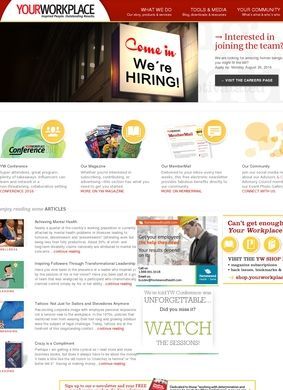
Type the domain into a browser today and you land on articles about Canadian online gambling payout sites, which is a jarring thing to find when you came looking for an HR and workplace culture brand. The scraped content puts it bluntly: YourWorkPlace is no longer in operation. So anyone arriving at this listing is reviewing a company that has wound down, and its old web address has been bought or repurposed for an unrelated topic. That fact reshapes everything else here. Whatever YourWorkPlace built, the live site is not the place to verify it anymore.
Magazine and conference platform
What it was, though, is worth setting out clearly, because the body of work was real. YourWorkPlace started as a Canadian multimedia company built around HR and workplace culture, founded by Sandra Asanin, an HR professional who said her own experiences with unhealthy work environments pushed her to do something about it. The stated mission was to help organizations create places where employees feel motivated and engaged. That is a crowded space full of vague promises, but the outputs here were specific enough to point at.
Your Workplace Magazine
The flagship was Your Workplace Magazine, a print and digital publication covering workplace culture, wellness, leadership, and management practice. It picked up real recognition along the way, including Cover of the Year for a Business Magazine in 2003 and a Canadian Cover Award in 2014. Magazine cover awards are a narrow kind of honour, granted more for design and editorial polish than for the depth of the journalism, so I read them as a sign the production values were taken seriously, not as proof the editorial moved the needle in HR departments. Still, awards of any sort over a decade apart suggest something with staying power, not a one-issue experiment.
Programs for recognition and development
Beyond the magazine, YourWorkPlace ran annual conferences under the Imagine Your Workplace Conference name, aimed at HR and people-management professionals. It also produced practical tools, guides, and coaching resources for managers, and ran the YW Awards, a program that recognized companies with strong workplace cultures. The thematic spine across all of it was consistent: psychological safety, open communication, employee wellness, leadership development, and engagement. That coherence matters. A publisher, a conference, an awards program, and a coaching arm all orbiting the same set of ideas reads like a genuine point of view rather than a grab bag of revenue lines.
Contact information unavailable
The honest answer leans toward very little, at least not through the website. Kingston, Ontario was the home base, and the Facebook listing still shows that location while flagging the business as closed. The domain now points to gambling content, so anything resembling a company contact point has vanished. The usual checks on how reachable a company is do not really apply here.
Review presence across platforms
The third-party review picture is quiet. The Facebook page carries four reviews but is not yet rated, so no star average shows. LinkedIn has 683 followers with no numerical rating attached. Nothing turns up on Trustpilot, Google, Yelp, or BBB. For a company that published an awarded magazine and ran national conferences, those numbers are modest, though they track with a business whose audience engaged through events and a subscription publication more than through public review platforms. A LinkedIn following of professionals is the kind of trail that lingers long after a company stops trading, and it at least confirms the YourWorkPlace name was known inside Canadian HR circles.
Accessing archived material
If you are trying to hire YourWorkPlace, subscribe to the magazine, or register for a conference, that ship has sailed, and the gambling content now sitting on the domain is a clear warning not to trust anything you find at the old address. The brand name lives on mainly as a reference point: a Canadian voice that spent years arguing, through print and in person, that workplace culture deserved serious attention. People researching the history of Canadian HR media, or hunting for back issues and archived conference material, may still find value in knowing YourWorkPlace existed and what it stood for.
Legacy in Canadian HR circles
For that purpose, the practical task becomes tracking down archived copies through libraries, professional networks, or people who once worked on the publication, since the current site offers nothing usable. Any contact details floating around online should be treated with caution, because a closed business cannot be relied on to respond, and the repurposed domain muddies the trail further. The work YourWorkPlace produced was credible and recognized in its time. The awards and conference run leave a more solid record than most defunct media ventures manage. The frustration is that none of it is accessible where you would expect to find it, and there is no clear path back in for someone who wants to engage with what YourWorkPlace left behind.