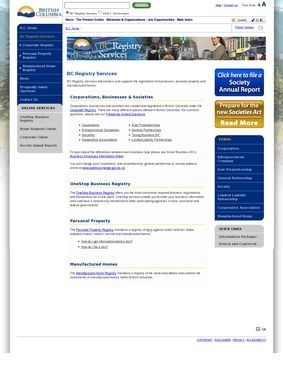
BC Registration Services is the Government of British Columbia's online registry for incorporating, registering, and managing businesses across the province. It sits on the gov.bc.ca domain and connects to the wider provincial registry system, the same machinery that keeps corporate records for individuals, companies, and organizations operating in B.C. A person forming their first company and a lawyer filing for a client both end up on BC Registration Services.
The catalogue of tasks it covers is the practical reason to open it.
What you can file through the registry
The core of BC Registration Services is corporate lifecycle work. You can incorporate a new B.C. company, register an extraprovincial corporation that was formed elsewhere but does business in the province, and keep an existing entity current through filings and record updates. Those updates reach across provincial and local government organizations, so a change entered once travels to the bodies that need it instead of having to be re-filed in several places.
That breadth is the argument for using it over any patchwork of separate forms.
The record-update side deserves its own mention. Keeping personal and business details accurate with government is the kind of task people put off because it usually means repeating themselves across several offices. Routing those updates through the provincial registry cuts that down, and for a business that has changed an address, a director, or a name, doing it once in the right place is the difference between a clean record and a stale one.
Incorporating and managing a B.C. corporation
Incorporation and ongoing management are the heavy items. The system is built to carry a company from formation through the routine maintenance that follows, the filings a corporation has to keep up with year after year to stay in good standing. For anyone who has wrestled with this on paper, folding it into one provincial portal is the whole point, and here it happens without a trip to a counter.
Name searches and other filings
Before a company exists, it needs a name, and the registry runs name searches as a distinct service. Results and other filings carry stated turnaround windows: a name search is quoted at five business days, and other filings run to ten.
Those are not instant. It pays to plan around them, and someone expecting a same-day incorporation will need to reset that expectation. Published timelines beat vague ones, and BC Registration Services states them plainly instead of leaving applicants to guess.
Signing in and paying
Access is gated behind government identity, which is standard for filings with legal force. Three routes exist, and picking the right one before you start saves a headache later.
This is not a business directory listing that a company can polish or ignore at will; using BC Registration Services is mandatory for anyone incorporating or staying current in the province, so the sign-in design has to work equally for a first-time filer and for a professional agent doing this every week. That is the reason three separate login paths exist instead of one screen for everybody.
Sign-in through a BC Services Card or BCeID
You can log in with a BC Services Card, with a Basic or Business BCeID, or with a physical BC Token that has to be obtained in person. The card and the BCeID cover most users; the token is the fallback for the cases that require it.
Setting up the right credential is the first hurdle, and it is the part most likely to trip up a newcomer, so sorting the login before sitting down to file is time well spent. This is the step where people stall, not the filing itself.
Paying by card, banking, or BC OnLine
Payment is flexible. BC Registration Services takes credit cards and online banking, and it ties into BC OnLine, the province's account-based billing system that heavier users and professional filers already work with. Between those options, most people will find a method they can use without having to set up something new just to complete a filing.
BC OnLine is worth understanding on its own if you file often. It is the standing account that law firms, paralegals, and busy corporate filers lean on, and it turns repeated one-off payments into a running ledger. A founder incorporating a single company will not need it. Someone managing a portfolio of entities almost certainly will, and setting it up early smooths every filing after the first.
Turnaround, and who it serves
One honest caveat about this review itself: the exact landing address at bcregistryservices.gov.bc.ca did not respond when I tried to load it directly, so the working entry points are the connected official pages across the broader gov.bc.ca registry family. The service behind them is unquestionably the province's own, so the standing of BC Registration Services is not in question; the note is only about which precise URL opens on a given day.
As a government utility, BC Registration Services does the job it exists for. It is comprehensive across the corporate tasks a B.C. business will run into, the identity and payment options are broad, and the processing times are published up front. It makes no attempt to be quick or charming, and it should not be measured on that. What it aims for is authority and completeness, and on both counts it delivers.
The one real friction is front-loaded, and it is honest to name it. Almost everything hard about BC Registration Services happens before the first filing: choosing and setting up a credential, understanding which login fits, and, for frequent users, standing up a BC OnLine account. Clear that setup and the filings themselves are orderly. Skip it and the process stalls at the door. This is the trade the province makes for filings that are legally binding, and it is a defensible one.
Incorporating a B.C. company for the first time comes down to the same three steps no matter who is filing: set up a BC Services Card or BCeID, run a name search before building anything around a chosen name, and budget the full ten business days for the filings that follow. Firms managing several entities get more out of pairing that same portal with a BC OnLine account once the groundwork is done, since it keeps records current across the province without repeating the login problem on every filing.