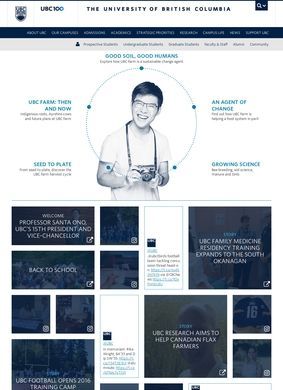
Two campuses sit behind one name here: a Vancouver site on University Boulevard and a second, quieter campus in Kelowna's Okanagan Valley. The University of British Columbia runs both as a single public research institution, and the split is worth knowing before you start reading, because a lot of what the site describes assumes you already understand which campus you are aiming for. Admissions, housing, program availability and campus culture all vary between the two, and the front door does not hide that. The University of British Columbia presents them as siblings, each treated on its own terms.
Homepage sections and navigation paths
The homepage of the University of British Columbia organizes itself around a handful of clear sections: About UBC, Admissions, Academics, Research, Campus Life, and a Strategic Directions area that reads as an institutional statement of intent. If you are a prospective student, the path from landing page to program list is short. If you are already enrolled, or teaching, or an alum checking in, the same navigation serves you without forcing everyone down the applicant funnel. That restraint is easy to miss and harder to build than it looks.
Research areas named on the site
What surprised me was how specific the research pages get. The University of British Columbia names the work directly: heat pump technology, wildfire technology paired with prescribed fire training, climate change and urban sustainability studies, and medical research into asthma, allergies and schizophrenia. They point to real programs and labs, and they give a reader a genuine sense of where the University of British Columbia puts its weight.
There is even an Arts PhD strand aimed at climate solutions, which is an interesting choice to feature. It shows that the University of British Columbia treats climate as a problem for historians, philosophers and social scientists as much as for engineers. Prospective graduate students hunting for a supervisor get something concrete here: it tells them what conversations are already happening on the ground.
The breadth is the point. Prescribed fire training and heat pump engineering rarely overlap, yet both belong to a large research university that has to cover a lot of territory. The University of British Columbia does not pretend to specialize in one thing, and the site is honest about that scope. That honesty is a small mark of trust, and it carries through the pages that follow.
Degree programs across disciplines
On the teaching side, the offering is what you would expect from an institution of this size: undergraduate and graduate degree programs across a wide field of disciplines, reachable through the Academics and Admissions sections. The site keeps the first screen light: it gives you the entry points and lets you drill down. Someone comparing options at several universities can get oriented quickly on the University of British Columbia site, useful when you are working through a shortlist.
Campus life beyond the classroom
Campus Life is where the tone loosens. The detail I keep coming back to is the free yoga classes offered to students and the surrounding community. It is a small thing, and that is exactly why it lands. A university that bothers to mention open yoga sessions is telling you something about how it wants campus to feel, and it quietly widens the audience beyond enrolled students to neighbours and community partners who can simply show up. Little gestures like that shape the character of the University of British Columbia.
That audience mix runs through the whole thing. Prospective and current students, undergraduate and graduate, faculty and staff, alumni, and community partners all get a foothold somewhere in the structure. The University of British Columbia clearly writes for more than the eighteen-year-old applicant, and the navigation reflects that plurality. Each group can find its own entry without wading through someone else's.
The Strategic Directions section is the one part that will speak more to insiders than to casual visitors. It lays out institutional priorities and direction in a way that faculty, staff and partners will read closely and most undergraduates will skim past. Including it on the public site is a deliberate move toward transparency about where the University of British Columbia is heading, and it belongs there even if it is not the reason most people arrive.
Social media presence across platforms
Social presence is broad: Facebook, Instagram, Twitter/X, LinkedIn, YouTube and TikTok are all linked. The TikTok inclusion stands out, since it aims squarely at the demographic deciding where to apply. A university reaching students where they already spend their attention is doing basic outreach well, and the spread of platforms means alumni and community followers get a channel that suits them too.
Is the site too much to take in?
If there is a limitation worth naming, it is that a site this large can feel like a lot to take in at once. The two-campus reality, the many audiences and the wide research menu all coexist on the same domain, so a first-time visitor may need a few clicks to find their lane. The information is there and well sorted; it simply rewards a little patience. That is the trade-off any comprehensive institution makes, and the University of British Columbia handles it about as cleanly as the scale allows. A sharper on-ramp for first-time visitors would not hurt, but nothing here is broken.
Weighing it whole, this is a resource that does its job. The University of British Columbia gives prospective students clear paths into programs, gives researchers a detailed picture of active work, and gives the wider public a few open doors like those yoga sessions. The content is specific where it counts and organized around real audiences. Nothing about it feels padded.
For a prospective graduate student weighing where to apply, this is where I would point you first: go straight to the Research section, find the specific area that matches your interests, whether that is wildfire and prescribed fire training or the climate-focused Arts PhD, and then trace it back through Academics to the department and potential supervisors. Reach out to that department directly and ask which campus, Vancouver or Okanagan, hosts the work you care about. The University of British Columbia has laid the groundwork for that kind of targeted digging, and it pays off most for the reader who arrives with a pointed question in hand.