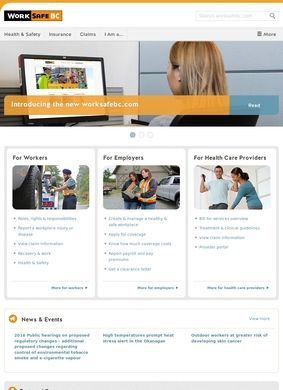
A worker in British Columbia falls off a ladder on a job site, or a small contractor gets asked for a clearance letter before a client will release payment, or a safety committee member needs to know exactly what the regulation says about confined-space entry. Each of those is a different person with a different urgency, and each one ends up at the same place. WorkSafe BC is the provincial board behind workers' compensation in British Columbia, and the site is built to absorb all of those arrivals at once, which is a tall order given how little the three situations have in common.
WorkSafe BC is statutory, meaning it is the body the province has tasked with running both workplace safety and the insurance that backs injured workers. That dual mandate shows up immediately in how the content is split. There is a health and safety side, where you can search the Occupational Health and Safety Regulation, read hazard guidance tied to specific risks, and find training and certification routes. And there is the insurance and claims machinery, which handles coverage, premiums, payroll reporting, and the administration of benefits when someone gets hurt. Holding those two functions under one roof is unusual, and the site does not pretend they are the same thing.
Insurance registration and clearance letters
For employers the practical draw is the insurance section. Registering for coverage, reporting payroll, and pulling clearance letters are all routed through here. Clearance letters in particular matter to anyone hiring subcontractors, because they confirm a contractor's account is in good standing before money changes hands. That is a small administrative document with real financial weight behind it, and having it available through an authenticated portal saves a phone call that used to be the only way to get one. Premium reporting lives in the same area, so the employer-facing workflow is contained rather than scattered.
Managing workplace injury claims
The claims and return-to-work content is where the human stakes are highest. A workplace injury or occupational disease gets reported through the site, and from there an account holder can view claim status, manage the file, and coordinate the return-to-work process through WorkSafe BC. That last piece is easy to underrate. Getting an injured worker back to suitable duties is a negotiation involving the worker, the employer, and often a clinician, and WorkSafe BC positions itself as the coordinator of that, with separate provision for vocational rehabilitation providers who run recovery programs for people who cannot go back to what they did before. The site treats those providers as a distinct audience with their own needs, which is the right call, since their relationship to a claim is nothing like a worker's or an employer's.
Serving healthcare providers and specialists
Healthcare providers form yet another group the site serves, which makes sense once you remember that a compensation claim runs on medical reporting. WorkSafe BC needs treating clinicians inside the loop, and giving them their own entry point keeps clinical reporting from being bolted onto an interface designed for someone else. This segmentation is more honest than the usual approach of one generic dashboard that tries to flatten five very different jobs into a single menu, because the work these audiences do genuinely diverges and the structure reflects that.
From regulations to enforcement information
Underneath the role-specific areas sits a layer of reference material. The OHS Regulation is searchable, which is the single most-used resource for a safety committee member trying to settle a question about fall protection or machine guarding. There is also a law and policy section carrying the policy documents and regulatory guidance that sit above the regulation itself, the interpretive material that decides how a rule gets applied in a grey case. Inspection and enforcement information is here too, so an employer can understand what an officer is looking for and what happens after a visit. None of this is light reading, but it is the kind of content people come looking for on purpose.
The site backs all of this with a forms and resources database you can search, and a set of language options that acknowledges British Columbia's workforce is not monolingual. The forms database deserves a specific mention. Anyone who has dealt with a compensation system knows the friction is almost always finding the correct form for a narrow situation, and a searchable repository is the difference between a five-minute task and an afternoon of guessing. The authenticated online services portal ties the personalised functions together, so once you are signed in, claim management, premium reporting, and account administration are reachable in one session rather than as separate errands.
WorkSafe BC also runs engagement and consultation channels, which is the part of a regulator's job that is easy to dismiss until you need it. When a regulation is being revised, the people who live under it get a say, and the site provides the route for that input. It is not glamorous and most account holders will never touch it, but its presence means the rules are not handed down sealed, and for an organisation with enforcement power the openness counts for something. WorkSafe BC carries that enforcement role openly alongside the consultation route.
Independent reviews of WorkSafe BC turn up a mixed picture. The organisation has ratings on Google and other platforms, and worker reviews in particular tend to be polarised, with complaints about claim delays and employer-side friction alongside acknowledgment that the coverage itself is substantial. This is fairly typical for a statutory insurer with compulsory participation; the population leaving reviews skews toward people who had a difficult claim experience. The published evidence does not add up to a clean endorsement or a clear warning, which is worth knowing before a first interaction.
If there is a fair criticism of the site itself, it is that the sheer breadth can disorient a first-time visitor who does not yet know which of the five audiences they belong to. A new sole proprietor wondering whether they even need coverage faces the same wide front door as a seasoned safety officer who knows exactly which regulation clause they want. That is the unavoidable cost of one site doing the work of what could easily be three or four, and WorkSafe BC mostly manages it through clear role-based navigation, though the burden still falls partly on the visitor to self-identify before the site can help them efficiently.
What the site does well is refuse to be vague. The functions it advertises are concrete and consequential: report an injury, check a claim, pull a clearance letter, search a regulation, register for coverage, coordinate a return to work. These are not soft promises, they are transactions with outcomes attached. For a body whose decisions affect someone's income after an injury and someone else's premiums and legal obligations, that practicality is the whole job, and WorkSafe BC takes it seriously. Workers, employers, clinicians, and rehabilitation providers all find a path shaped to what they came to do, which requires the organisation to understand its own constituents well enough to design for them separately. The result is a resource that holds up under pressure, and that is exactly the moment most people reach for WorkSafe BC.