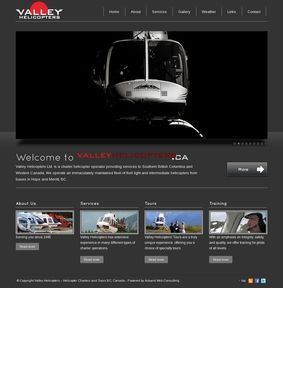
Valley Helicopters is a charter helicopter operator based in Hope, British Columbia, flying across the Lower Mainland and the southern interior of the province from additional bases in Merritt and Kamloops. It runs Bell aircraft on jobs that range across resource work, emergency response, and passenger flights, and it has done so for more than thirty years under the same company banner.
Longevity counts for something here. Valley Helicopters has flown for more than three decades under president Brad Fandrich, and it has stayed a mid-sized outfit of somewhere around eleven to fifty people. That size is a reasonable fit for the work: big enough to field a varied fleet and keep several bases staffed, small enough that a customer is likely dealing with people who actually fly the machines instead of a distant call centre. Experience of that length in mountain flying is slow to build and hard to replace.
The service list reads like a working aviation outfit rather than a tourist operation built around one sightseeing loop. Utility and construction support, natural resource work for logging and mineral exploration, aerial survey, passenger transport, and specialty lift jobs all sit on the roster. Valley Helicopters keeps tours and charters on the list too, but they share space with the heavier commercial and industrial flying that fills a working week.
Work in the mountains and along the coast
What sets the flying apart is where it happens. Valley Helicopters specializes in mountain flying and coastal operations, two of the more demanding environments a rotary pilot works in, with shifting winds, tight landing zones, and terrain that punishes sloppy planning. A company that lists those as its specialty is saying something specific about the kind of pilots and machines it puts in the air.
The clientele is broad. Valley Helicopters states that it serves the public, government, and industry alike, which fits the spread of the work: a film crew or a sightseeing party on one flight, a forestry contractor or a government agency on the next.
Geography explains the three bases. Working out of Hope, Merritt, and Kamloops puts aircraft within reach of the Fraser Canyon, the Nicola Valley, and the ground north and east of them, so a job in the southern interior does not begin with a long, costly repositioning flight from one distant hangar. For time-sensitive work, fire support especially, that spread of bases shortens the response, and it is a practical reason a local operator often beats a bigger name flying in from farther off.
Resource, utility, and lift jobs
The bread and butter is industrial. Logging support and mineral exploration put crews and gear into places a truck cannot reach, and specialty lift work handles the loads that have to arrive by air. Utility and construction support covers moving materials and giving crews an aerial vantage on a site. Aerial survey rounds it out for anyone needing eyes over ground that is hard to cover any other way.
This is the flying that pays the bills, and Valley Helicopters has built its name on being able to do it in country where the margin for error is thin. Aerial survey and lift jobs both put a premium on precise, steady flying, which is where a maintained fleet and seasoned pilots pay off most.
Emergency response and heli-skiing
Two lines of work show the range. Valley Helicopters supports search and rescue and forest fire operations, the sort of flying where a fast, well-kept aircraft and a pilot who knows the terrain make the real difference. On the recreational side it handles heli-skiing and avalanche control, taking skiers to snow no lift reaches and helping manage the slide risk that comes with it.
Tours and charters fill in around both, giving a visitor a way to see the region from the air without needing a commercial reason to fly.
The fleet and how it stays in touch
The aircraft are all Bell: a 206 Jet Ranger, a 206 L4, a 407, and a 429. That is a sensible spread of light and medium machines for the mix of passenger and lift work described. The lighter 206s suit passenger and survey runs, while the 407 and 429 step up for heavier lift and longer legs. Valley Helicopters presents the fleet as well maintained, which is the baseline anyone should want from an operator flying in the mountains.
Communication gets unusual attention. Every aircraft carries satellite tracking and telecommunications gear that allows calls in flight, and Valley Helicopters runs its own radio repeater network stretching from the Lower Mainland into the BC Interior for real-time flight following. For work in remote valleys where a normal signal drops out, that private network is a genuine safety and coordination advantage, and it is the sort of investment a smaller operator does not always make.
Bell aircraft and a private repeater network
Put the two together and a pattern emerges about Valley Helicopters: an operator that has spent money where it counts for backcountry work. Bell airframes are a known quantity for parts and reliability, and pairing them with continuous flight following means someone on the ground always knows where a machine is. For a client putting a crew or family members on board over rough country, that combination answers the first question worth asking, which is what happens if something goes wrong out there.
Contact details for Valley Helicopters are easy to find. Phone numbers for the Hope and Kamloops operations and for the Merritt base appear on the site, a physical address in Hope is published, and a contact page is linked in the site navigation. An email address is present, obfuscated in the page to fend off spam, which is a normal and sensible choice.
Outside reputation is sparser than the operation deserves. Wanderlog carries customer reviews describing positive tour experiences, with friendly, professional pilots singled out, but no aggregate star rating or review count surfaces there. A Yelp listing for the Hope location exists without a visible score, and a YellowPages Canada entry notes plainly that no one has rated the business yet. No Google, Trustpilot, or Better Business Bureau figures turned up. The individual comments that do exist read well; there simply are not many of them gathered in one place.
For a company whose real work is industrial and emergency flying, a slim tourist-review trail is less damning than it would be for a restaurant. A prospective charter customer is still left leaning on the operational record and the fleet details instead of a wall of star ratings.
Backcountry work in southern British Columbia, whether the job is forestry, a survey contract, or a heli-ski trip, comes down to a direct call: describe the job and the terrain, then ask about aircraft availability and the flight-following setup for the route. A sightseeing booking works the same way. What justifies it is the fleet and thirty-plus years of mountain experience, not the sparse online reviews.