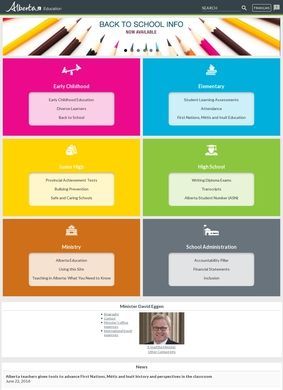
Where does a parent in Alberta go to check what their child is supposed to be learning, or a recent graduate go to pull an old transcript? For anyone inside the province's school system, the answer is Alberta Education, the Government of Alberta ministry responsible for schooling from early childhood through grade 12. Its longtime web address, education.alberta.ca, now forwards to the ministry's page on the central alberta.ca site, so a visitor who types the old URL lands a step away from where they expected.
The destination is the same official source: the body that writes Alberta's curriculum, runs its diploma exams, certifies its teachers, and moves funding to its school boards.
The remit is wide, and the audience is close to everyone connected with a school. Parents, students, classroom teachers, principals, school board administrators, and families who educate at home all end up here for something, because Alberta Education owns the pieces of the system that individual schools cannot set for themselves. A single teacher can choose how to run a lesson. That teacher cannot decide what counts as the grade nine curriculum, how a diploma exam is scored, or what it takes to hold a teaching certificate in the province.
Those sit with the ministry. The site is organized around those responsibilities, so its navigation follows the shape of the ministry more than the questions a first-time visitor might phrase, which can make the first few clicks feel bureaucratic.
What the ministry publishes for schools and families
For most visitors, Alberta Education works as a reference desk. It holds the programs of study that define what gets taught in each grade, a body of K-12 teaching supports, and dedicated areas for the parts of the system that need their own treatment. Indigenous education has its own section, as does French language education, and there is material on supporting diverse learners, the students who need something other than the standard path.
Early childhood services sit at the front end of all of it, since Alberta Education treats the years before grade one as part of the same continuum. The specialized sections are more than boxes to tick. Indigenous education and French language education each carry legal and treaty commitments the province has to meet, so the material there answers to obligations, which is part of why it sits with the ministry and not with individual boards.
None of this is built to entertain. The pages are dense, official, and written to be authoritative instead of easy reading, which is the right call for a document a school administrator or a home educator has to rely on. Alberta Education is the primary source, so its wording of a curriculum requirement or a certification rule is the wording that governs. That is the reason to read it directly instead of a secondhand summary, and it is also why the redirect is worth noting: the authoritative content did not disappear, it moved under the province's central domain.
Two of the ministry's functions are easy to overlook because they happen offstage. Alberta Education certifies the province's teachers, which means the credential every classroom teacher in Alberta holds is issued and governed here, along with the requirements, the application process, and the conduct standards attached to that certificate. It also funds the school boards, deciding how provincial money reaches local districts.
Neither function produces a page a casual visitor lingers on, yet together they are most of what makes the ministry more than a publisher of documents. Curriculum sets what is taught and certification sets who may teach it, while the funding decides what the boards can afford to do about either.
Diploma exams, assessments, and student records
The assessment machinery is one of the site's heaviest-used corners. Alberta runs provincial assessments through the grades and diploma exams at the end of high school, and Alberta Education publishes the rules, schedules, and results information that surround them, part of its stated job of evaluating outcomes across the province. For a grade twelve student, a diploma exam is a real gate into post-secondary, and the official account of how it is weighted and administered lives here rather than on any third-party study site.
The same part of the system connects to student records. Transcripts and the student information that follows a learner through school and out into university applications or the job market are handled through the ministry, which makes this section one people come back to years after they have left the classroom. That longevity is unusual for a government page. Most people touch it at a couple of high-stakes moments, a diploma exam and later a transcript request, and Alberta Education is the custodian at both.
Home education and distance learning
Alberta Education gives families more room than many provinces to educate outside a conventional classroom, and the site is where the terms are set. Home education options are documented alongside online, distance, and blended programs, so a parent teaching at home or a student taking courses remotely can find the funding, notification, and supervision requirements attached to each route. These are the practical questions that decide whether an alternative path is workable at all.
A family cannot simply declare that it is home-schooling and leave it there; there are rules, and this is where they live, which is why the section matters so much to the households that depend on it.
For rural families especially, distance learning is sometimes the only realistic route to a full course list, so the programs documented here are less a lifestyle choice than a matter of access.
The initiatives the ministry is pushing
Beyond the standing reference material, the site tracks what Alberta Education is currently changing, and the list is not short. A draft K-6 curriculum is under review, the kind of change that ripples through every elementary classroom in the province once it is finalized, and the review pages are where the proposed programs of study can be read before they take effect.
A draft curriculum is exactly the sort of document worth reading at the source, since summaries of a proposed change tend to arrive filtered through whoever is for or against it. Alberta Education also lists school food programs among the current commitments, a practical measure aimed at students who cannot learn well hungry. Two larger operational pushes sit next to the curriculum work, and both come attached to numbers.
The first is a classroom complexity support team, one of the ministry's current priorities, backed by a cited figure of $100 million and aimed at the widening mix of needs a teacher now manages in a single room. The second is a school construction push, and it carries the most concrete target the site puts forward. Reading these pages together gives a fairly clear picture of where Alberta Education is putting its attention and its money, which is useful information whether a reader agrees with the direction or argues with it.
The numbers are stated plainly, and stated numbers can be checked against results later. For a resource that exists to set policy and report on it, that specificity is the useful part, since a vague commitment gives a parent nothing to hold the ministry to.
Building more than 200,000 student spaces
The School Construction Accelerator Program is the ministry's answer to a province adding students faster than it can seat them, with a cited target north of 200,000 new student spaces. For a parent in a fast-growing suburb where the local school already runs on portables, that is the figure worth watching, and the site is where the plan and its progress are meant to be tracked. Whether construction keeps pace with the target is the open question the numbers invite, and nothing on the page settles it.
Each of these initiative pages links back out to the same central alberta.ca domain that the education.alberta.ca address now redirects into.