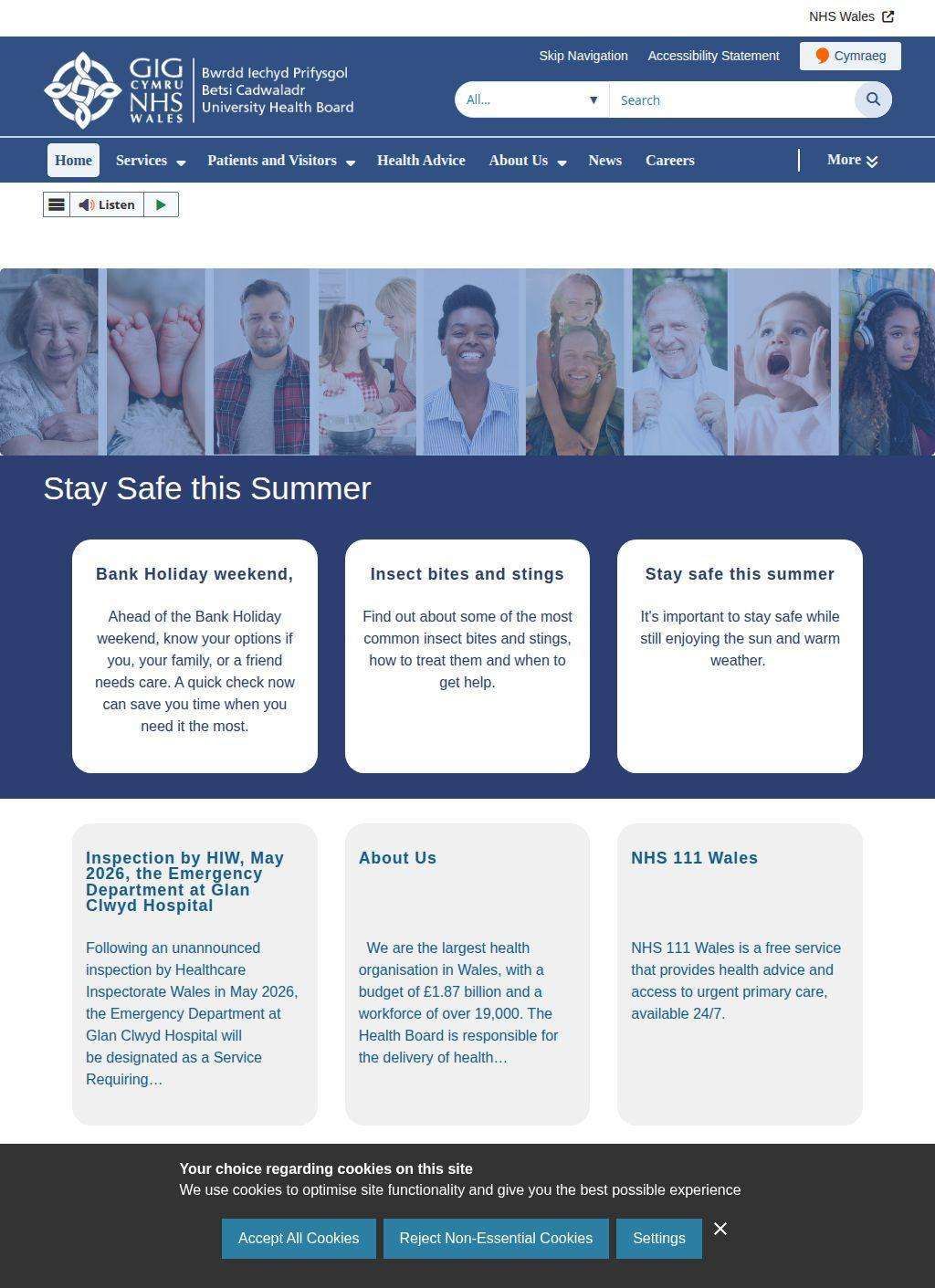
Someone in Wrexham wakes up with a child running a high fever, or needs a blood test booked before a follow-up appointment, or has to find out whether they can visit a relative on a ward this week. Those are the moments that send people to the site of Betsi Cadwaladr University Health Board, and the homepage is built around exactly that kind of arrival. The organisation is the NHS body responsible for care across the whole top of Wales, and a fair amount of thought has gone into making its front page answer the urgent question first. The first things on offer are practical: appointment booking, blood test scheduling, a hub that spells out current visiting arrangements hospital by hospital. It reads like a site that knows most visitors arrived with a task, not a browse.
Geographic reach across North Wales
Betsi Cadwaladr University Health Board covers a lot of ground. It runs NHS services across the whole of North Wales, six counties in total: Anglesey, Gwynedd, Conwy, Denbighshire, Flintshire and Wrexham. By geographic area that makes Betsi Cadwaladr University Health Board the largest health board in Wales, and the site does not hide the scale. Three district general hospitals sit at the centre of it, Ysbyty Gwynedd in Bangor, Ysbyty Glan Clwyd in Rhyl, and Wrexham Maelor Hospital, with a layer of community hospitals, mental health units and primary care facilities underneath. Anyone using the Wrexham entry to find their local provider is looking at one node in a fairly large network.
Three district general hospitals and community facilities
What the clinical side of Betsi Cadwaladr University Health Board covers is broad and stated plainly. Emergency and urgent care, elective surgery, outpatient clinics, maternity, paediatrics, mental health, community nursing, and Allied Health Professionals all get their place. That spread tells a resident roughly what Betsi Cadwaladr University Health Board can handle within the region instead of sending them further afield. The site does not oversell any one of these; they sit on the page as the working list of what a health board this size is responsible for, and that restraint is, frankly, a relief after sites that try to dress up routine services as something remarkable.
Clinical services offered
This is where I think Betsi Cadwaladr University Health Board has put its real effort. The online tools are not decorative. There is appointment booking, separate scheduling for blood tests, and a virtual clinic setup that includes a virtual waiting room. Someone built the equivalent of sitting in a corridor before a video consultation, so patients are not left wondering whether they joined too early or got dropped. The NHS Wales app is offered for both iOS and Android, pulling some of this onto a phone where a lot of patients will deal with it.
Appointment booking, blood tests, virtual clinics
The visiting information hub on the Betsi Cadwaladr University Health Board pages deserves a mention on its own. Visiting rules at hospitals change, and a relative trying to plan a trip across North Wales needs current answers, not a generic policy from two years ago. Putting that front and centre shows that the people running Betsi Cadwaladr University Health Board's site understand which questions generate the most anxious clicks. The same goes for blood test booking being broken out as its own path; it is one of the most common reasons to interact with a health board, and giving it a dedicated route saves people from hunting through general appointment pages.
Hospital visiting information by location
Accessibility is handled with more seriousness than many public bodies manage. Welsh-language services run throughout the site, which is not a nicety in North Wales but a genuine expectation for a large share of the population. ReadSpeaker audio is provided across the pages too, so the content can be heard as well as read, which helps anyone who struggles with screens or with text. For an organisation serving six counties with a wide age range and a real bilingual community, both of those choices read as considered work, not box-ticking. It is the sort of detail that tells you Betsi Cadwaladr University Health Board treats its digital presence as part of the service and not a leaflet stuck online.
Welsh language and accessibility features
Beyond patient-facing tools, Betsi Cadwaladr University Health Board uses the site to carry the parts of its work that a public body is obliged to make visible. Board governance documents and meeting minutes are published, which lets residents see how decisions get made about the services they rely on. There is a recruitment portal too, running under a "train-work-live" programme aimed at healthcare professionals thinking about moving to or staying in the region. That is a sensible thing for a rural and coastal health board to push, given how hard staffing can be away from the big cities, and it sits naturally alongside the clinical content instead of feeling bolted on.
Board governance documents and staff recruitment
Complaints and concerns are routed through the People's Enquiry and Resolution Service, PEARS, which the site gives its own presence. Having a named, findable channel for raising problems is something I weigh fairly heavily when judging any health provider, because the willingness to publish the route for criticism says more than any amount of positive framing elsewhere. Betsi Cadwaladr University Health Board does not bury it, and that counts.
How do patients file complaints or concerns?
If you step back and look at the whole thing as a single resource, it is organised around the user more than around the institution's org chart. A person from Wrexham can get to Wrexham Maelor Hospital information, book what they need, check visiting arrangements, switch to Welsh, and find the complaints route without a guided tour. Whoever maintains the pages for Betsi Cadwaladr University Health Board seems to have started from what a worried resident needs and built outward. There is enough depth here that you could spend real time in the governance section if you wanted to understand how the board operates, while a patient in a hurry can ignore all of that and still get their task done.
User-centered design and organization
On third-party reputation, a search turns up NHS Wales patient survey results and occasional press coverage tied to waiting times and inspection reports, but no aggregated ratings platform with a count to cite. That is normal for a public health board: accountability runs through formal inspection bodies and media reporting, not consumer review platforms.
Formal inspection bodies provide accountability
I do not want to overstate the polish, because a website is only ever the front door. The booking tools, the virtual waiting room, the app: these are promises about how the underlying services behave, and a health board is judged on outpatient waits, ward conditions, ambulance response and the experience of being a patient across a huge rural region, none of which a homepage can demonstrate.
Betsi Cadwaladr University Health Board has clearly invested in making the digital layer clear, bilingual and genuinely useful for the common tasks. What the site cannot tell you is whether booking a slot reliably leads to being seen on time, or whether PEARS resolves the concerns people bring to it. The published evidence points to Betsi Cadwaladr University Health Board as a public body that has thought carefully about its digital front end; the gaps, if any, are behind it.
Business address
Betsi Cadwaladr University Health Board
Wrexham Maelor Hospital, Croesnewydd Road,
Wrexham,
Wrexham
LL13 7TD
United Kingdom
Contact details
Phone: 01978 291100