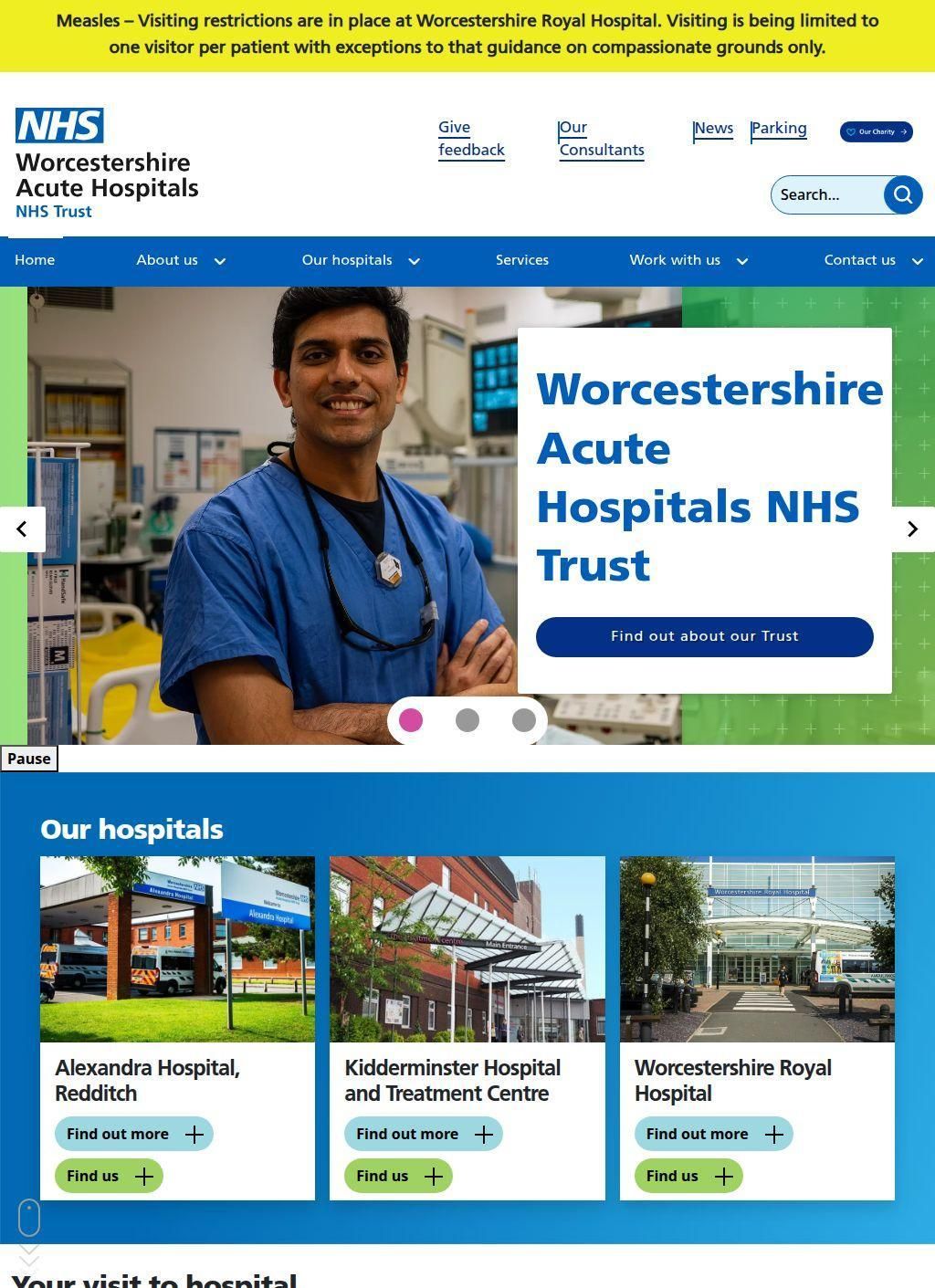
Running acute hospital care across Worcestershire from three sites, Worcestershire Acute Hospitals NHS Trust covers Worcestershire Royal Hospital in Worcester, the Alexandra Hospital in Redditch, and Kidderminster Hospital and Treatment Centre. The website is built around those three locations and the practical questions a patient or visitor brings to them, and the first thing it does well is tell you which hospital handles what before you set off anywhere.
Clinical services across three hospitals
The clinical range covered here is broad in the way you would expect from a secondary care provider. Emergency care sits at the front, and Worcestershire Acute Hospitals NHS Trust routes urgent but non-life-threatening cases through the NHS 111 online referral pathway, which is sensible triage to surface prominently. Beyond A and E, the site lists surgical procedures, outpatient appointments in face-to-face, video and telephone formats, maternity and labour services, blood testing, and interventional radiology. The outpatient detail is worth pausing on, because the three appointment formats are spelled out plainly enough that you can work out in advance whether a trip to Worcester or Redditch is even necessary. That small clarity saves real time for someone juggling work or childcare around a clinic slot.
Outpatient appointments in multiple formats
What rounds out the picture is the attention to patients who are easy to overlook. Worcestershire Acute Hospitals NHS Trust publishes information on inpatient ward care, paediatric services, learning disabilities support, and LGBTQ+ health, and it groups accessible information and communication support alongside the rest of its patient resources instead of burying it. A site can carry every department in England and still leave a deaf patient or someone with a learning disability guessing, so seeing those supports treated as standard fare rather than an afterthought is reassuring.
Practical information for patients
A hospital website partly lives or dies on the practical stuff, and Worcestershire Acute Hospitals NHS Trust handles the practical stuff carefully. Visiting guidance is current, including a note that visiting is restricted because of measles precautions. That is the sort of live operational detail that often goes stale on institutional sites and here does not. Parking information is given for all three locations, and there is guidance on travel cost assistance and patient transport services for people who cannot easily get themselves to an appointment. Ward maps round that out.
Travel costs and transport assistance
The travel cost and transport material is the most quietly useful part of the whole site, because it speaks to a problem that keeps people away from care entirely. Someone weighing up whether they can afford the journey to a Redditch clinic needs that information in plain sight, and Worcestershire Acute Hospitals NHS Trust puts it there. The parking pages doing the same job per site means a visitor is not left decoding a single generic policy that may or may not apply to where they are actually going.
Contact details per location
The contact information is concrete. Each of the three hospitals has its own switchboard number and full street address on the site, and Worcestershire Acute Hospitals NHS Trust leaves no ambiguity about which building a letter or a relative is meant to reach. For anyone arriving at this listing through a business directory, that specificity is the difference between finding the right information quickly and bouncing between pages.
Staff recruitment and research programmes
Beyond patient care, Worcestershire Acute Hospitals NHS Trust uses the site for the wider role an NHS Trust plays in its area. It carries staff recruitment listings and volunteering opportunities, which is relevant to a region where these three hospitals count among the larger employers, and it sets out research and innovation programmes that connect the day-to-day clinical work to longer-term improvement. Whether a member of the public reads the research material closely is debatable, but its presence reflects a Trust doing more than keeping the lights on.
Patient feedback routes
Patient voice is handled through two routes kept distinct from each other: PALS for informal queries and concerns, and a formal complaints process for anything that needs escalating. Separating the two is the right call. A patient who wants a question answered should not be funnelled into a complaints procedure, and someone with a serious grievance should not be fobbed off with an informal chat. Worcestershire Acute Hospitals NHS Trust drawing that line clearly is a mark of an organisation that has thought about how feedback actually reaches it.
Searching for third-party reviews of Worcestershire Acute Hospitals NHS Trust turns up a limited number of independent ratings on general platforms. Worcestershire Acute Hospitals NHS Trust is not the kind of provider people rate on consumer platforms in any volume; formal feedback routes such as the NHS Friends and Family Test and Care Quality Commission reports are the main channels. The CQC inspection record is the more meaningful reference point for anyone assessing the Trust's standing, and the expectation of a deep pool of consumer reviews of the kind you find for private providers simply does not apply here.
If there is a limit to what the website can do, it is the inherent one facing any large Trust: the sheer volume of departments and pathways means a first-time visitor has to do some navigating to land on the exact page they need. That is not a flaw so much as a consequence of the organisation's size, and the per-site structure does most of the work of taming it. Someone coming in with a single specific question, say maternity at Worcestershire Royal or an outpatient blood test in Kidderminster, will get there, just not always in one click.
The honest test of a site like this is whether it serves the patient rather than the institution, and Worcestershire Acute Hospitals NHS Trust passes it. The clinical breadth is wide, the practical logistics are unusually well covered, and the access-focused services are given proper weight instead of a token mention. At this level of provision, Worcestershire Acute Hospitals NHS Trust reads like a body that knows most of its visitors arrive worried or in a hurry and wants to shorten the distance between landing on the page and getting the answer they came for.
How this site compares to NHS England
Set against the obvious alternative, NHS England's national site at nhs.uk, the two do different jobs and a reader needs both. The national service is the place for general health advice, the A to Z of conditions, and finding services anywhere in the country. What Worcestershire Acute Hospitals NHS Trust gives that nhs.uk cannot is local specificity: the exact Redditch parking situation, the current measles visiting restriction, the right switchboard for the Kidderminster centre, the maternity arrangements at Worcestershire Royal. The Trust's own site is the one to bookmark for anyone whose care sits with these three hospitals, with the national service kept open in the next tab for everything that reaches past the county line.
Business address
Worcestershire Acute Hospitals NHS Trust
Charles Hastings Way,
Worcester,
Worcestershire
WR5 1DD
United Kingdom
Contact details
Phone: 01905 763333