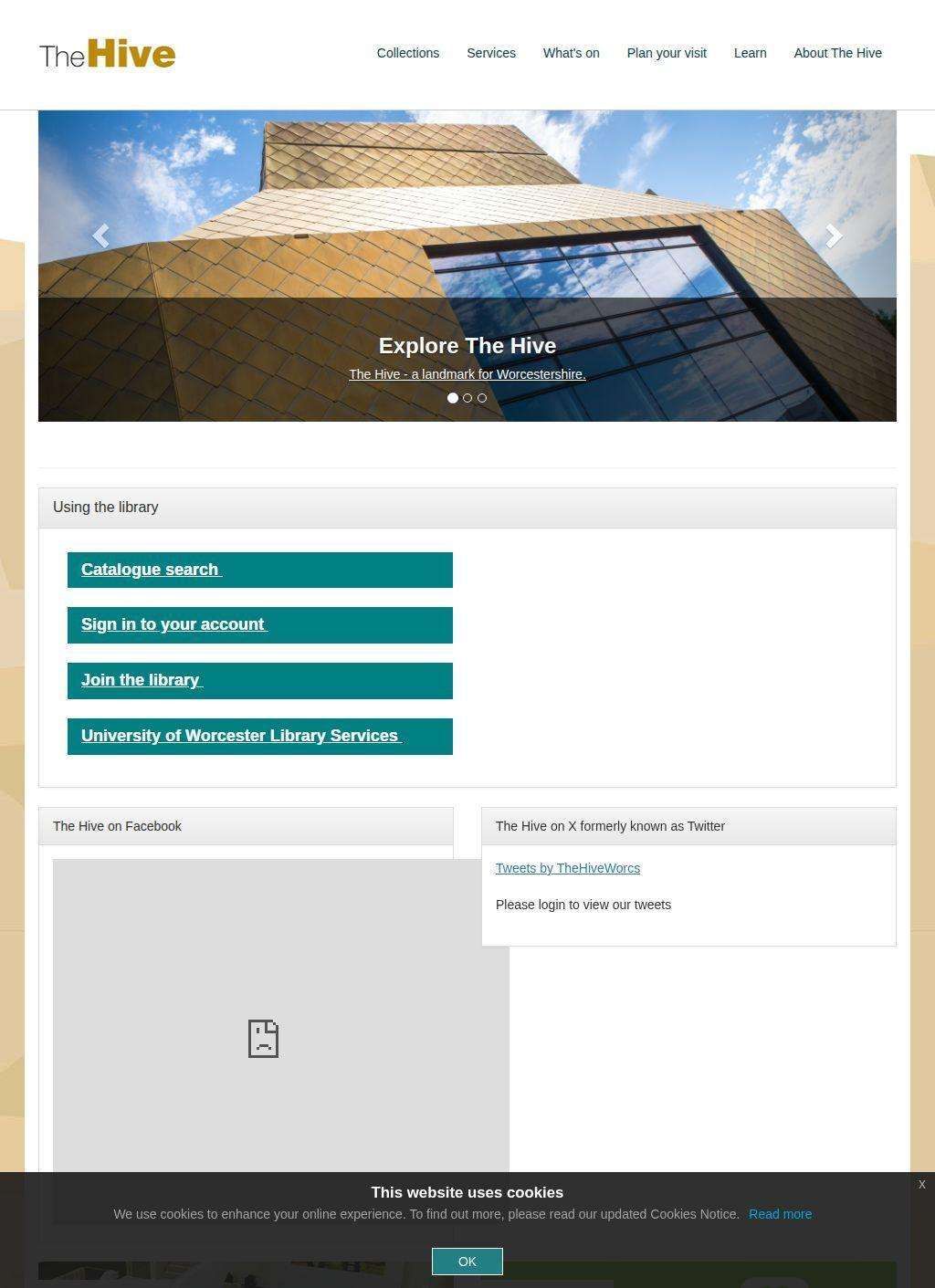
Borrowing a novel and pulling up a centuries-old parish record can happen under the same roof at The Hive, a building in Worcester that doubles as both the public library for the county and the main library for the University of Worcester. That dual role is the thing to understand before anything else. It serves the general reader who wants the latest fiction alongside the undergraduate chasing a deadline, and the arrangement reflects a genuine partnership between Worcestershire County Council and the University of Worcester, two bodies that agreed to share a building and staff a fully integrated service together.
A shared library serving students and the public
The catalogue at The Hive covers what you would expect from a sizeable public collection: general fiction and non-fiction, with the usual library card registration, borrowing, and reservation functions handled online. Digital access runs through Bolinda Digital, so members can take out ebooks and audiobooks without setting foot inside. None of this is unusual on its own, but the breadth matters because the same membership reaches the academic side of the building as well, which is not something most town libraries can claim.
Digital borrowing through Bolinda
Where The Hive separates itself from an ordinary lending library is the Worcestershire Archive and Archaeology Service, which is housed inside the building. Through a programme called Explore the Past, the public can get at local and county archive material and archaeological records that would otherwise sit behind the doors of a specialist repository. For anyone researching family history or tracing a property, a parish, or the older layers of the county, this is the part that justifies a trip in person. The combination of a working public library and a county archive in one place is genuinely useful, and it means a casual visit and a serious research session can begin from the same desk.
Worcestershire Archive and Archaeology Service
The physical space is built around more than shelves. There are dedicated study spaces that students and members of the public can book, which keeps the academic and community uses from colliding too badly during busy periods. A cafe, The Cafe at The Hive, sits inside the building, and there are rooms available to hire for groups or events. The What's On programme runs talks and activities, and there is a strand of learning resources plus children's and community services, so the building is plainly intended to function as a cultural centre.
Space and programming across multiple uses
That mix is worth weighing honestly. A single site trying to be a study library, a public lending service, an archive, an events venue, and a family destination risks doing several things adequately and none of them exceptionally. The published offering does suggest the institution has thought about the seams between those uses, with bookable rooms and study areas as the practical mechanism for sharing the space. Whether the experience holds in practice depends on how crowded it gets, and the site does not pretend that every visit will be quiet. What it communicates clearly is the range of what is available and who each part is for.
Why the archive holdings matter most
The collection's local and county archive holdings are the strongest reason to single The Hive out from other libraries in the region. General fiction and non-fiction can be found in plenty of places. The archaeological records and the county archive cannot, and pairing them with public study space lowers the barrier for ordinary residents who want to do real historical work without an academic affiliation. That is a quietly democratic thing for a public body to offer, and it is the feature most likely to bring someone back repeatedly.
Inside a modern building at Sawmill Walk
Architecture is part of The Hive's identity. It sits at Sawmill Walk, a site once referenced as Henwick Grove, and its modern design is distinctive enough to be a talking point. That is a minor note next to the services, but it does shape the experience of using the place, since the building was clearly intended to feel like a destination.
What students get from the university library
For the student population the practical draw is simple. The Hive is the university's main library, so the academic collection, the study environment, and the borrowing system are all built to carry coursework as well as leisure reading. The fact that this same infrastructure opens to the wider Worcestershire public is the unusual part, and it is the reasoning behind the whole joint model. A resident gets access to a scale of resources that a standalone town library would struggle to fund, and the university gets a library embedded in the community rather than walled off on a campus.
Outside reputation is limited. No substantial public review presence for The Hive turned up across the main platforms, which is common for library services. The Hive is a public body and its governance sits with the council and the university, so the institutional backing is easier to verify than a customer review count would be. The Worcestershire County Council and University of Worcester backing makes the arrangement straightforward to verify. Casual readers and families will find a well-stocked lending service with digital options through Bolinda and a regular events calendar.
How should you use The Hive?
Researchers should head directly for the archive and archaeology service and the Explore the Past route, booking a study space if they expect to stay a while. The catalogue search, card registration, and reservation tools cover the day-to-day mechanics. The span of the collection, from current novels through county archive material and archaeological records, is the clearest summary of what The Hive is trying to be. The archive arm is what makes The Hive genuinely different from any other library in the area.
Business address
The Hive
Sawmill Walk, The Butts,
Worcester,
Worcestershire
WR1 3PD
United Kingdom
Contact details
Phone: 01905 822866