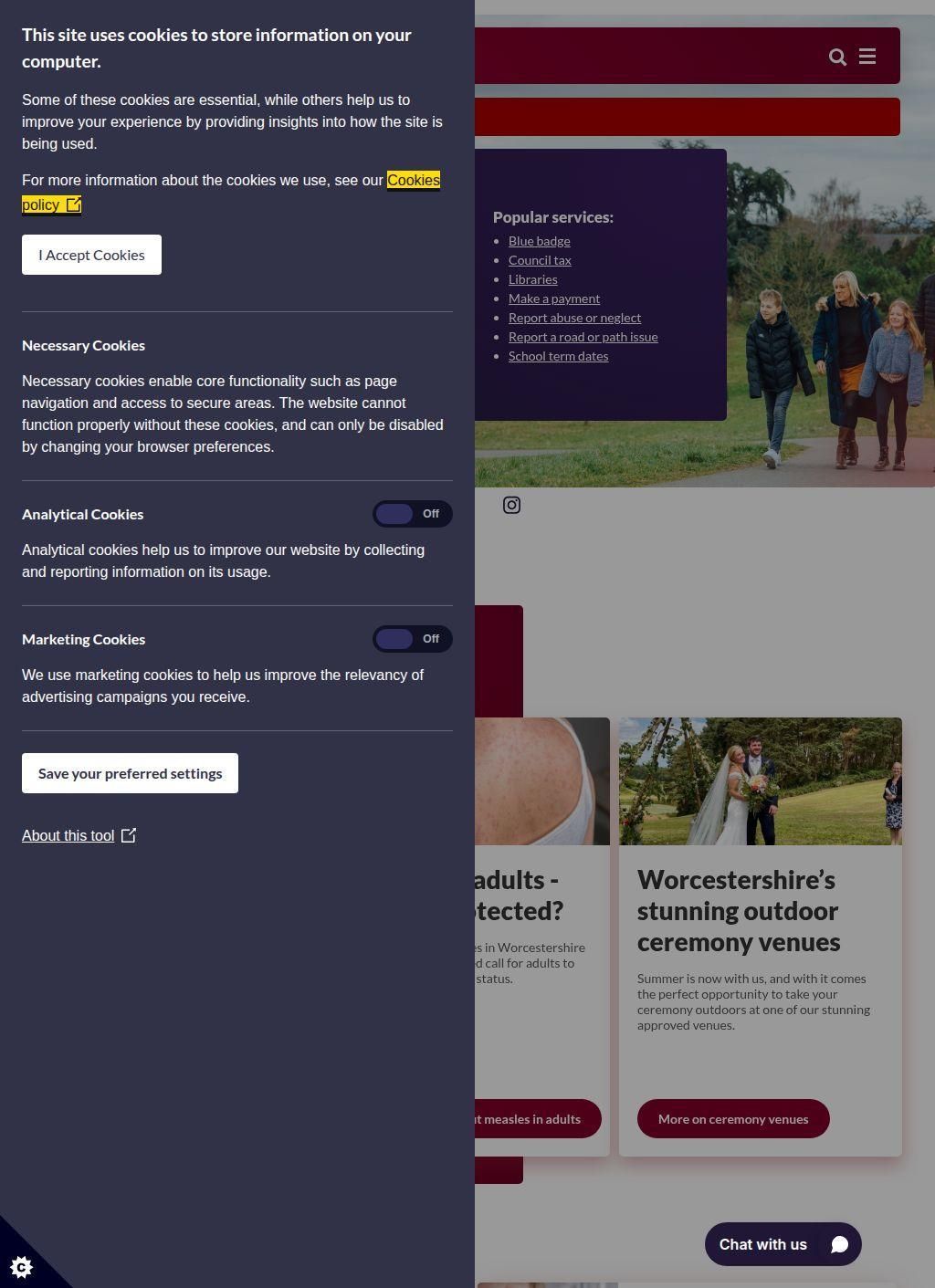
Worcestershire County Council is the upper-tier local authority for the county of Worcestershire in the West Midlands of England, and its website is the practical front door to nearly everything the council does for roughly 600,000 residents. The site spreads itself across the full statutory remit, from adult social care and child protection through to road maintenance and council tax payments. A first pass through the navigation gives a fair sense of how much sits under one roof here.
Social care and safeguarding services
The social care sections are where the heavier, life-affecting material lives. Adults can request a care needs assessment, read about direct payments, and look up registered care homes. Families dealing with children's services find information on fostering, adoption, and child protection, plus the safeguarding routes for reporting abuse or neglect of either a child or a vulnerable adult. These are not pages anyone clicks through for fun, and the Worcestershire County Council site keeps them reasonably distinct from the lighter administrative content so a person in a crisis is not wading through bin collection schedules to reach the right phone route.
Council tax parking and highways
Day-to-day business is well represented too. Council tax information and payment, the Blue Badge parking scheme, household waste and recycling sites, and highways fault reporting all have their own paths on the Worcestershire County Council site. The highways area also folds in public transport information, which makes sense for a county authority that has to think about getting people between Worcester city and the more rural reaches. Planning is split into the strategic side plus the minerals and waste planning that a county council, not the districts, handles, so the boundaries of responsibility are drawn the way the local government structure actually works.
It is worth pausing on how much of this is statutory. Worcestershire County Council does not get to choose whether to provide adult social care or child protection; those duties are fixed in law, and the site has to present them clearly enough that a person under pressure can act. The discretionary extras, such as the cultural events and the countryside programmes, sit on top of that obligatory base, and the design keeps the legal floor visible without burying it under the nicer-to-have material.
Postcode based service finder
One feature does real work in tying the sprawl together. The "My Area" tool asks for a postcode and returns the services tied to that spot, which is genuinely useful in a two-tier setup where residents are forever unsure whether a given problem belongs to the county or to their district, whether that is Malvern Hills, Wychavon, Bromsgrove, Redditch, Wyre Forest, or the smaller patch around Tenbury. I found the postcode entry point more intuitive than hunting through a service index, because most people know their postcode and very few know which authority owns potholes versus planning.
Alongside the locator sit the routine portal elements: a member area, job listings, and an events calendar. The recruitment pages matter for an organisation of this size, since Worcestershire County Council is one of the larger local employers, and keeping vacancies on the same domain as everything else is sensible. Event listings lean toward the cultural and community side, the sort of thing the libraries and countryside teams tend to run.
Education services emergency alerts
Education is handled with the calendar in mind. School term dates, admissions, and SEND support each have dedicated space, and there is a school closure alert function that comes into its own during snow or flooding. Worcestershire County Council pairs those closure notices with road closure and emergency notifications, so the site doubles as a live information channel when weather disrupts the county. That emergency layer is easy to overlook on a calm day and exactly what people scramble for on a bad one.
Library catalogue health programmes
The libraries offering from Worcestershire County Council extends past opening hours and locations into a searchable catalogue and digital resources, which keeps the county-wide network usable for people who never set foot in a branch. Health and wellbeing content runs through the public health programmes, including the Healthy Worcestershire strand, part of the public health duties that Worcestershire County Council took on when those responsibilities moved to county authorities some years back. Environment pages cover countryside management and flood risk, the latter no small concern given the Severn and Avon both pass through the area.
Historical archive service access
A quieter corner deserves a mention. The Worcestershire Archive and Archaeology Service gives access to historical records and archaeological material, which is the kind of holding most residents will never need but which makes the site valuable to historians, genealogists, and anyone researching the county's past. It sits a little apart from the service-delivery bulk, and that is appropriate, since its audience is different from someone trying to pay a bill. That a body like Worcestershire County Council bothers to host serious archival access at all says something about the range it is willing to carry.
Business support trading standards
Business users are not left out either. There is local enterprise information and a trading standards presence, which connects the regulatory role of Worcestershire County Council to its support function for firms operating in the county. The breadth means a single visit can take in something as immediate as reporting a blocked drain and something as deliberate as planning a school application, and Worcestershire County Council has clearly tried to map that range onto a structure people can follow.
If there is a fair criticism of a site this large, it is the perennial one for any council web estate: depth invites sprawl, and the sheer number of services means some journeys take more clicks than a newcomer expects. The postcode tool blunts that, and the social care and emergency sections are kept clean, but the breadth Worcestershire County Council carries is a constant design pressure. Nobody builds a tidy site when the brief is the entire statutory output of a county authority.
Worcestershire County Council uses the site as both a transactional service and a reference point, and the two roles mostly coexist without tripping over each other. Someone paying council tax, someone reporting a safeguarding concern, and someone digging through parish archives are all served from the same domain, with the My Area locator and the emergency alerts doing the heaviest lifting in keeping that spread navigable. The closure and road notices are the part most likely to be bookmarked, useful precisely on the days when residents need the council to tell them something fast.
Business address
Worcestershire County Council
County Hall, Spetchley Road,
Worcester,
Worcestershire
WR5 2NP
United Kingdom
Contact details
Phone: 01905 763763