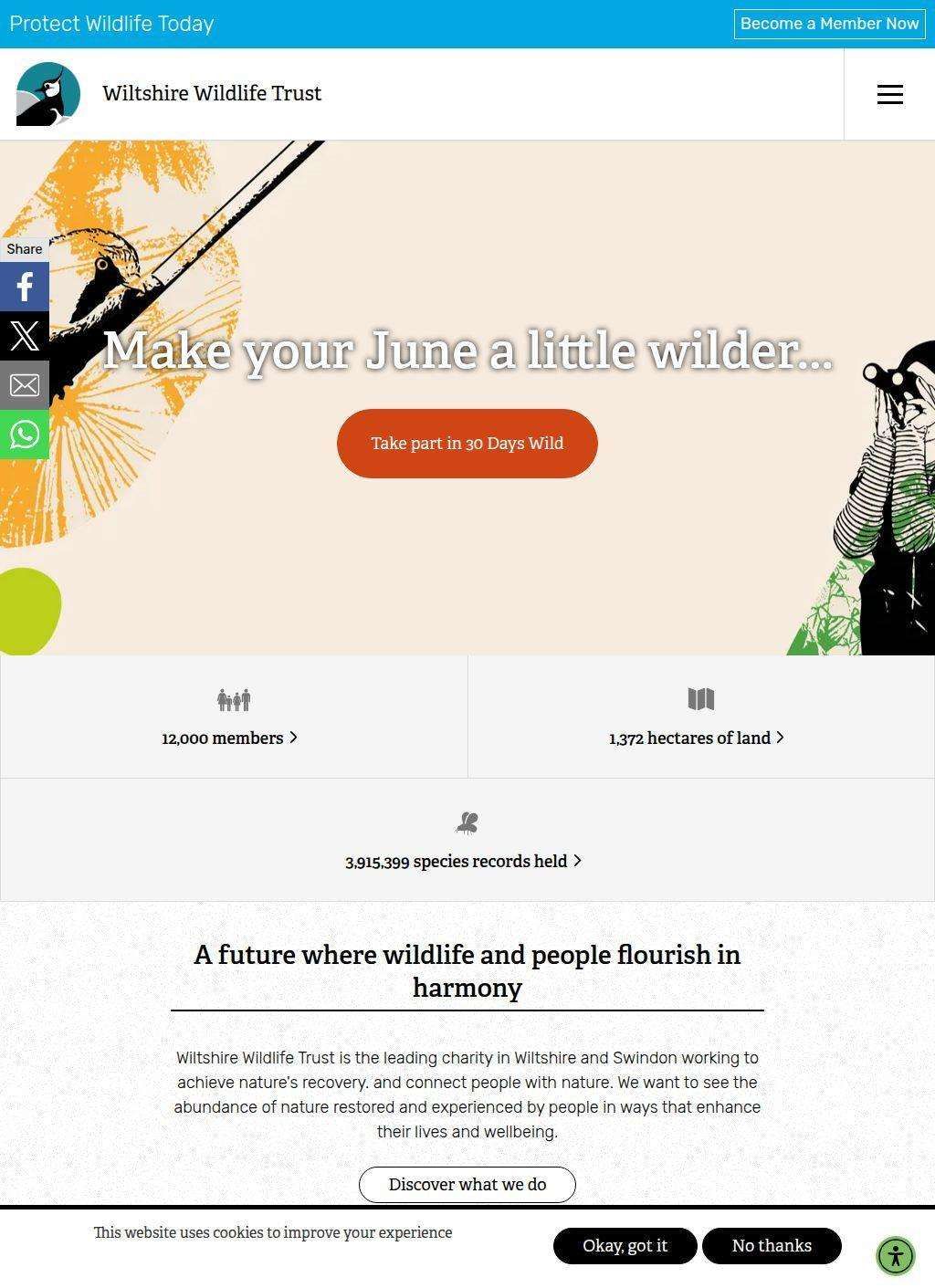
Running a Biological Records Centre with 3,915,399 species entries says something about how Wiltshire Wildlife Trust operates before you read a word of mission copy. This is an organisation that counts things, keeps the data, and acts on it. The same precision shows up in the land figures: 1,372 hectares spread across a network of nature reserves in Wiltshire and Swindon, actively managed rather than simply owned on paper. Anyone curious about how conservation works at a county scale will find more depth here than the usual donate-and-feel-good appeal.
Reserves double as event venues
The reserves are the obvious starting point. Sites such as Lower Moor Farm and Clattinger Farm anchor the portfolio, and Wiltshire Wildlife Trust treats them as working landscapes as much as places to walk. Several reserves have cafes on site and can be hired as venues, which turns a wildlife visit into something a family or a group can build a full day around. That dual purpose, habitat and hospitality, is handled without one undercutting the other. Venue hire at a reserve also quietly does double work for the charity: income from weddings, meetings and events feeds the conservation budget while putting more people on the land in the first place.
Protecting rare chalk streams
Where Wiltshire Wildlife Trust gets genuinely interesting is the conservation work most visitors never see directly. There is a dedicated Water Team and a programme focused on chalk stream protection. Chalk streams are globally rare, and Wiltshire holds a meaningful share of them, so a county-level body with staff specifically assigned to that habitat is a serious commitment, not a token line item. A named, standing Water Team as opposed to a project that surfaces when funding allows says something clear about where the priorities sit. Water quality and stream health are slow, technical problems that reward exactly this kind of patient, in-house attention.
Partnering with farmers on land management
Alongside the water work sits a strand of partnership with farmers on land management. This is the unglamorous middle ground of conservation, where outcomes depend on persuading the people who own and work the land to change practice, and Wiltshire Wildlife Trust appears to invest real effort in it. Pairing the Biological Records Centre with this farm-facing work is the smart move: the records give the advice an evidence base, and the advice gives the records a purpose. The whole thing reads as joined up in a way that county-level bodies do not always manage.
For anyone who wants to understand a regional ecosystem beyond walking a pretty meadow, that combination is the draw. The land holdings, the water programme and the farmland advisory work form a coherent picture of how Wiltshire Wildlife Trust tries to hold a working countryside together.
The people-facing side of the operation is broad, stretching further than the school-trip activity you might expect. Wiltshire Wildlife Trust runs education from school and group visits through to Forest Schools aimed at both adults and pupils, plus Wildlife Watch groups for children. A teacher, a parent and an adult who simply wants to learn outdoors are all catered for, with the same reserves doing double duty as classrooms.
Wellbeing programs for different communities
Health and wellbeing is where the breadth becomes striking. There is a Men's Wellbeing Programme, a set of Swindon Community Wellbeing initiatives, a Wild Roots to Recovery programme, and Workplace Wellbeing services for employers. Each targets a different audience, men who might not otherwise seek support, a town with its own community needs, people in recovery, and staff teams under pressure, and the segmentation looks as though the offer was shaped around who turns up and what they need, not assembled as a single generic class.
Care farms at Lakeside and Willows
Wiltshire Wildlife Trust operates two Care Farms, at Lakeside and The Willows, giving structured time on the land to people who benefit from it. Conservation used as a vehicle for social outcomes, and the fact that Wiltshire Wildlife Trust has built these into named, distinct programmes with dedicated sites puts the work well past pilot stage.
Corporate membership and consulting services
Wiltshire Wildlife Trust also opens a route in for businesses. Corporate membership comes with Wild Work Days, environmental consulting is offered, and there are Community Energy initiatives sitting alongside the more familiar volunteering and membership options. The roughly 12,000 members give Wiltshire Wildlife Trust a base that most local charities would envy, and the consulting and energy work suggest an outfit comfortable operating commercially where it makes sense, then folding the proceeds back into the core mission.
Diversified funding streams
The funding model is laid out without coyness: ordinary membership, donations, legacy gifts and corporate partnerships, supported by trading and consulting income. For a body running 1,372 hectares of reserves plus a records centre plus a stack of wellbeing programmes, that mix leaves Wiltshire Wildlife Trust looking deliberately diversified, which is reassuring for anyone thinking about long-term support.
Wiltshire Wildlife Trust keeps its registration details out in the open, charity number 266202 and company number 730536, which is exactly what you want from an organisation asking for legacy gifts and corporate money. None of this is dressed up. Wiltshire Wildlife Trust gives you the scale, the programmes and the structure, and lets the work speak for itself. That transparency, combined with the diversified income, is what you want to see when treating a charity as a long-term commitment rather than a one-off donation.
Balancing scale with complexity
If there is a critical note, it is simply that the sheer number of programmes can make the overall picture feel sprawling on a first pass. Reserves, water, farming advice, several named wellbeing strands, two care farms, education tiers, corporate schemes and energy work add up to a lot of doors. That is a function of genuine breadth, and a first-time visitor may need a couple of trips before the full shape of what Wiltshire Wildlife Trust does falls into place.
Even so, the depth wins out. Few county wildlife bodies can point to a records centre of nearly four million entries, and Wiltshire Wildlife Trust backs that with land, water specialists and a wellbeing arm of this size. The Community Energy work and the environmental consulting round it out into something closer to a small institution than a single-cause charity. The work Wiltshire Wildlife Trust does is concrete, locally rooted and evidently long-running, and the site reflects that without overselling.
Business address
Wiltshire Wildlife Trust
Elm Tree Court, Long Street,
Devizes,
Wiltshire
SN10 1NJ
United Kingdom
Contact details
Phone: 01380 725670