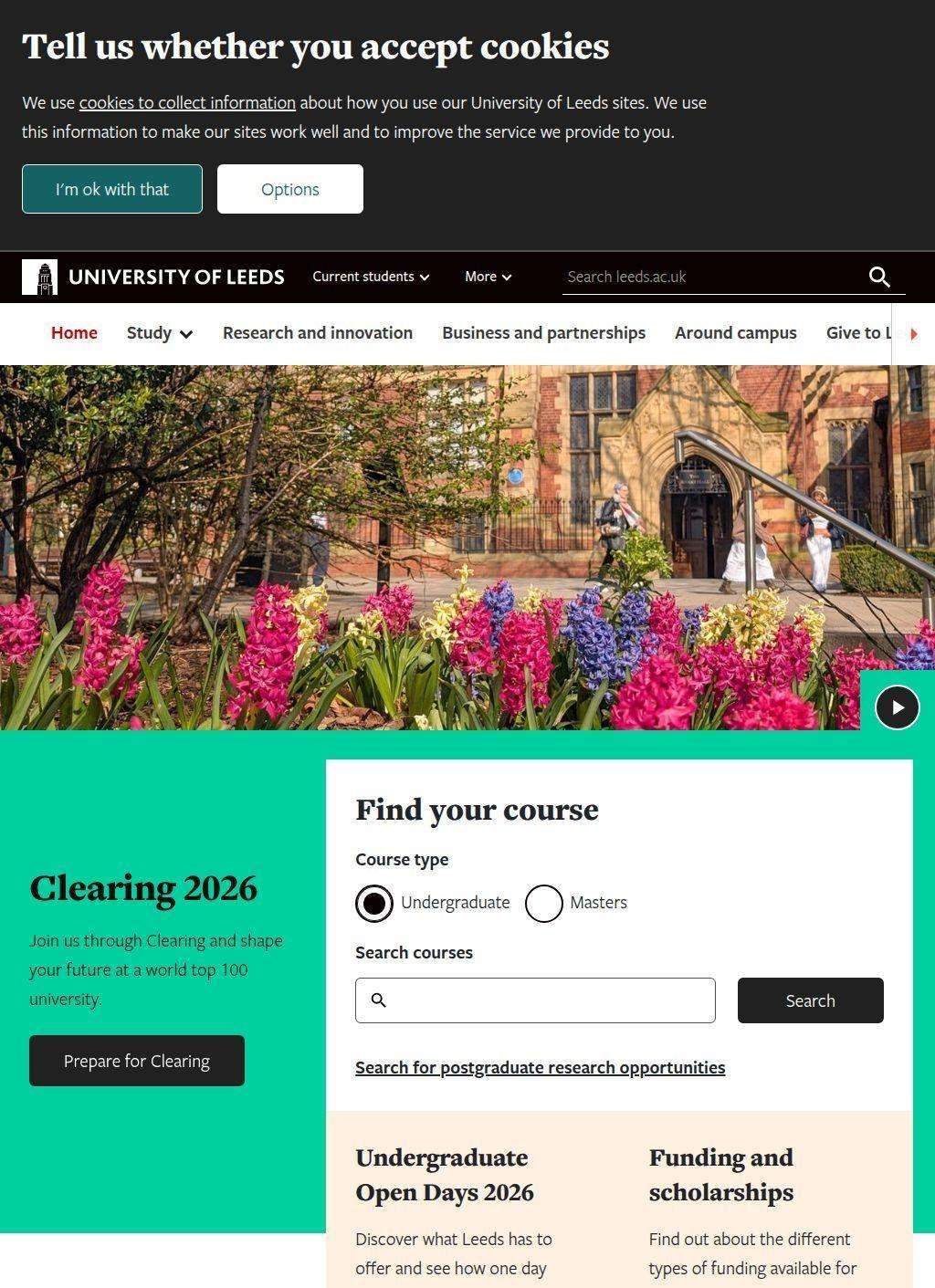
What does a prospective student actually get from the University of Leeds beyond a familiar name and a Russell Group badge? A wide spread of study routes, for one. The University of Leeds runs undergraduate degrees, taught Master's courses, PhD research degrees, foundation courses for those who need a stepping stone, and a set of fully online programs for people who cannot or will not relocate. That range is genuine and well organised, not a scattering of leftover options. Course search sits on its own dedicated address, courses.leeds.ac.uk, which keeps the prospectus separate from the marketing pages and makes browsing by subject straightforward.
Study routes and program formats
The teaching and research are split across seven faculties, and the list reads like a deliberate attempt to cover most of academic life: Arts, Humanities and Cultures; Biological Sciences; the Leeds University Business School; Engineering and Physical Sciences; Environment; Medicine and Health; and Social Sciences. A student in the sciences and a student in the humanities are clearly meant to find a home here, and the faculty structure points to real depth instead of breadth for its own sake. Founded in 1904 as a public research university in Leeds, West Yorkshire, the University of Leeds has had more than a century to build out those departments, and the coverage on the page is consistent with that history.
Academic structure across seven faculties
What gives the research side some character is the specificity of what gets highlighted. Textiles and colour science is an unusual thing for a university to lead with, and it points to a genuine specialism rather than a generic claim to do research. Alongside it sit childhood blood disorders, environmental conservation, the cultural and creative industries, and regional civic engagement. Those are not interchangeable buzzwords. A university that names childhood blood disorders and colour science in the same breath is telling you something about where its strengths sit, and a prospective postgraduate can take that as a useful pointer toward which supervisors and labs might be worth chasing.
Research specialisms in textiles, medicine, environment
The civic engagement strand reads as more than boilerplate at a university whose campus is woven into the city instead of being tucked away on a distant out-of-town site. The University of Leeds occupies a stretch of Woodhouse Lane, and the wording about regional engagement reads as a real commitment to the surrounding area instead of a line of marketing polish. For an applicant weighing whether an institution feels connected to the world around it, that is a fair point in the University of Leeds's favour.
Campus integration with the city of Leeds
Research depth is one thing; the practical scaffolding around it is another, and this is where the University of Leeds shows it has thought about the day-to-day. Students get Minerva, the online portal that holds the academic machinery together, plus a dedicated mobile app for the parts of university life that happen on the move. There is a VideoLeeds media platform and campus library services on site, which together suggest a campus that has invested in keeping its digital and physical resources current.
Student resources and support services
A degree is only part of what a student is buying, and the University of Leeds covers a good deal of the rest. Accommodation comes in two flavours, on campus and out in the city, which gives a student a real say in whether to live in halls or take a flat closer to where the cheaper rents are. Careers support goes beyond a token gesture, with employer placement programs built in, and there is a Masters funding advisory service for the perennial question of how a postgraduate course gets paid for. Money advice attached to postgraduate study is the sort of thing that is easy to leave off a site and quietly useful when it is there.
Accommodation options on campus and off
Anyone researching the University of Leeds through a business directory or general search will find the ranking figures quickly, and they back up the institution's reputation. The University of Leeds sits inside the global top 100 in the QS World Rankings for 2027, places 18th in the UK in the Complete University Guide, and lands in the top ten most targeted universities by graduate employers according to High Fliers for 2026. That last figure is the one a career-minded applicant should weigh hardest, because being heavily targeted by employers tends to translate into recruiters showing up on campus, active placement pipelines, and graduates getting interviews. A top-100 global standing is respectable; a top-ten employer-targeting position is the kind of number that pays a graduate's rent.
Employer targeting and graduate outcomes
There is also a thoughtful touch for applicants who are still undecided: a chat option that connects prospective students with people currently studying at the University of Leeds. Talking to a current student tends to surface what the prospectus will never tell you, the bad lecture theatres, the genuinely good societies, the truth about a particular module. Offering that connection directly and online says the University of Leeds is reasonably confident about what its own students will report back.
The Brotherton library collection
The library deserves its own mention, and the Brotherton in particular carries a reputation among Leeds students and researchers that the bare phrase library services does not quite capture. A serious research collection is one of the quieter reasons a humanities or social sciences applicant might pick one institution over another, and the provision at the University of Leeds is consistent with more than a century of accumulation.
Put together, the picture is of a large, established research university that knows what it offers and lays it out without much fuss. The seven faculties, the spread from foundation courses to PhDs, the online programs, the careers and accommodation infrastructure: these add up to a credible whole, and the University of Leeds presents them in a way that a confused seventeen-year-old or a returning adult learner could navigate.
The gap the site cannot close is the one that sits behind every university listing. A top-ten employer-targeting position and an 18th-in-the-UK ranking describe the University of Leeds in aggregate; they say nothing about whether a specific department, in the specific subject an applicant cares about, is any good. A university can be heavily recruited from overall while a particular course coasts on the reputation of stronger neighbours. Nothing here lets a prospective student close that gap, and the friendly chat with a current student, useful as it is, is no substitute for subject-level outcomes data. The published evidence makes a strong case for the University of Leeds as an institution; the department-level due diligence still falls to the applicant.
Business address
University of Leeds
Woodhouse Lane,
Leeds,
West Yorkshire
LS2 9JT
United Kingdom
Contact details
Phone: 0113 243 1751