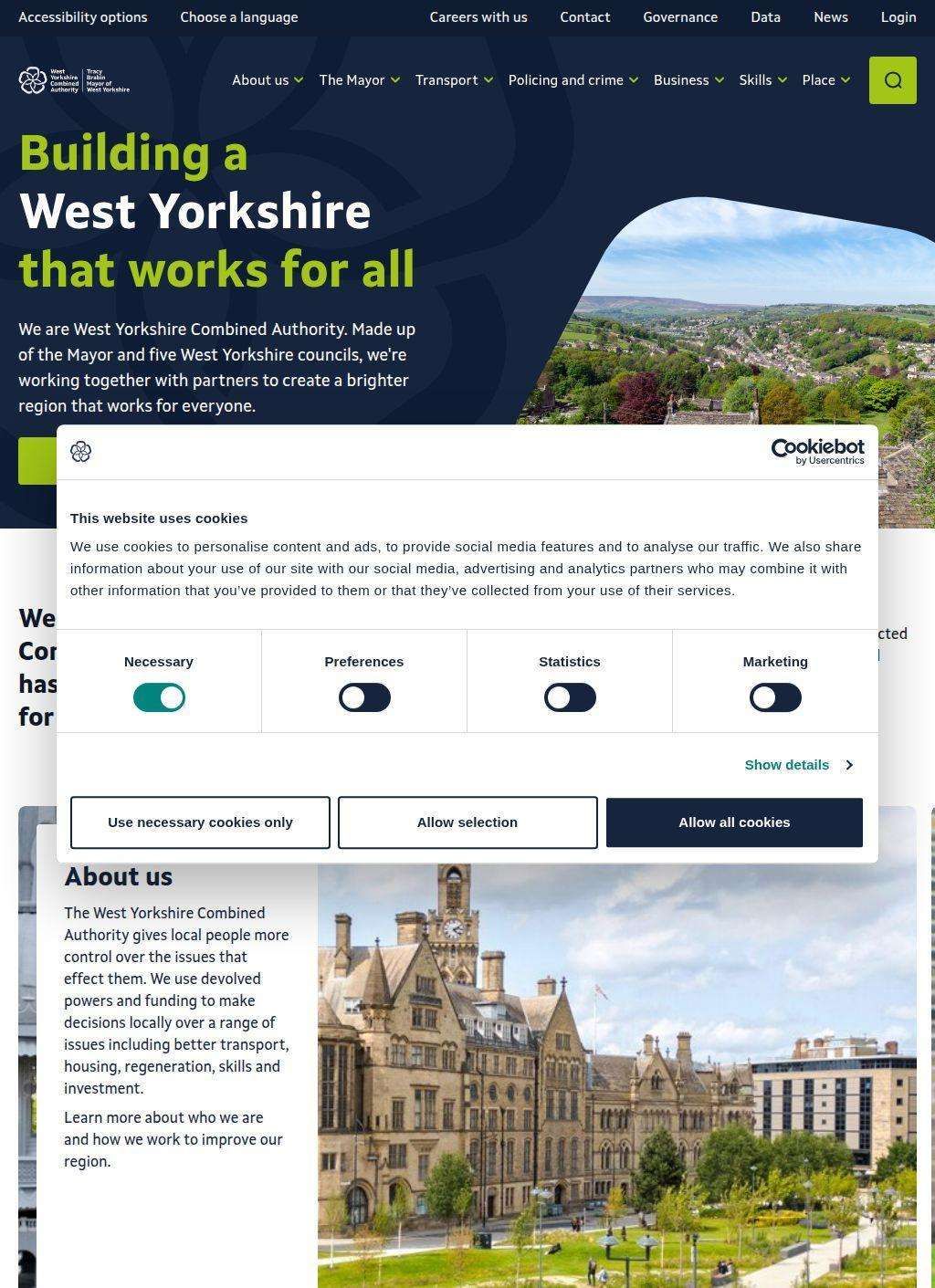
West Yorkshire Combined Authority is the regional government body for West Yorkshire in northern England, covering roughly 2.4 million people across five councils: Bradford, Calderdale, Kirklees, Leeds, and Wakefield. It is led by an elected mayor, Tracy Brabin, and holds powers devolved from central government over transport, skills, economic development, and policing. That mandate is wide, and the site reflects it: this is one of those organisations where the breadth of what it touches is the first thing you notice, because a single body is steering buses, apprenticeships, road safety, and net zero policy at once.
Transport and the Weaver Network
Transport is the area where the authority's work reaches residents most visibly, and West Yorkshire Combined Authority puts the Weaver Network front and centre. Weaver is the brand for an integrated transport system that pulls buses, trains, cycling routes, and walking infrastructure under one identity, the idea being that a journey across the region stops feeling like a stitched-together set of separate operators. Behind that, West Yorkshire Combined Authority is using bus franchising powers, which let the public body specify routes, fares, and standards instead of leaving those decisions entirely to commercial operators. The pages also set out advocacy for rail improvements, a reminder that some of what the authority does is lobbying for investment it does not directly control.
Skills programmes and business support
Skills and employment get treatment that goes beyond a vague promise of opportunity. West Yorkshire Combined Authority administers training, apprenticeships, and adult education, and the Adult Skills Fund is the concrete piece here: free qualifications for eligible adults who want to move forward in work. Pair that with the Business Growth Hub, which gathers start-up resources, trade and export support, and sector development programmes in one place, and you get a fairly clear map of how West Yorkshire Combined Authority tries to connect people to jobs and help local firms grow. The Fair Work Charter sits alongside, pushing employers toward better employment standards. These are the kinds of programmes that a curious resident or a small business owner can actually act on, which is more than can be said for a lot of public bodies whose remit stays abstract.
Policing and community safety oversight
The policing and crime function is one many people may not associate with a combined authority, and the site is useful precisely because it lays it out. West Yorkshire Combined Authority oversees the Police and Crime Plan, community safety programmes, and victim support services, and it runs the West Yorkshire Violence Reduction Partnership along with the Vision Zero road safety initiative aimed at eliminating deaths and serious injuries on the roads. A Safety of Women and Girls campaign sits within the same area of responsibility. I found this section clarifying, because it shows the mayor's office holding strategic responsibility that was previously spread across separate offices.
Housing regeneration and net zero targets
On place and environment, the commitments are specific enough to be checked against published targets. West Yorkshire Combined Authority invests in housing regeneration and cultural programmes, and it has set a target of net zero carbon by 2038, well ahead of the national date. Home Energy West Yorkshire is the practical end of that ambition, an energy efficiency scheme aimed at residents rather than at policy documents. For households weighing insulation or heating upgrades, a regional scheme like that is worth knowing exists.
A challenge inviting young people's ideas
There is a deliberate thread running toward younger residents too. The Mayor's Big Ideas Challenge invites young people to put forward proposals, which shows the authority wanting engagement from a group often left out of regional planning. It is a small programme next to transport budgets and skills funding, but its presence rounds out the picture of an organisation trying to be visible at several levels of local life at once.
One authority holding many responsibilities
What is striking across all of this is how much sits under one roof. West Yorkshire Combined Authority is not a single-issue agency, and the site is honest about the range. Transport, policing, skills, business support, housing, climate, and youth engagement all appear as standing areas of work with their own programmes attached. For someone trying to understand who is responsible for what in this part of Yorkshire, that consolidation is genuinely helpful, because it answers the common confusion about whether a question belongs to the council, the mayor, or some other tier of government.
Finding a specific scheme on the site
The site does come with the density you would expect of a public body covering several million people, which means navigating West Yorkshire Combined Authority takes patience when you are looking for one specific scheme. The home energy programme, the Adult Skills Fund, the Business Growth Hub, and the Weaver Network each have their own footprint, and pulling them together into a single mental model takes a few clicks. That is the nature of an organisation with this many functions, and it is hard to see how West Yorkshire Combined Authority could present everything more simply without hiding the genuine scope of the devolution deal it operates under.
Why this source is worth consulting
For a resident, a business, or anyone studying how English devolution actually works on the ground, West Yorkshire Combined Authority is a primary source worth consulting rather than a secondary summary. The transport brand alone is the kind of thing that affects daily life across the five council areas, and the skills and energy programmes have real money and eligibility rules behind them. The breadth is the headline, and the depth is enough to act on. West Yorkshire Combined Authority sits at the centre of decisions that shape how 2.4 million people travel, train, and stay safe, and it makes that role reasonably legible to anyone willing to read past the front page. The programmes are already running; the question is whether the people they are designed for know to look.
Business address
West Yorkshire Combined Authority
Wellington House, 40-50 Wellington Street,
Leeds,
West Yorkshire
LS1 2DE
United Kingdom
Contact details
Phone: 0113 251 7272