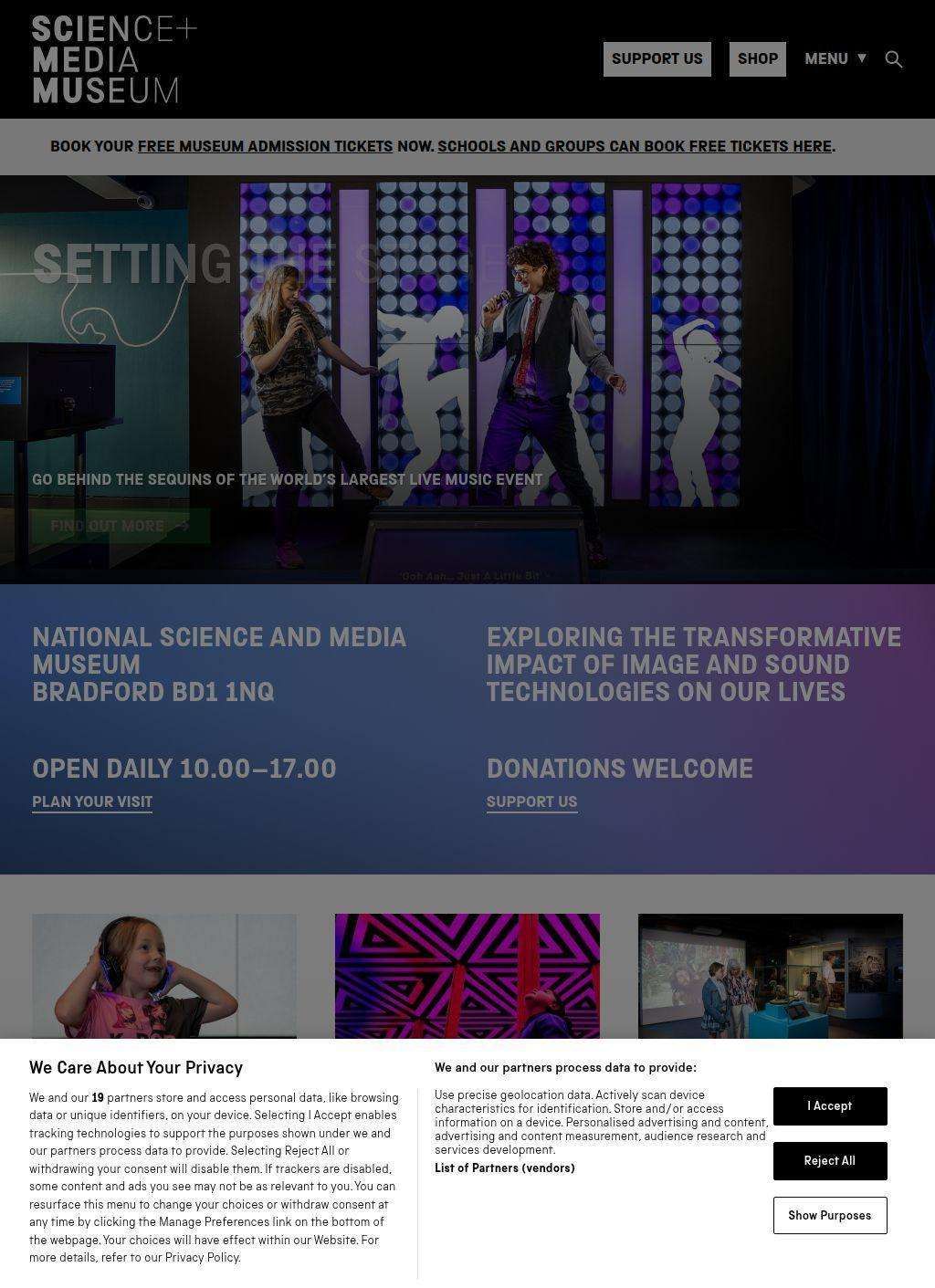
What does a free national museum in Bradford actually give a visitor who walks through the door? At the National Science and Media Museum the answer is broad: interactive science galleries, two cinemas including the largest IMAX screen in the region, an enormous photographic and film collection, and a roster of temporary shows. Admission costs nothing, with donations welcomed, and the doors open daily from ten in the morning until five in the afternoon. For a city-centre attraction that covers light, sound, photography, film and broadcasting under one roof, that is a generous starting position.
The museum sits within the Science Museum Group, which places it alongside some of the better-known national collections in the country. That parentage shapes what you find on site. This is not a small local gallery improvising on a tight budget; it has the backing and holdings of a national institution, and the breadth of the offering reflects that. A family arriving for a half-day, a teacher planning a class trip, and a researcher hunting through archives are all served by the same address, which is unusual. A listing in a business directory can point you to the door, but what the National Science and Media Museum does once you are inside is something you have to experience.
Wonderlab interactive galleries
The permanent draw for most families is Wonderlab, an interactive space built around light and sound. It is hands-on by design, the sort of gallery where children push, pull, listen and look instead of reading placards from behind a rope. Light and sound are sensible themes for a museum that has spent its life thinking about how images and recordings are made, and the gallery ties neatly into the wider story the building tells about photography and film. The design philosophy is clear: engagement over passive observation.
Photography, moving pictures, broadcasting
Beyond Wonderlab, the National Science and Media Museum carries the threads of its subject through permanent displays covering how photographs are captured, how moving pictures developed, and how broadcasting reached homes. The decision to centre a whole museum on the technologies of seeing and hearing is more coherent than the scatter you sometimes get at a general science venue. There is also Wonderlab+, an online set of family learning activities, which extends some of that hands-on spirit to people who cannot make the trip to Bradford in person. It is a thoughtful addition that shows the National Science and Media Museum thinking beyond its own walls.
The temporary programme adds to the appeal. A featured exhibition marking seventy years of the Eurovision Song Contest is the kind of show that pulls in visitors who might not otherwise think of a science venue, and it fits a place that studies media and broadcasting. Temporary shows like this give regulars a reason to return to the National Science and Media Museum rather than treating it as a one-visit checkbox.
Cinema venues and programming
Cinema is a genuine strength at the National Science and Media Museum, and not a token one. IMAX Bradford runs a fifty-two-foot screen, described as the largest in the region, which is a real reason to choose this venue over a multiplex for the right film. Alongside it, Pictureville Cinema programmes new releases, arthouse titles and family screenings. For a film lover the pairing is hard to beat: blockbuster spectacle on the big screen, and a more considered selection of pictures next door. Both venues are part of the core offer, not bolt-ons, and the programming reflects curatorial thought rather than whatever happens to be in wide release.
Collection access for researchers
The collection is where the National Science and Media Museum stretches well past the day-visitor experience. Its online catalogue opens up more than 325,000 objects and archives, which is a serious holding by any measure and a resource for anyone working on the history of photography, film or television. Researchers can request access, and that route is spelled out on the site and easy to find, which says something about how the National Science and Media Museum sees its role beyond the gallery floor. Collections of this scale are typically locked away behind institutional barriers; that access is clearly explained and publicly advertised is the exception.
Schools group visits and facilities
Schools are clearly a priority. Free group tickets are available, and group booking portals plus accessibility information are laid out for planners who need certainty before they bring thirty children across the county. The practical detail that makes a class trip feasible is knowing exactly what is provided, and the National Science and Media Museum delivers that. The museum also runs volunteering programmes and offers venue hire and corporate sponsorship, so it operates as a civic and commercial space as well as a visitor attraction. That dual role is unusual among national museums.
Serving multiple visitor types
That spread of audiences is the thing worth dwelling on. The National Science and Media Museum is trying to be useful to families on a wet Saturday, to schools chasing curriculum links, to academics deep in an archive, and to companies looking for an event space. Most venues pick one or two of those and do them. This one reaches for all of them, and the website is organised to match, with distinct paths for each group instead of a single undifferentiated front door.
Family visits and admission costs
For families, the case is strong. Wonderlab plus a film on a screen that genuinely dwarfs anything local, at no admission cost, is a solid half-day or full-day proposition, and the donations model keeps the barrier low for households watching their spending. The risk with a place this wide-ranging is that it tries to do too much and ends up spreading itself too finely, and a visitor whose only interest is, say, contemporary art will find this is not the venue for them. Going by the evidence on the site, though, the focus on light, sound, photography and film holds the National Science and Media Museum together and keeps it from sprawling into incoherence.
For researchers and teachers the case is just as clear, and arguably stronger, because the collection and the schools provision are substantial, not decorative. The National Science and Media Museum gives those users concrete tools: a searchable catalogue of hundreds of thousands of items, a defined access route, free group entry. Those are not flourishes; they are the working machinery of a national institution doing its job. Outside reviews are positive, with visitors consistently praising the cinema and the interactive galleries, and the volume of feedback across platforms reflects steady footfall.
The honest qualification is that breadth can blur a museum's identity, and a casual visitor might struggle to summarise in one line what the National Science and Media Museum is for. The museum has earned the right to be many things at once, given the depth behind each strand. If you are within reach of Bradford and you care about how images, recordings and broadcasts are made, the National Science and Media Museum rewards the trip, and the cinema programme alone gives you a reason to come back after the galleries are familiar. It is a serious venue carrying a serious collection, and the free admission makes the decision to go an easy one.
Business address
National Science and Media Museum
Pictureville,
Bradford,
West Yorkshire
BD1 1NQ
United Kingdom
Contact details
Phone: 0330 058 0058