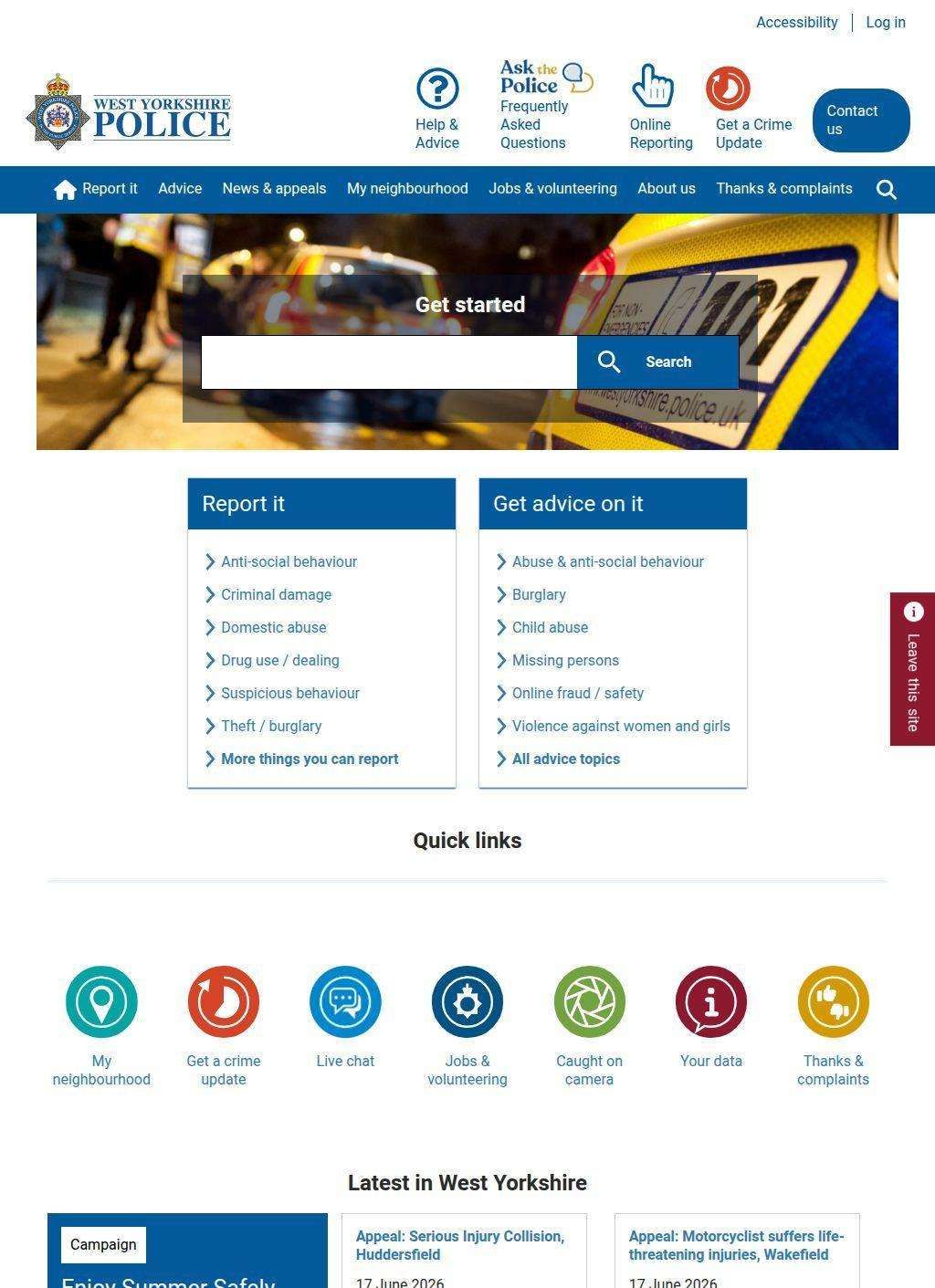
West Yorkshire Police is the territorial police force for West Yorkshire in northern England, covering the five districts of Leeds, Bradford, Wakefield, Kirklees and Calderdale. Its website is the digital front door for one of the largest metropolitan forces in the country, and the range of what sits behind that front door is wider than a person expects when picturing a police site as a place to dial 999. The core of it is reporting and information: what to do in an emergency, what counts as a matter for the non-emergency 101 line, and which situations can be logged online without ringing anyone at all.
Report crime and antisocial behaviour online
That online reporting layer is the part that has grown the most in recent years. Rather than treating the phone as the only channel, the site carries structured forms for reporting a crime that is not in progress, updating an existing report, telling the force about antisocial behaviour, or passing on information about a wanted or missing person. A visitor can report road traffic offences, lost property, and abandoned vehicles through the same routes. It is a genuine attempt to take routine volume off the 101 queue, and for anyone who has waited on that line it will read as a sensible trade.
Check local crime data by postcode
One of the more useful things West Yorkshire Police puts in front of the public is local crime data. The site lets you drill down by area to see recorded crime and to understand what is happening street by street, with the national data feeding into maps and figures that residents can check for their own postcode. The data comes from West Yorkshire Police recorded figures, and it turns an abstract sense of safety into something a person can actually look at before deciding whether to walk a particular route at night or where to buy a house.
Finding your neighbourhood officers
Tied to that is the neighbourhood policing structure. West Yorkshire Police is organised into district teams, and the site names the officers and PCSOs attached to local areas, along with the priorities those teams have set and the ways to reach them. I find this the most quietly valuable section, because it answers a question the emergency numbers never do: who, specifically, is responsible for my street, and what are they working on right now. The force also publishes details of local meetings and engagement events where residents can raise concerns face to face.
The news and appeals area runs alongside this. West Yorkshire Police uses it to circulate witness appeals, images of wanted individuals, missing person notices, and updates on ongoing investigations and court outcomes. It doubles as a public record of the force's activity, and it is refreshed often enough to feel current instead of ceremonial. Appeals frequently link back to the online reporting forms, so a member of the public who recognises a face has a direct route to say so.
Safety and prevention advice fills out the informational side of West Yorkshire Police online. There is guidance on protecting a home from burglary, spotting and avoiding scams and fraud, road safety, and support pathways for people affected by domestic abuse. West Yorkshire Police also points toward partner agencies and specialist services, since a police force is rarely the only body involved when someone is at risk. The advice is written for ordinary readers, not for other professionals, and that keeps it usable.
Joining West Yorkshire Police
For people looking to join, the site sets out the routes into the force in some detail. West Yorkshire Police recruits regular officers, special constables who volunteer their time, and cadets, and the pages explain eligibility, the stages of the application process, and what the training and early service actually involve. Given how much recruitment forces have needed to do to rebuild numbers, it makes sense that this part of the site is prominent and reasonably plain-spoken about what the job demands.
The accountability material is where a public body like this earns trust, and West Yorkshire Police does not bury it. There is information on the Professional Standards Directorate and how to make a complaint about the conduct of an officer or a member of staff, which is the mechanism that keeps the force answerable when it gets something wrong. The complaints route is set out clearly enough that a person without legal knowledge could follow it, which is not something every force manages. West Yorkshire Police keeps the wording readable rather than defensive.
Beyond individual complaints, the site carries Freedom of Information publications, disclosure logs, and force performance and accountability data. Much of this connects to the Police and Crime Commissioner for West Yorkshire, the elected office that holds the Chief Constable to account and sets the policing plan. Publishing that data openly is partly a legal obligation and partly a signal, and West Yorkshire Police treats it as both. Victim support pages sit near this material, explaining what help is available after a crime and how to access it, along with links to the organisations that carry that work forward.
A candid note on this review: both automated attempts to fetch the live site returned a 403 refusal, which is common for large government sites that block automated traffic, so the current page content could not be pulled directly this time. The description here rests on the well-documented and stable structure of the force's official web presence, which changes in emphasis over time but keeps the same load-bearing sections. Anyone visiting in person should expect the layout to shift around the edges even if the core stays put.
What holds the whole thing together is that West Yorkshire Police is trying to be two things at once: an emergency and reporting service where speed and clarity are everything, and a public information resource that rewards depth instead. Those two jobs pull in different directions, and the site handles the tension by pushing urgent actions to the top and letting the reference material live a click or two down. It is not designed to be browsed for pleasure. It is designed so that a person under stress can find the right button quickly and a person doing homework can find the underlying data if they keep digging.
The recruitment and prevention content shows a force conscious that policing depends on public cooperation as much as enforcement, and West Yorkshire Police leans into that by making advice and joining information as visible as crime reporting. The tone across the site stays functional throughout, with plain instructions and few flourishes, which is exactly right for the audience it has to serve. Across Leeds, Bradford, Wakefield, Kirklees and Calderdale, this site is the natural first stop for almost any interaction with West Yorkshire Police short of a genuine emergency, and the ordering of the pages reflects that priority from the first screen down.
Business address
West Yorkshire Police
PO Box 9, Laburnum Road,
Wakefield,
West Yorkshire
WF1 3QP
United Kingdom
Contact details
Phone: 101