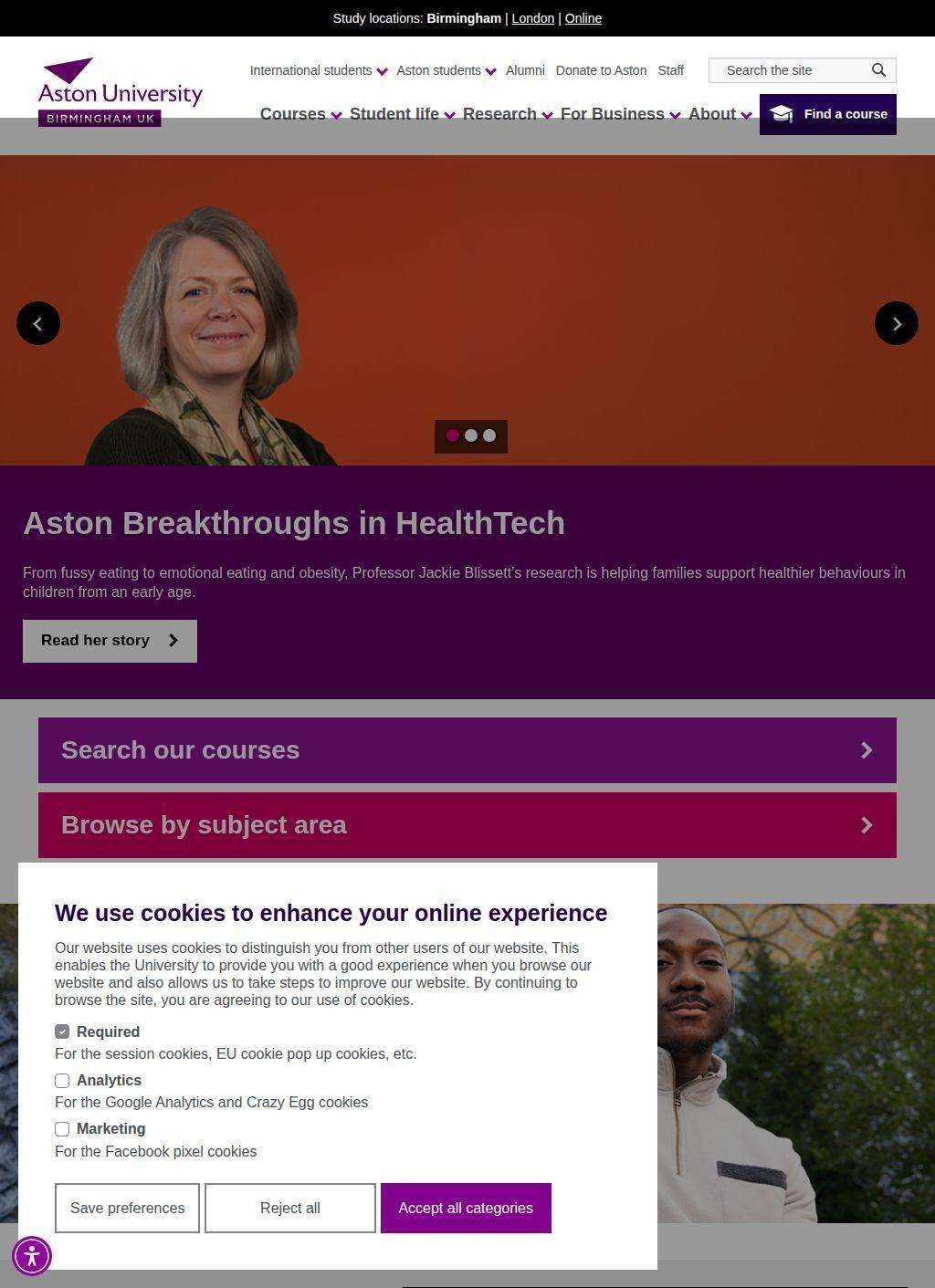
A prospective student sitting with a shortlist of Birmingham institutions usually wants two things in a hurry: what can I study, and will I be looked after while I do it. Aston University answers both quickly on aston.ac.uk, because the site is built around Courses and Student Life as its two front doors instead of making you dig through faculty jargon. The Courses area splits cleanly into undergraduate, postgraduate, foundation programmes, degree apprenticeships, and online or distance study, because those are five genuinely different audiences with different anxieties. Someone weighing an apprenticeship against a traditional degree is not the same person hunting for a part-time PhD, and the structure respects that.
Two entry points courses and student life
What sits underneath at Aston University is a set of nine academic schools spanning Business, Engineering, Law, Medicine, Pharmacy, Computer Science, and Psychology and health sciences. That spread tells you a lot about the character of the place. The science and technology leaning comes through clearly, and it pairs with professional fields like law and pharmacy that bring accreditation and clear career routes. A teenager who already knows they want engineering or medicine can find their school and follow it down into specifics; someone still undecided can browse the breadth without feeling funnelled. I found the school-by-school layout easier to reason about than the endless A-to-Z course lists some universities default to.
Nine academic schools from business to psychology
The Student Life section is where the site does its quieter, more useful work. It gathers accommodation, student support services, careers guidance, library resources, and a general orientation to Birmingham itself. The campus is described as city-centre, on the Aston Triangle, and the accommodation is flagged as award-winning. Marketing language like a helping hand through university life is exactly what you would expect an institution to write about its own support, so I would read that as a prompt to check the specifics rather than as proof of anything. The value is in the categories being present and findable: knowing before you apply that careers advice, library access, and pastoral support each have their own home is reassuring in a concrete way.
Inside student life support services
International reach is a defining thread here. Aston University draws students from more than 120 countries, and the site is clearly shaped for people applying from outside the UK as much as domestic school-leavers. For an applicant in another country, the campus-in-a-city framing does real work, since it answers the unspoken question of what daily life will look like far from home. The Birmingham orientation content sits next to the accommodation details, which gives that audience somewhere to picture themselves at Aston University long before they arrive.
Beyond teaching, the Research pages make the university's second identity plain. There are research excellence pages, impact case studies, knowledge exchange material, and doctoral and PhD programme information. This is the part of the site aimed at a more specialised reader: a would-be doctoral candidate assessing supervision and research strength, or an academic gauging whether the institution's work aligns with theirs. Impact case studies are a sensible inclusion because they show research meeting the outside world instead of staying on the page, and they double as evidence for anyone deciding whether the institution is a serious research base or simply a teaching shop.
Business services aimed at employers
The Business Services strand is the one that will surprise people who think of a university purely as a place students go. Aston University uses its site to court employers and companies directly, with talent recruitment aimed at businesses wanting to hire graduates, expertise and consultancy partnerships, workspace and office space, and a dedicated Business Hub for corporate collaboration. A local firm looking to recruit, run a research partnership, or take space near the campus is treated as a first-class visitor here, not an afterthought hidden three clicks deep.
That employer-facing posture is a strong signal about how the institution sees its role in the West Midlands economy, and it is the kind of listing entry that reflects a genuinely outward-looking place. If you run a company in the region and have never thought of the local university as a partner, this section is worth an hour of your time.
Is Aston University highly ranked?
On standing, the site cites a couple of recent markers: a 21st place ranking in the UK from the Guardian University Guide, and a University of the Year for Student Success title from the Daily Mail. Rankings deserve a measured reading, because every institution quotes the tables that flatter it and the methodologies vary wildly. Still, the student-success framing lines up neatly with the emphasis the rest of the site places on support, careers, and outcomes, so at least the accolade and the self-presentation point in the same direction. A student weighing offers can take those as one input among several, not a final verdict.
If I have a reservation, it is the familiar one for any large institutional website: the sheer number of audiences it tries to serve at once can make the homepage feel like a switchboard. Prospective undergraduates, current students, alumni, staff, and businesses all have a claim on the front page, and threading a single clear path for each is genuinely hard. Aston University handles it better than many by leading with the two categories most visitors actually arrive for, but a first-time visitor may still need a moment to find their lane. That is a design tension inherent to the job, not a failure of care.
Taken as a whole, aston.ac.uk works as the primary gateway it sets out to be: admissions, course detail, campus life, research, and partnership enquiries all live here in a form you can navigate without a map. The site rewards a visitor who knows roughly what they came for and gives enough scaffolding to the undecided to keep them moving. Aston University has built it to be functional, reasonably honest about what it offers, and organised around real user needs instead of an internal org chart.
For an international applicant deciding between UK science and technology institutions, Aston University is a strong candidate to shortlist, and the concrete next step is to open the relevant school page, then read the accommodation and student support sections side by side before booking an open day or campus visit. Prospective doctoral students should go straight to the research excellence and impact pages to gauge fit. And a West Midlands employer curious about hiring or collaboration should head for the Business Hub and ask directly about talent recruitment or partnership options.
Business address
Aston University
Aston Triangle,
Birmingham,
West Midlands
B4 7ET
United Kingdom
Contact details
Phone: 0121 204 3000